The
Holy Trinity is widely revered in the Land of Arae, with many a village cleric serving the Almighty in their communities or abroad. Such clerics are the standard clerics of Law (LG, CG, NG) referenced in page 11-13 in the
Blood and Treasure Players Handbook, with all of the benefits and restrictions mentiond therein. However there are many clerics who are moved to become closely allied with one of The Trinitys mighty servants;
The Archangels and The Holy Saints (to be detailed soon).
Below are detailed the
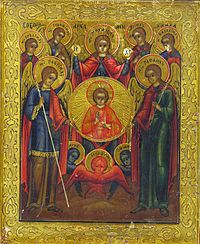
Seven Archangels (or
Seven Spirits) who serve
The Holy Trinity. They are immensely powerful beings who are completely loyal to The Almighty. Individually they can (in DnD terms) be considered Lesser to Intermediate deities in their own right, but all would react poorly to being called "gods". Rather they are the "Children" of the Most High.
Each stat block of the Archangels has the following details:
Alias: Different spellings and names in other cultures. Dwarves and Halflings usually use the standard (Human) names and Gnomes usually use the Elven versions of the names. Orcs are universally terrified of the Archangels, and so rarely address them at all.
Feast: Days in which the Archangel is celebrated.
Symbols: Symbols by which the archangel is recognized and invoked.
Patronage: This is what the archangel in question most interests himself. Any event that effects a large amount of the archangels patronage will draw that beings attention.
Cleric Alignments: Clerics who identify and seek to coordinate with a particular Archangel must be of this listed alignment.
Power: Rather than turning or destroying undead, clerics of a particular Archangel gains this listed power.
Favored Weapons: Clerics of a specific Archangel are also proficient in these weapons, as they are symbolic of their patron archangel.
Auriel (God is my light)
Alias: Uriel, Usiel, Uzziel, Oriel, Suriel, Urian, and Uryan. Bridhil (Fey), Varda (Elves),
Feast: September 29 (Western), November 8 (Dwarven)
Symbols: Flaming sword, Fire in palm
Patronage: Sacrament of Confirmation, Summer, art, poetry, science and crafsmanship
Cleric Alignments: Chaotic Good, Neutral Good
Power: Clerics dedicated to Auriel have the same abilities as sages to answer questions (see page 42 in the Blood and Treasure Players Handbook for details).
Favored Weapon: Knife or Dagger
"You cannot understand the things with which you have grown up; how then can your mind comprehend the way of the Most High? And how can one who is already worn out by the corrupt world understand incorruption?" -Ariel to Ezra, 2 Esdras 4:10-11
Ariel means “God is my light.” Ariel is known as the angel of wisdom. He shines the light of God’s truth into the darkness of confusion. People sometimes ask for Auriel’s help to: seek God’s will before making decisions, come up with fresh creative ideas, learn new information, solve problems, resolve conflicts, let go of destructive emotions such as anxiety and anger that can prevent them from discerning wisdom, and recognize dangerous situations so they can try to avoid them.
In art, Auriel is often depicted carrying either a book or a scroll, both of which represent wisdom. Another symbol connected with Auriel is an open hand holding a flame, which represents God’s truth.
Clerics
Clerics dedicated to Auriel are always deeply learned, compassionate men and women. Humility is a vital trait of these clerics, even though they are widely sought as counselors, and confidants. Clerics allied with Auriel look more like tutors, scribes and scholars than priests, and think more of their scrolls and books than they do their persons.
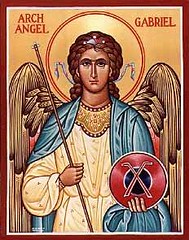
Gabriel (God is my Strength)
Alias: Jibril, Gavriel, Gibrail, and Jabrail. Aldaran (Elves), Bema (Dwarves), The Wild Huntsman.
Feast: September 29 with Saints Michael and Raphael, November 8
Symbols: Trumpet, White Hound with a Red Head (Gabriel Hound)
Patronage: Revelation, music, annunciation, gossip, Winter, righteous vengeance
Cleric Alignments: Any Good
Power: Clerics dedicated to Gabriel can use music to cause one or more creatures to become
fascinated with him in the same manner as a bard. This music must come from either singing or a
wind instrument (such as a trumpet or horn).
Favored Weapons: Mace
"For he is the minister of God to thee for good. But if thou do that which is evil, be afraid; for he beareth not the sword in vain: for he is the minister of God, a revenger to [execute] wrath upon him that doeth evil." -Rom 13:4
Gabriel means "God is my strength." Other spellings of Gabriel's name include . Gabriel is known as the angel of revelation. God often chooses Gabriel to communicate important messages. People sometimes ask for Gabriel's help to: clear away confusion and achieve the wisdom they need to make decisions, obtain the confidence they need to act on those decisions, communicate effectively to other people, and raise children well.
Gabriel is often depicted in art blowing a horn. Other symbols that represent Gabriel include a lantern, a mirror, a shield, a lily, a scepter, a spear, and an olive branch. Other (older) depictions show Gabriel with a pack of huge hunting dogs, which he uses to harry evil spirits.
Clerics
Clerics dedicated to Gabriel are often musicians and many are renowned animal trainers (particularly horses and dogs). All spend at least some time learning to read music and songs. Clerics of Gabriel are relentless pursuers of justice, looking to correct wrongs and to aid those under the boot of oppression.
Michael (Who is like God?)
Alias: Mikhael, Mikael, Mikail, and Mikhail. Manwe (Elf), Wolcanfrea (Dwarven), The Elder King
Feast: November 8 / November 21, September 29 ("Michaelmas"); May 8
Symbols: Archangel; Treading on a dragon; carrying a banner, scales, and sword
Patronage: Autumn, Churches of The Holy Trinity, Good Dragons, dragon-slayers, paladins, soldiers, guards, grocers, sailors
Cleric Alignments: Lawful Good
Power: Clerics dedicated to Michael can can smite chaotic (CE, LE, NE) creatures in the same manner as a paladin.
Favored Weapons: Morningstar
"At that time shall Michael stand up, the great prince which standeth for the children of thy people: and there shall be a time of trouble, such as never was since there was a nation even to that same time: and at that time thy people shall be delivered, every one that shall be found written in the book." -Daniel 12:1
Michael means "Who is like God?" Michael is known for his exceptional strength and courage. He’s a leader who reigns as the head of all the angels. Michael fights for good to prevail over evil. He protects and defends people who love God. People sometimes ask for Michael's help to: gain the courage they need to overcome their fears, obtain strength to resist temptations to sin and instead do what's right, and stay safe in dangerous situations.
Michael is often depicted in art wielding a sword or a spear. Other symbols that represent Michael include armor, banners, and scales. Gold and Silver Dragons are sometimes shown as companions or mounts.
Clerics
Clerics allied with Michael are Crusaders through-and-through, with many being dual or multi-class fighter-clerics. All clerics of Michael are monster hunters, and will seek to oppose any and all manifestations of evil, particularly those instigated by Infernal beings or their servants. Paladins are mightily drawn to the banner of Michael, for obvious reasons.
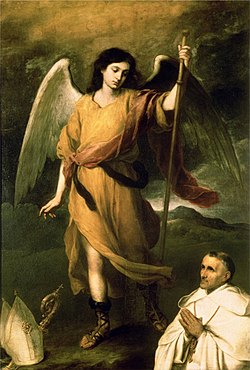
Raphael (God heals)
Alias: Rafael, Repha'el, Israfel, Israfil, and Sarafiel. Irmo (Elves), Eord (Dwarves), Losfan (Gnome), The Great Healer
Feast: September 29; October 24
Symbols: Archangel holding a bottle or flask; Archangel and a young man carrying a fish; young man carrying a staff.
Patronage: Apothecaries, alchemists, blind people, love, Spring, laughter, magic users
Cleric Alignments: Chaotic Good, Neutral Good
Power: Clerics dedicated to Raphael gains a +2 bonus to save vs. mind control and can cast
break enchantment 1/day.
Favored Weapons: Quarterstaff
“Bless God and give him thanks before all the living for the good things he has done for you, by blessing and extolling his name in song. Proclaim before all with due honor the deeds of God, and do not be slack in thanking him." -Raphael, Tobit 12:6
Raphael means “God heals.” Raphael is known as the angel of healing. He’s full of compassion on people who are struggling physically, mentally, emotionally, or spiritually. Raphael works to bring people closer to God so they can experience the peace God wants to give them. He’s often associated with joy and laughter. Raphael also works to heal animals and the Earth, so people connect him to animal care and environmental efforts. People sometimes ask for Raphael’s help to: heal them (of illnesses or wounds that are physical, mental, emotional, or spiritual in nature), help them overcome addictions, lead them to love, and keep them safe while traveling.
Raphael is often depicted in art holding a staff that represents healing or an emblem called a caduceus that features a staff and represents the medical profession. Sometimes Raphael is depicted with a fish (which refers to a scriptural story about how Raphael uses parts of a fish in his healing work), a bowl or a bottle.
Clerics
Clerics allied with Raphael are herbalists, apothecaries and wandering healers and teachers. Most of them are "
Mendicant" priests who live quite poorly, but some set up shop in remote villages or in the wilderness as healers. So great is the dedication of these clerics that all but the worst bandits and monster will often leave them in peace, as such beings may need the healing touch of a cleric soon enough.
Raguel (Friend of God)
Alias: Raguil, Rasuil, Raguhel, Ragumu, Rufael, Suryan, Askrasiel, and Thelesis. Nuada (Elves), The Great Judge
Feast: November 1
Symbols: Gavel and Book
Patronage: Order, cooperation, vengeance, justice, the sea
Cleric Alignments: Lawful Good, Neutral Good,
Power: Clerics dedicated to Raquel are skilled in hide, listen at doors and move silently.
Favored Weapon: Mace
"The forces of darkness are always among us, child. And the light cries out ever for vengeance. There is light and there is darkness, and I cannot rest until the darkness is destroyed and the light shines into the hearts of all." -The Spectre (Raguel). The Books of Magic
Raguel means "friend of God." Raguel is known as the angel of justice and harmony. He works for God's will to be done in human relationships, so they can experience fairness and peace. Raguel also works for God's will to be done among his fellow angels, supervising their work on the assignments God gives them and holding them accountable. People sometimes ask for Raguel's help to: overcome mistreatment and get the respect they deserve, resolve conflicts in their relationships, solve stressful problems in mutually beneficial ways, bring order out of chaos, remain true to their spiritual convictions under pressure, and fight injustice through helping people they know who are neglected or oppressed.
In art, Raguel is often depicted holding a judge's gavel, which represents his work fighting injustice in the world so that good will triumph over evil.
Clerics
Clerics allied with Raquel are renowned detectives, magistrates and other agents of justice. All of them seek to bring peace through clear thinking and selfless acts. Many serve as clerks and accountants for the nobility, as they are considered to be unflinchingly honest.
Phanuel (face of God)
Alias: Paniel, Peniel, Penuel, Fanuel, and Orfiel. Nienna (Elves), Heskil (Dwarves), Merciful One
Feast: September 1st
Symbols: Book, Door
Patronage: Repentance, forgiveness, exorcism, penance
Cleric Alignments: Any Good
Power: Clerics of Phanuel are standard "Law" clerics as detailed on page 11-13 in the
Blood and Treasure Players Handbook, with all of the benefits and restrictions mentioned therein. As a bonus to their devotion, clerics dedicated to Phanuel gain the Alertness feat for free (see page 32 in the
Blood and Treasure Players Handbook).
Favored Weapon: Sling
“And the fourth voice I heard driving away the Satans and not allowing them to come in front of the Lord of Spirits to accuse those who dwell on earth” -Enoch 40:7
Phanuel means "the face of God." Phanuel is considered to be the leader of the Ophanim group of angels -- the angels who guard God’s throne in heaven. Phanuel is also known as the angel of repentance and hope. He encourages people to repent of their sins and pursue eternal relationships with God that can give them the hope they need to overcome guilt and regret.
In art, Phanuel is sometimes depicted with an emphasis on his eyes, which represents his work watching over God’s throne, as well as his duties watching over people who away turn from their sins and toward God.
Clerics
Clerics allied with Phanuel are intense men and women who seek an ever-increasing intimacy with The Holy Trinity and to help others do the same. The awareness of their surroundings and themselves make clerics of Phanuel excellent detectives, demon hunters and explorers. Many clerics of the Archangel become thief catchers, and gallows thieves. Despite their usefulness and goodly purpose and devotion, clerics of Pahnuel disturb most folk, as their penetrating attention makes most people nervous.
Sariel (Prayer of God/Angel of Death)
Alias: Suriel, Suriyel, Selapheal, Salathiel, Selathiel, Sealteal, Seraphiel, Sarakiel, and Saraqael. Mandos (Elves), Bannoth (Dwarves), Vadok (Orcs), Angel of Death
Feast: None.
Symbols: Angel bearing scales or a scythe, Black-winged angel
Patronage: Those who are dying, the elderly,
Cleric Alignments: Neutral Good
Power: Clerics dedicated to Sariel may use a touch of death once per day. They must make a successful melee attack against an opponent and roll 1d6 per cleric level. If the roll is higher than the target’s current hit points, they die.
Favored Weapon: Flail or Dire Flail
"Another angel (Sariel)
, who had a golden censer, came and stood at the altar. He was given much incense to offer, with the prayers of all God’s people, on the golden altar in front of the throne. The smoke of the incense, together with the prayers of God’s people, went up before God from the angel’s hand." -Rev 8:3-4
Sariel means “the prayer of God” or “one who prays to God.” He is also referred to as “Zerachiel” which means “God’s command” and describes Sariel's duties leading people’s souls to judgment. Selaphiel is known as the benevolent spirit of death (one of very few). He brings both judgement and relief for those who suffer, ushering the spirits of the departed to either their rest or their everlasting doom. He is also known as the spirit of prayer and repentance, helping connect to God through prayer, giving them the focus they need to block out distractions and concentrate on praying. Sariel motivates people to express their deepest thoughts and feelings to God in prayer, and to listen carefully for God’s responses.
In art, Sariel is often depicted carrying a golden censer and ushering the souls of the departed to the afterlife. Many of his depictions are ominous or dark, and occasionally bear a skull motif.
Clerics
Clerics dedicated to Sariel are an interesting, even odd lot. They wear black or grey robes and carry reaping implements (flails).Clerics of Sariel are renowned embalmers, and usually act as undertakers for any community in which they dwell. Such men and women are servants of mercy, and look to bring a peaceful end to those who are coming to the end of their days. They seek to encourage repentance before death, and to ease the passing of those in great pain. Despite this selfless aim, most people fear these "Death Priests" and usually avoid them.
 The Cult of The Stink is what passes for a church for Gaffer Grime. Its members are the downtrodden masses of poor in industrialized or otherwise overcrowded cities such as Kana, Huamato and Faladriad. Beggars, thieves, mudlarks, toshers, ferrymen and all who leave on waterways have members in the cult or at least pay their respects regularly. Humans, Orcs, Half-Orcs, Goblins and Gully Dwarves are the most common members. Monsters often associated with the cult are Carrion Crawlers, Rats, Monstrous Vermin, Ghouls, Ghasts, Scrags and Otyughs.