Showing posts with label DnD 5E. Show all posts

Sunday, September 16, 2018

COSMIC SEAS: MAGEWRIGHTS OF THE SPACELANES

In the Cosmic Seas setting, magic is a tool that’s incorporated into many jobs. There are entirely magical careers, such as Astrologer/Navigators. But much of the time, mundane skill and magic are combined. A lamplighter can work with mundane lanterns, but also learns to create and maintain ship and street lamps, running lights and radium bulbs that are so common on ships and at ports-of-call with a cantrip.
A magewright knows one to four cantrips or spells. Magewrights don’t use spell slots. Cantrips can be used casually, but their spells are usually cast as rituals—even if the spell doesn’t normally have the ritual tag. When converting a spell to a magewright ritual, it can have a casting time of up to one hour. It’s also common for a magewright’s ritual to have an additional component cost in Stardust Crystals, the fuel of the magical economy. A typical cost would be 25 gp for a 1st level ritual, 50 gp for a 2nd level ritual, doubled for each subsequent level; but this is only a basic guideline. The point is that the limitations on a magewright are time and money. A locksmith can cast more than one arcane lock in a day; but it costs an hour and 50 gp for each lock they want to create.
While the common spell list is a starting point for magewright spells, you can modify these spells
quite versatile. Prestidigitation can heat or chill an object, light or extinguish a flame. Both the lamplighter and the chef may know prestidigitation, but the chef’s version may only work on food, while the lamplighter can only light or extinguish flames. An actor may know a version of thaumaturgy that helps project their voice but doesn’t provide any of the other benefits. Artisans often know versions of guidance that only helps with their particular art.
In dealing with a magewright, think about the form that their magic takes. A locksmith can perform knock as a ritual. But they don’t just snap their fingers. They might use lengths of wire or iron rods, tracing patterns around the lock they are dealing with while murmuring incantations. The magewright performs magic as both a job and a science.

SAMPLE MAGEWRIGHTS
Here are some examples of magewrights common in the Cosmic Seas setting, and the services that they provide. Not every healer can cast lesser restoration, and not every astrologer can cast divination, these are general guidelines.
·         Astrologer/Navigator. Proficient in Arcana and with navigators’ tools. Augury (ritual 50go cost); divination (1-hour ritual, 200 gp).
·         Boatswain/Bosun. Mending, message, locate object (1-hour ritual, 50 gp component cost). Familiar with Carpenters tools
·         Chef. Prestidigitation (food only), purify food and drink (ritual), gentle repose (ritual, food only). Familiar with cook’s tools.
·         Healer. Proficient with Medicine and herbalism kits. Spare the dying, detect poison and disease (ritual), lesser restoration (1-hour ritual, 50 gp component cost).
·         Lamplighter. Light, continual flame (1-hour ritual, 50 gp component cost); uses tinker’s tools to create and repair lanterns.
·         Locksmith. Arcane lock (1-hour ritual, 50 gp component cost), knock (ritual, 50 gp component cost); proficient with thieves’ tools and tinker’s tools.
·         Mechanist. Mage hand, prestidigitation, protection from energy (1-hour ritual, 50 gp component cost), animate object (ritual 300 gp component cost). Familiar with Alchemists and Tinkerers tools.
The term magewright specifically refers to an arcane spellcaster. In religious communities’ adventurers may find divine casters performing these same functions. casters performing these same functions. Such a divine caster is called an Adept. Divine magic is a gift instead of a science, and adepts typically work on behalf of their faith rather than selling their services.

Thursday, August 30, 2018

ANTHRO D&D: BADGER FOLK (RACE)

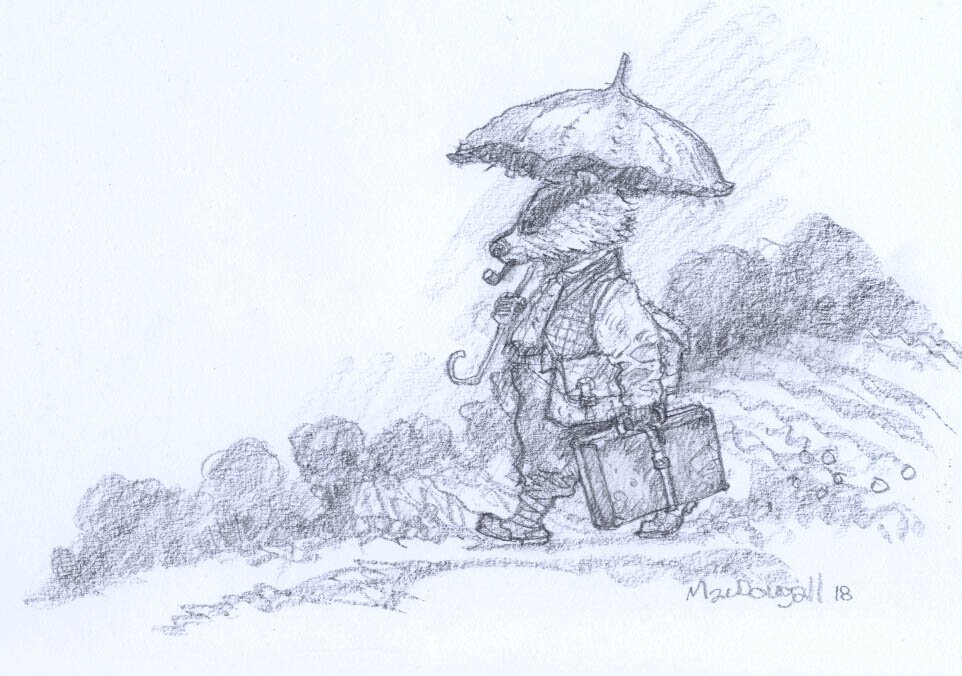
This is the start of a series of Anthropomorphic, "furry" races for use with D&D 5th Edition. This and the following races can easily be placed in a D&D 5th Edition setting, joining or even replacing the standard races. In the Cosmic Seas setting, such anthro animals are common in ports of the Dragon Empire, and are the result of magical experiments through the ages. The artwork presented here is from the marvelous Larry MacDougall, a superb artist and friend. Check out his work.


BADGER FOLK (RACE)
“They had felt hungry before, but when they actually saw at last the supper that was spread for them, really it seemed only a question of what they should attack first where all was so attractive, and whether the other things would obligingly wait for them till they had time to give them attention. Conversation was impossible for a long time; and when it was slowly resumed, it was that regrettable sort of conversation that results from talking with your mouth full. The Badger did not mind that sort of thing at all, nor did he take any notice of elbows on the table, or everybody speaking at once. As he did not go into Society himself, he had got an idea that these things belonged to the things that didn't really matter.” -Kenneth Grahame, The Wind in the Willows
Badger-folk are a species of Beastmen created from common badgers. They are a tough, loyal and deeply wise species that has made a society of their own. Badger-folk are wise and tough, with a great passion for building elaborate underground homes and towns, which they defend to the death. Often short-tempered and vengeful, badgers generally live solitary lives, emerging only occasionally from their burrows to hunt, wage war and seek mates. They are known for their strength, wisdom and loyalty.
Personality. Badger-folk are edgy and easily riled, though loyal to those who befriend them and, on rare occasions, even playful (especially toward children). They are most savage and feral when on the defensive, though they are still quite formidable on the attack.
Physical Description. Badger-folk are powerfully built black, white, brown and grey fur with a small head, a stocky body, small black eyes and short tail. All badgers have a broad white stripe of fur running from the bridge of the nose over the top of the head and down to the base of the skull. A badger’s arms are unnaturally large and well-muscled, and her fingers end in hard claws 2 to 3 inches long. Badger-folk constantly emit a fetid odor.
Badger Names. Badgers tend to choose thick sounding names that are easy to say. Male names- Achak, Brock, Dax, Tasso. Female names- Azcona, Brook, Griebel, Honani, Kitchi. 
Badger-Folk Traits
Badger-Folk share the following racial traits.
Ability Score Increase. +2 Constitution, +1 Wisdom.
Alignment. Most badger-folk are lawful, believing firmly in the benefits of a well-ordered society. They tend toward good as well, with a strong sense of fair play and a belief that everyone deserves to share in the benefits of a just order.
Size. Badgers stand between 4 and 5 feet tall and average about 150 pounds. Your size is Medium.
Speed. Your base walking speed is 30 ft. You have a burrow speed of 5 ft.
Bite and Claws. Badger-Folk are proficient with your unarmed strikes, which deal 1d6 piercing or slashing damage on a hit.
Darkvision. You can see in dim light within 60 feet of you as if it were bright light, and in darkness as if it were dim light. You can’t discern color in darkness, only shades of gray.
Keen Smell. You have advantage on Wisdom (Perception) checks that rely on smell.
Savage Attacks. When you score a critical hit with a melee weapon attack, you can roll one of the weapon’s damage dice one additional time and add it to the extra damage of the critical hit.
Tenacious. When you take damage, you can use your reaction to roll a d12. Add your Constitution modifier to the number rolled and reduce the damage by that total. After you use this ability, you can't use it again until you complete a short or long rest.
Hybrid Nature. You have two creature types: humanoid and monstrosity. You can be affected by a game effect if it works on either of your creature types.
Languages. You can speak, read, and write Common and Badgerish. Badgerish is full of snarls and guttural sounds, and those characteristics spill over into whatever other language a badger might speak.


Tuesday, July 24, 2018

COSMIC SEAS: NECROTIC ENERGY

NECROTIC ENERGY DAMAGE
“Never before had he known what shapeless black things lurk and caper and flounder all through the aether, leering and grinning at such voyagers as may pass, and sometimes feeling about with slimy paws when some moving object excites their curiosity. These are the nameless larvae of the Other Gods, and like them are blind and without mind, and possessed of singular hungers and thirsts.” 
-H. P. Lovecraft. Dream Quest of Unknown Kadath
In the Cosmic Seas setting, mortal space explorers are constantly at risk from exposure to the dreaded Necrotic Energy. This life draining energy permeates the space between the worlds and is always seeking ways to drain the life and light from the worlds. 
Necrotic Energy affects a spherical area, radiating out from a source point. Necrotic Energy can extend into solid objects with only lead offering protection from this energy. The closer one gets to the center of an area of necrotic energy, the stronger the necrotic energy effect becomes. Necrotic Energy entries list the maximum level of necrotic energy in an area, as well as the radius out to which this necrotic energy level applies. Each increment up to an equal length beyond that radius degrades the necrotic energy strength by one level. For example, a source of high necrotic energy with a radius of 20 feet creates a zone of medium radiation 21 feet to 40 feet from the center in all directions, and a similar zone of low necrotic energy from 41 to 60 feet.
Necrotic Energy damage is poison damage and any ability or spell that affects poison will, likewise, affect necrotic energy damage. Creatures that are immune to poison damage take no damage from necrotic energy, and creatures resistant to poison damage suffer half the normal levels of exhaustion on a failed saving throw, rounding down.
Creatures that are exposed to necrotic energy must make a saving throw each round or suffer levels of exhaustion, as set out in the Necrotic Energy Damage table. If the saving throw fails by 5 or more, the creature suffers more levels of exhaustion, as set out in the Necrotic Energy Damage table.

TABLE: NECROTIC ENERGY DAMAGE

Necrotic Energy Level               
Constitution Saving Throw DC
Failed Saving Throw
Failed Saving Throw by more than 5
Low
10
One level of exhaustion
Two levels of exhaustion
Medium
15
Two levels of exhaustion
Three levels of exhaustion
High
20
Three levels of exhaustion
Four levels of exhaustion
Severe
25
Four levels of exhaustion
Five levels of exhaustion
  
NOTES: Necrotic Energy is my answer to Radiation, and even as an in-game explanation for the cold of space. In the Cosmic Seas setting, horrid undead entities lurk in Space, and necrotic (negative) energy is an excellent catchall for the horribleness and danger of space travel. 


Monday, December 11, 2017

VOIDJAMMER 5E: Hurwaeti

HURWAETI (WIGGLES)
The hurwaeti are an ancient humanoid race distantly related to both sahuagin and lizard men. In space, they usually function as mercenaries, common crewmen, or occasionally as pirates, traders, or salvagers operating their own ships. The hurwaeti were once a great spacefaring race that had colonized many systems, spreading art, civilization, morality, and and philosophy favoring altruism and discipline throughout the spheres. But an ancient war broke up their empire and killed the brightest and most energetic individuals. The destruction stranded the hurwaeti colonists, leaving them to degenerate into the swamp and salt wiggles. The remaining spacefarers became impoverished wanderers, content to simply earn a living for themselves and their tribes.
Hurwaeti have dark olive-green hides and long limbs, webbed fingers and toes, and gnome-like faces with large ears, noses, and long, sharp chins. Adult hurwaeti often have short, sparse beards and tufts of coarse hair atop their heads. Venerable adults tend to have long beards, thicker tufts of hair, and bushy eyebrows. Hurwaeti favor simple clothing, usually long, brightly colored loin cloths, and belts and packs for carrying equipment.
Hurwaeti tribes are made up of clans, each ruled by an elder. The senior clan head – usually the oldest and wealthiest – governs the tribe. All disputes within the tribe are settled by appealing to the tribal chief. Priests are usually Druids or Clerics dedicated to Cosmos (especially his pessimistic aspects) and are often chiefs of clan-heads.

Hurwaeti Names
Hurwaeti tend to use lizardfolk names, with inflections of their own ancient cultures. Male Names: Aeia, Mitvia, Puddleglum, Vuella, Ida. Female Names: Simin, Oiert, Tuess, Aedo

Hurwaeti Traits:
The hurwaeti are an ancient humanoid race distantly related to both sahuagin and lizard men.
Ability Score Increase. Your Wisdom increases by 2 and your Dexterity increases by 1.
Age. Hurwaeti mature at 30 years and live for 300 years.
Alignment. Most hurwaeti tend towards self-interest, and rarely develop the extremes of alignment.
Size. Adults are between six and seven feet tall and weigh from 190 to 230 pounds. Your size is Medium.
Speed. Your base walking speed is 30 feet, and you have a swim speed of 30 feet.
Leaper. You can long jump or high jump twice the normal distance.
Fog Cloud. You can cast fog cloud as a 1st-level spell once with this trait and regain the ability to do so when you finish a long rest. When you reach 5th level, you can instead cast it as a 2nd-level spell.
Spacefaring. You have proficiency with Vehicles (Spelljamming)
Hold Breath. You can hold your breath for 15 minutes.
Scales. If you are wearing no armor, your AC is 11 + your Dexterity modifier.
Languages. Common, Draconic

Wednesday, December 6, 2017

VOIDJAMMER 5E: Wildspace Orcs


ORC, Wildspace
The Orcs that are found across the stars, having a long history in space, punctuated in a number of long and bloody conflicts with the Elves and other races. Wildspace Orcs are more Lawful in alignment (Lawful Evil) than groundling orcs, and have learned the importance of an organized ship and taking care of their equipment. The orcs that cannot grasp these details do not survive long.
Orcs usually use ships made by other races such as humans, but do have a number of their own vessels. These orc-made ships are very mechanical in design, and are all quite potent warships. 
Orcs organize themselves into clan ships and asteroid enclaves that are pure pirate, but organized in a strict code of conduct known as the Black Code. This code is a set of laws and taboos that the orcs adhere to with religious zeal. And though violent and cruel, can be appealed to by non-orcs in negotiations. Orc Clerics can become disciples of the Black Code (Acheron Planar Clerics), and are walking encyclopedias of sailor superstition, taboos and variations on Black Codes. Such priests wear black coats and are called Provosts.
Wildspace Orc Names
Wildspace Orc tend to take orcish names.
Male: Dukagsh, Yikart, Urkutz, Zark, Morkitar, Wrackblood, Rendflesh, Spikestar, Neverfang, Voulge,
Female: Baggi, Emen, Engong, Kansif, Myev, Neega, Ovak, Ownka, Shautha, Sutha, Vola, Volen, Yevelda

ORC TRAITS
Your orc character has the following racial traits.
Ability Score Increase. Your Strength score increases by 2, your Constitution score increases by 1, and your Intelligence score is reduced by 2.
Age Orcs reach adulthood at age 12 and live up to 50 years.
Alignment. Orcs are vicious raiders, who believe that the world should be theirs. They also respect strength above all else and believe the strong must rule over the weak to ensure that weakness does not spread like a disease. Wildspace Orcs follow a harsh and unforgiving code of laws and regulations (the black code). As such, most are lawful evil.
Size. Ores are usually over 6 feet tall and weigh between 230 and 280 pounds. Your size is Medium.
Speed. Your base walking speed is 30 feet.
Darkvision. You can see in dim light within 60 feet of you as if it were bright light, and in darkness as if it were dim light. You can't discern color in darkness, only shades of gray.
Aggressive. As a bonus action, you can move up to your speed toward an enemy of your choice that you can see or hear. You must end this move closer to the enemy than you started.
Weapon Training. You have proficiency with the hand axe, battle axe, pistol, and musket.
Menacing. You are trained in the Intimidation skill.
Powerful Build. You count as one size larger when determining your carrying capacity and the weight you can push, drag, or lift.
Languages. You can speak, read and write Common and Orc.

Wednesday, November 8, 2017

Dungeons and Dragons 5E: Taking the Plunge!

After finally purchasing the Dungeons and Dragons 5th edition Players Handbook and Dungeon Masters Guide and reading them, I have decided on running a local game. Also, as a tinkerer, I feel the need to create a setting that incorporates all of the awesomeness that is to be found in the PHB. Making a setting that is both all my own, and hearkening back to all of the weird stuff that I loved as a kid to the even weirder stuff I like today.

So what does that mean? It means Spelljammer, Planescape, He-Man, Voltron, Blackstar, Dragons, weird Comic Books, Dinosaurs and anything else I can cram in there. But keeping the weird and wonderful D&D feel. So stay tuned!

DISNEY & DRAGONS: D&D in Fantasyland

Many times, in recent years I have encountered would-be players of Dungeons and Dragons whose sole experience with the fantasy genre h...