Thursday, September 24, 2015

Changeling The Dreaming: HOUSE PLEIADES


“It was a star," Mrs. Whatsit said sadly. "A star giving up its life in battle with the Thing. It won, oh, yes, my children, it won. But it lost its life in the winning.” -Madeleine L'Engle, A Wrinkle in Time
Symbol: Seven Pointed Star (Faerie Star or Elven Star)
Legends connecting the Fae with the stars are widespread across many cultures. House Pleiades is a house that since the early days of the Sundering allied themselves with the Stellar Incarnae of the Pleiades star cluster, gaining great allies with these strange beings. Mater Pleione, the founder of the house,  left the Mortal Realm in the early days of the Sundering to found the Realm of Seven Stars in the Dreaming Aether. There, she and her daughters created a mighty realm away from the politics of Arcadia.
And so in the grim days of the Shattering and the long Interregnum House Pleiades kept to its own Realms and the Stellar Trods across the Aether. The True Fae amongst them either retreated into the stellar abodes of the stars they served or took to the Changeling Way. There along with their kinain followers this house developed mighty magics and Aether Ships to maintain their Realm. And there they waged many battles with Nightmare Chimera and Dark Fae, dark shadows between the stars.
Before the Sundering, Mater Pleione was the consort of the Titan Atlas (a Fomorian of great power), and so members of this house are not trusted by most other houses. Thought the Autumn World was cut off from the "Fleet of Stars" these Fae and their kinain consors established bases nearby on the Dreaming aspect of Venus, Europa, Jupiter and the Otherworlds of Vulcan and the Hollow Earth.
Stellar Incarnae
The Stellar Incarnae that they serve are beings of light, and so anything that catches and enhances light is favored by members of this house. So bright colors, prisms and other crystal patterns are common in their designs and personal adornment. Older members of this house prefer flowing robes or cloaks, flowing hair and garments that allow movement. It is said that the persistent Crystal Spires and Togas theme found in so much of science fiction can be linked to this house.
Since the Return, House Pleiads has sought to reconnect with its Earthbound Fae relations, but has little use for squabbles between Sidhe and Commoner. This house prefers to be allied with forward thinking fae such as House Dougal,  Nocker Aethernauts, Krofted Inanime (Solimond and Undine in particular) and similarly adaptable fae. In their mortal lives, House Pleiades Sidhe are stargazers, Astronomers, Astrologers and anything else that deals with the nightime sky and the stars.
Boon: Nobles of House Pleiads may see clearly in pitch darkness. A chimerical crown of pale silver light shines from her brow while this power is in use. The character must state when this Boon is in effect, but it requires no roll or expenditure. The character suffers no difficulty or dice-pool penalties from darkness. House Pleiads fae gain Remembrance 3 and cannot botch Kenning or Gamarye rolls. House Pleiades fae may learn the Spirit Link Art without joining a Nunehi nation, as they already have patrons in the spirit world.
Ban: Members of of House Pleiads are all servants of the Seven Sisters, and as such are subject to the desires of these powerful beings. At any point one of these patron spirits may ask a favor of the character, which comes via a spirit servant of the Incarna, usually in a dream. Members of this house are bound to obey this summons unless forcibly restrained. Furthermore, members of this house attract the attention of Nightmare Chimera and related Spirits such as Banes (Chimera and Spirits are the same thing in my campaigns), and will always be the favored target of such creatures.

HOUSE PLEIADES COLONIES
In the days leading up to the Shattering, House Pleiads brought kinain and enchanted mortal followers into the Dreaming, creating homesteads in the Aether (Dream Space). These colonies were placed on distant planets (asteroids, moons, etc) that are reached through the Dreaming using Star
A Scout Ship docking at a Star Colony
Trods. As with all Dream Realms these are worlds in their own right, and have both a physical and Dreaming portion, just as Earth does. The Stellar Colonies placed on these worlds were composed of enchanted mortals, a kinain ruling caste and a few Changelings to start out. All initially in allegiance to the True Fae Firstborn who planted them there.
During the days after the Shattering, these colonies were cut off from Earth, and had to fend for themselves against Nightmare Chimera and wicked Fae. Many times, these colonies have developed their own cultures, partly based on their origins and part on the strange environment. These colonies are also home to imported Earth animals, Inanimae and all manner of strange chimers, from aliens of every description to chimerical robots. A small number of True Fae can be found in the colonies, but they are very rare away from the Pleiades Star Cluster.
Nowadays, Most of these colonies resemble Greek or Roman cultures with some Central and South American elements mixed in. The overall effect is reminiscent of the images of Atlantis found in art and folklore. Despite the presence of Romanesque architecture and toga-wearing locals, technology is advanced, making use of weird elements and magic for its construction and power sources.

I will be posting on the Dreaming Aether very soon.

Friday, September 18, 2015

Changeling The Dreaming: The Kinain

A Kinain is a mortal that possesses faerie blood, but is not a full Changeling. Kinain are usually born of a Changeling and a mortal or two Changelings. About 15-20% of those with one Changeling parent are Changelings themselves, while about 40-50% of the children of two Changeling parents are Changelings as well. The rest are Kinain.
Some Kinain are marked with unusual traits by their Faerie Blood that depend on their heritage ( a descendant of a satyr is hairy and social, while a descendant of a Boggan is short and usually works with his hands). Many also have strange abilities also known as Fae Gifts, some of which can be controlled and others that are wild and unpredictable. Some go through life completely unaware of their Fae natures, and others are taken by the Kithain into Fae society, making them a valuable part of the Changeling community.
Their Fae-like nature makes them also competent sources of Glamour, something that some Changelings exploit by ravaging them. One advantage of this is that Kinain are immune to the pains of Cold Iron or Bedlam, but instead always carry the danger of becoming Dream-struck.
Use of this material requires the Changeling The Dreaming Rulebook. Its a great game, check it out!

KINAIN SOCIETY
Among mortals, Kinain stand out as otherworldly persons and are drawn to professions that allow them to take advantage of this, such as stage magicians, musicians, fortune tellers and similar.
Though most kinain are mixed in to the general populace, a number of family lines, clans and cultures have anough Changelings and thus Kinain to be distinct. These families are usually fringe people, living in odd locations, or otherwise slipping through the cracks so as to avoid trouble. A few such groups are: 
Urmen (Romani Gypsies): The Urmen Clan is a clan of Romany that is considered to be mysterious even by the standards of the Rom, and are widely known as seers and magicians of great skill. Also calling themselves the "Minions of the Moon" or the "Servants of Alako", have a strong streak of Eshu blood with those of the Satyr kith as a large minority. Urmen are a small and widespread clan in the Mortal World, preferring wilderness areas and remote locales. 
House Merinita (Hermetic Mages): House Merinita is a chapter of the legendary Order of Hermes, an ancient order of Mortal wizards. House Merinita consists entirely of kinain (all kiths), and has long been a staunch ally of the Fae. Members of this house are focused on the research and practice of Fae Arts and have been close allies with the Fae since ancient times.Membership requires high rankings in Faerie Blood (rank 3+), Fae Sight and at least one dot in a Fae Art and Realm.  
The Star Nation of Tau Ceti (Otherworlds): These Kinain (called the Cetians) are descendants of Sidhe kinian who were long ago brought to the Dreaming aspect of the Tau Ceti star system, but are now fairly widespread across the Aether. They possess a "Roman" sense of style and culture, favoring togas and skirts. The Cetian kinain are all of ancient Sidhe stock, though a number also possess Troll blood as well. (More on Dreaming Space in the very near future...).

Note: I will be posting more in the near future regarding kinain families and groups, as well as material on the Dreaming and Fae civilization.


KINAIN CHARACTER CREATION
Kinain are required much like Changelings, but with the following changes. See Changeling The Dreaming 2nd Edition for details.
Choose character concept, Legacy, Seeming, and Heritage (what Kith you're related to)
Select Attributes: 6/4/3
Select Abilities: 11/7/4
Select Advantages: Backgrounds (5), Fae Gifts (5) (Also based on Faerie Blood)
Finishing Touches: Record Beginning Glamour, WP, and Banality
Childling: Glamour (4), Willpower (1), Banality (2)
Wilder: Glamour (3), Willpower (3), Banality (4)
Grump: Glamour (2), Willpower (5), Banality (6)
Spend Freebie (21)

Attributes (5 pts per dot)
Abilities (2 pts per dot)
Glamour (3 pts per dot)
Arts (5 pts per dot)
Realms (3 pts per dot)
Backgrounds (1 pts per dot)
Willpower (1 pts per dot)

Faerie Blood (Background)
This background represents the extent to which the kinain has been exposed to the realms of faerie. This does not necessarily mean that the character has fae blood, but can represent time spent in faerie, or in the presence or fae. A kinains glamour cannot exceed his or her rank in this background.  
O Mortal.
• A drop of power, an odd person.
•• An otherworldly person, seen as odd but intriguing.
••• Clearly unusual, seems more dramatic than most.
•••• The center of attention, and a magnet of much adventure.
••••• As close to being a true faerie as a mortal can become.

Feth Fiada/Mist Veil (Background)
The Mists protect your normal actions as they do any other Changeling. This background raises the difficulties of mortals to track or notice the kinain. 
* You are not easy to remember by most, but some may recall some features about you
** You are a little harder to remember, and blend in to the crowd.
*** You will not be remembered, but it will bother those who are trying ot remember you a little bit.
**** You will not be remembered, and it will not bother the person who is trying to remember you.
***** You are a leaf on the wind. A ghost in the night. No one in the area will recall seeing you.

Fae Gifts
These gifts may be purchased at the posted price with Fae Gift points (5) and with Freebie points.

An-da-shealladh/Fae Sight (2 point Fae Gift): You can see and hear into faerie realms, without the need for being enchanted. The character cannot necessarily touch faerie creatures because he can see them though.

The Bardic Gift (1-5 point Fae Gift)
The kinain has a supernatural skill with entertainment. This can take the form of acting, music, storytelling or something similar.
*  Strain of Soothing: Charisma + (Performance or Persuasion) diff 7, all social roll difficulties in     the area are reduced by one.
** Strain of Laughter: Manipulation + (Performance, Expression, Persuasion or Subterfuge) Diff 8,     paralyze your audience with laughter for turns equal to the successes.
*** Strain of Sorrow: Manipulation + (Performance, Expression, Persuasion, or Subterfuge) Diff 8, get your target's sympathy and tears for a number of turns equal to the successes.
****  Strain of Slumber: Charisma + (Performance, Expression, or Persuasion) with the diff being the  target's WP can put them to sleep for a number of minutes equal to the successes rolled.
*****  Strain of Truth: Charisma + (Performance, Expression, or Persuasion) diff 9 can convince an  audience that you are telling the truth. 4 or more successes gains you Rapture; roll Charisma + the     same Ability again and each success gains you a point of Glamour. A botch on the first roll gains     you a point of temp Banality.

Fith-Fath/Invisibility (1-5 point Faerie Gift): Spend one Glamour and roll your Fith-Fath rating against the diff of the highest banality in the area. Each success hides you for a turn. Per+Kenning can detect it at a Diff 4.

Honored Birthright (5 point Fae Gift): You gain the Birthrights of your related Kith. Note - if you have two bloods, you can only use one of your Legacy's Birthrights.

Instinct (1-5 point Fae Gift)
This talent is a form of 'sixth sense' that adds to any rolls regarding the character's personal safety. Even when a character has no normal way to detect a danger, one with an Instinct rating has a chance to detect it. In such cases, Instinct + Perception could be rolled (diff 8). Results can range from the character getting a funny feeling about a person who means to jump them in the alley once they've cashed their check to not wanting to start a car wired to explode. A character's Instinct score should be added to init rolls in combat scenes as well (Instinct+Wits+Alertness).
This Affinity only works in regard to the character herself and is not added to rolls where the character is not in any personal danger.
*     Novice: You generally have an umbrella with you when it rains.
**     Practiced: You never get cold-cocked in a fight.
***     Competent: Good private eye material.
****     Expert: You never answer the phone when a creditor calls.
*****     Master: Jungle predators could learn from you.

Luck (1-5 point Fae Gift)
This talent enables the character to add an extra die or two to a dice pool when she decides things look really bad. However, each Luck die can be used only once per story. So, if the character has three points of Luck she might use one point (die) early on to help win at gambling, but then she only has two Luck dice to use when she's confronted by three angry bouncers at the club. Note: This does not give you automatic successes, only extra dice to add to pools. In game terms, Luck dice can only be used once every three real life days. Luck dice can be used even in skills that the character has no talent in. For example, a Kinain with absolutely no throwing ability could roll her dex + 3 luck die (if she has 'em) to hit a moving target with a big rock and pull a David and Goliath and impress all her friends.
*    Novice: You find pennies on sidewalks.
**    Practiced: You can always find a parking spot.
***    Competent: You would have been kicked off the Titanic before it set sail.
****    Expert: You've been thrown out of a lot of casinos.
*****    Master: Compared to you, James Bond is one unlucky guy.

Nine Lives (4 point Fae Gift): Chimerical Death affects you as if you only have a Banality of 1. It can only be used nine times during a chronicle. Automatically in use.
Restricted: Have a viable reason why your character would have this or it will be rejected.

Parted Mists (5 point Fae Gift): The Mists don't affect you. You remember everything while enchanted. Automatically in use.

Riastradh/Berserker (5 point Fae Gift): Spend a point of Glamour and you gain two battle dice to apply to all of your Chimerical combat rolls. You MUST attack with a Chimerical weapon or attack for this to occur.

The Second Sight (1-5 point Fae Gift)
The Kinain has the "gift" of prophecy allowing him or her to have visions of the future.
Roll Perception + Second Sight, diff 8
*    Novice: The character can see up to one month into the past and two weeks into the future.
**    Practiced: The character can see up to one year into the past and six months into the future.
***    Competent: The character can see up to ten years into the past and five years into the future.
****    Expert: The character can see up to a hundred years into the past and fifty years into the future.
*****    Master: The character can see any point in the past or future, though the difficulty for anything beyond a hundred years past and fifty years forward is 10.

Spearman's Shield (1-5 point Faerie Gift): Get an additional soak die (based on your rating in this Gift) when you soak against Chimerical Damage only.

Taghairm/Shadow-Tongue (2 point Faerie Gift): You can hear and speak to the Dead, and they can hear you. Automatically in use.

Taibhsear/Dead Eyes (1 point Fae Gift): You can see ghosts. Automatically in use.

Weakened Mists (1-3 point Fae Gift): Subtract this rating from your Banality to remember what happened during the Mists.


Tuesday, September 8, 2015

Changeling the Dreaming: Some Basics

The world of Changeling The Dreaming is much like our own, and has much of the same history. However it is a world where all manner of strangeness lurks just out of sight, and real monsters haunt the shadows. Supernatural creatures are mostly gone from the world of men, but enough hang on in hidden places or even in plain sight, hidden more by the lack of awareness of mankind rather than the efforts or the supernatural. Most humans are unaware of just how weird the world really is, and are happier because of it.

Rather than get all into discussions on the nature of the spirit world and the material world, suffice it to say that Fairy Tales are REAL. And before you get all Disney about it, you should pick up a copy of The Complete Grimm's Fairy Tales, The Snow Queen, The Neverending Story or anything by Charles de Lint or Neil Gaiman. You can also watch a few episodes of Over The Garden Wall or Jim Henson's The Storyteller. As well as all being very entertaining and brilliant works, they all start to give a glimmer of the shadowy wonderland of Changeling The Dreaming.

The Fae of Changeling draw magical power (Glamour) from creativity, dreams, wonder, terror lust and madness. It is these things that empower and nurture their spirit-selves, and they make it their business to ensure a steady supply of these things. The only real limit to the power of Faerie Glamour is Banality, a sort-of metaphysical force of unbelief representing the death of wonder. It is this darkening of the heart of wonder that has closed much of humanity from the fae. Cold Iron is a manifestation of this force, and so is very dangerous to the Fae.

BRIEF HISTORY
Up until late-Medieval times, the Fae existed much like as it is depicted in Fairy Tales from around the world. In this Mythic Age the Fae would dwell part time on Earth, usually in Enchanted Forests
, Fairy Mounds, and similar locations. The rest of the time in one or more of the many Otherworlds. These mythic fae were sometimes good neighbors, but were dreadfully fickle creatures, and some had a habit of stealing unbaptized children. Mortals who lived near the Fae had all kinds of rituals and holidays to keep peace with these fickle beings, though in Christian (and Buddhist and Muslim) lands, this had to be done away from the eyes of the clergy. Then came the Shattering.

The Shattering is an occurrence in the history of Changeling The Dreaming in which the majority of paths to the Otherworlds were slammed shut, trapping large numbers of the Fae on Earth (and near-Earth regions of Faerie). The hows and the whys of this vary with the retelling, but that this occurrence came about at the same time as the Black Plague is unlikely to be a coincidence.
Locked out of the deeper realms of the Dreaming, the earthbound Fae had to scrabble to survive. Many of them could only exist on Earth for limited periods, in magical locales or under specific circumstances. And so desperate measures needed to be undertaken.

And so to survive in a world that is inhospitable to the ephemeral Fae, those left on Earth became Changelings. Normally the making of a Changeling was a fairly rare occurrence, in-which a fairy spirit is switched with a human soul (the human souls thus evicted are sent into faerie). And so all of the remaining Fae became changelings full-time. This allows the Fae to not only survive, but to allow their immortal spirits to carry on via reincarnation into human descendants.

Now supplied with human-suits, they live alongside mortals, appearing to humans as humans though most have some kind of hint that there is something special and/or odd about him or her. How they live and just how weird they are is up to the Storyteller and players. Me I like it pretty weird in my contemporary fairy tales, soooo...

If you want to know more about the setting of Changeling The Dreaming, puck up a copy through Onyx Path Publishing. There is all kinds of great stuff in there, from the Return of the Sidhe, the Concordance War, and all kinds of other details.

In future articles I will be discussing differing Kiths (Fae races) and some odd niches that they have found themselves in. Also some info on some new houses and societies and more than a few odd Chimerical creatures. So stay tuned!

Monday, September 7, 2015

Changeling: The Dreaming (an old obsession)

Changeling The Dreaming by the now-defunct White Wolf Publishing was one of those role-playing games that I loved from the beginning. It was all about Faerie Tales, Dreams and the Imagination, both the bight and the dark. It was designed to allow for all sorts of contemporary fantasy themes and moods, and left largely up to the Storyteller and players using it. Changeling, like the other game lines in the "classic" World of Darkness was set in a darker version of our own world. However unlike the other settings, Changeling was meant to be more modular and was in many way bigger and weirder than the others. It was about faerie beings and dreams after-all.
Most of the fans of the World of Darkness did not take to Changeling, as there was no huge metaplot to underline the setting. Though there were certainly factions and a world history in Changeling, it was meant to encourage creative chaos in setting up a chronicle (ie campaign). And so the setting never made the money that Vampire, Werewolf or Mage did. Too bad in my opinion.
One of the things that I loved about Changeling: The Dreaming was the creative people who cranked out new and fun material for the setting, long after White Wolf gave up on the setting. Some, like The Moonlit Trod,  The Dream Burrow, and The Right To Dream (and its wonderful Oz series) and others closed down or otherwise stopped updating years ago. But these and other sites were so wonderfully creative and energetic. And I have yet to see that kind of creative energy coming out of the new World of Darkness line of games.
As of now Changeling looks to be getting a facelift and an update in the form of a 20th anniversary edition from Onyx Path Publishing. So I thought I would show a little love for the old setting by posting some articles, art and rules tweaks from my own thoughts on Changeling The Dreaming.

For a print-on-demand or pdf version of the game check out DriveThroughRPG.

Friday, July 17, 2015

Wild Seas: Gaffer Grime [Deity]

Gaffer Grime
Title(s): Mr. Grime, The Stink, Ole Stinkwater
Home plane: Plane of Ooze
Power level: Lesser
Alignment: Chaotic Evil
Portfolio: Filth, disease, toshers, mudlarks and hidden treasure
Cleric Alignments: Any Chaotic
Domains: Chaos, Ooze, Trickery, Water
Favored Weapon: Billhook (treat as Sickle)
"Now from all parts the swelling kennels flow,And bear their trophies with them as they go: Filth of all hues and colours seem to tell. What street they sail'd from, by their sight and smell; Sweepings from butchers' stalls, dung, guts and blood; Drown'd puppies, stinking sprats, all drenched in mud, Dead cats, and turnip tops, come tumbling down the flood." -Jonathan Swift
The vile god known as Gaffer Grime is the patron of corrupted water, disease and the worst filth of the sewers. He appears as a hugely fat man with a wide mouth and filthy beard. Though horribly evil, he occasionally takes a liking to people who dwell in or near sewers, especially those of the tosher and mudlark trades.
Clerics of Gaffer Grime are the scholars amongst scavengers, always ready with sage advice and rough lessons.  There are no priestly raiments for clerics of Gaffer Grime, though a preference for stout boots and layers of clothing to hold off the damp are preferred. Holy symbols are a simple disc of shiny metal that has been gleaned from the muck.

THE CULT OF THE STINK
The Cult of The Stink is what passes for a church for Gaffer Grime. Its members are the downtrodden masses of poor in industrialized or otherwise overcrowded cities such as Kana, Huamato and Faladriad. Beggars, thieves, mudlarks, toshers, ferrymen and all who leave on waterways have members in the cult or at least pay their respects regularly. Humans, Orcs, Half-Orcs, Goblins and Gully Dwarves are the most common members. Monsters often associated with the cult are Carrion Crawlers, Rats, Monstrous Vermin, Ghouls, Ghasts, Scrags and Otyughs.
The Cult has shrines tucked away in secret corners of the sewer systems, with at least one major shrine dedicated to the god. Such shrines have at least one full-time guardian, with wandering defenders coming and going. The city-state of Kana is well aware of the cults existence, and more-or-less allows their presence in exchange for maintenance of the drainage system. The fact that abductions and occasional human sacrifice is conducted by the Cult is not made an issue of unless they abduct someone important. It's all very political.

Ooze Domain 
This domain is all about oozes, creatures quite common in the slippery places holy to Gaffer Grime. Clerics of Ole Stinkwater who take this domain are considered disturbing even to other followers of the sewer god.
Granted Powers:  Rebuke or command oozes as an evil cleric rebukes or commands undead. Use these abilities a total number of times per day equal to 3 + the character’s Charisma modifier.
1. Grease (Makes 10-ft. square or one object slippery.)
2. Melf's acid arrow (Ranged touch attack; 2d4 damage for 1 round + 1 round/three level.)
3. Poison (Touch deals 1d10 Con damage, repeats in 1 min.)
4. Rusting grasp  (The caster's touch corrodes iron and alloys.)
5. Evard's black tentacles (1d4 +1/level tentacles grapple randomly within 15 ft.)
6. Transmute rock to mud (Transforms two 10-ft. cubes/level.)
7. Destruction (Kills subject and destroys remains.)
8. Power word, blind (Blinds 200 hp worth of creatures.)
9. Implosion (Kills one creature/round.)


Tuesday, July 14, 2015

Wild Seas: A Piratical Campaign Setting

While pondering campaign settings for my local group, one concept that often pops into my head is a pirate-themed one. A world with deep seas, lots and lots of islands, and endless opportunity for swashbuckling adventure. And so I am throwing together a campaign setting with all of those elements, mixed with the basics of D&D. I wont be overly detailing too much of the setting, forcing me to "fly by the seat of my pants" so that I and my players will be continually surprised.
System-wise I will be using the Dungeons and Dragons 3rd Edition rules (not 3.5 or Pathfinder). This is mostly because all of my players either have the books, or can easily get them via online sources. Of course it is child's-play to convert any of this to other systems, particularly d20 ones.
Of course some basic setting details are needed. As follows:

THE MAP
Each Hex is five miles on the side.
The overall setting is a tropical world that is mostly covered with shallow seas. Two major continents and innumerable islands dot the seas. On land, well watered jungle and swamps predominate with only a few small areas of desert or grassland.
Animal life is abundant and fairly typical for a fantasy setting, though large horses are rare. Most of the animals you will see here are those you will see in pirate movies, Sindbad flicks and tarzan movies. Sea-monsters are abundant, with some really powerful ones such as Krakens, sea-dragons and far weirder things showing up from time to time.
The major Sea Power is the nation of KANA (see map), a sea-going power that is looking to control the shipping lanes. It is ruled by a parliamentary government and overseen by Queen Tetradia, a mighty wizardess and shrewd politician. All other nations are city-states and small kingdoms.

RACES
The standard races found in the PHB are allowed. Elves in this setting come from the Green Moon Verda, and only dwell in small settlements. There are more half-elves than elves. Orcs are also allowed as player characters and are more advanced than Orcs on other worlds, entering into trade with other races. Orcs and Half-Orcs typically work in the fouler and less admirable labor jobs of the seas, notably Whaling, deep sea fishing and other messy work.

THE SHIP
The player characters will all be employees of Adnan, Volnon and Gench Shipping Inc., a private shipping firm that handles specialized cargoes. This is code for transporting and selling stolen cargo as well as conducting normal trade runs. The crew is expected to protect goods for the Company, deal with pirates (who have to sell loot to someone) and find buyers.
The Wayward Sun is a modified Caravel, designed to be fast, tough and able to maneuver amongst islands and reefs. The vessel is equipped with a single ballistae, but the players are free to equip her more fully if desired. It is preferred that the PC's use magic and their own weapons to defend and/or conceal the vessel, but the DM will not try to broom handle their decisions.
This ship comes equipped with some special equipment, particularly continual flame lamps in the lower deck and hold (mounted), and a barrel of endless salt pork in the kitchen. Other foodstuff, water and supplies must be purchased elsewhere.

RELIGION (THE GODS)
Religion in the setting is to be thoroughly nautical. The gods and goddesses of the setting are the sorts of beings that are mentioned in sailors stories. These include such entities as Captain Jonah (the Sailors Devil), Mother Carey (embodiment of the untameable sea), Jack The Fiddler (guardian of Fiddler's Green), Mr. Friday (Demon Lord of Bad Luck) Thomas Mariner (Angel of the Seas Splendour) and others.
Though there are specialist priests, following a specific god or goddess, most of the clerics of the Wild Seas are generalists, revering (or wary of) all of the gods, goddesses and assorted spirits. Such clerics adhere to one of the following Churches:

The Church of Sun and Stars (Sun and Stars)
This church is a society dedicated to the Heavens themselves, the sun, moon and stars used for navigation. The Sun and Stars is the religion of intellectuals, captains, and elves though many still give reference to the gods and goddesses of Wind and Wave (see below). The Church of Sun and Stars teaches that the celestial bodies watch over all of us, and that all wisdom may be gleaned from studying them. Clerics are expected to be clean and well-dressed, often going as scholars or ships officers. Holy symbols are typically worn in plain view around the neck.
Holy Symbol: Astrolabe (pendant)
Cleric Alignments: Any Lawful (LG, LN, LE)
Favored Weapon: Mace
Domains: Sun, Knowledge, Law, Magic, Protection

The Church of Wind and Wave (Mariners Church)
This is the church of the gods and spirits of the air and sea. Like the sea and sky itself, these powers can be both fair and foul, and it takes a wily sort of priest to appease them. The Church of Wind and Wave teaches that the sea is uncontrollable, and that those who look to make their living on or from the sea must appease the many spirits that dwell there. Clerics dress as well-to-do sailors, sea combers and dock hands, and are always experienced in working ships. Rough hands and sea-tanned skins are common. Holy symbols are usually attached to belts or as arm-bands.
Holy Symbol: Carrick Bend Knot
Cleric Alignments: Any non-Lawful
Favored Weapon: Belaying Pin (Club)
Domains: Air, Chaos, Luck, Travel, Water

The Church of The Black Code (Black Code)
The Church of The Black Code is more of a religious philosophy than a true church. Adherents to the Black Code (see below) preach a gospel of keeping faith with your fellows and maintaining discipline on ship as well as rules for settling disputes and punishing oathbreakers. This Code is a set of laws that are a kind of ten commandments of pirates, privateers and others who live off of the sea.
Clerics of The Black Code are walking encyclopedias of sailor superstition, taboos and variations on Black Codes. Vestments are sea-coats, and black scarves or kerchiefs, usually faded or sea-stained. Clerics of the Black Code who achieve 7th level or higher are called Provosts.
Holy Symbol: Blackened silver piece (pendant)
Cleric Alignments: Any
Domains: Fire, Luck, Strength, War
Favored Weapon: Flail or Whip

THE BLACK CODE
These are the "Nine Commandments" of Buccaneers, Pirates, Privateers, Salvagers and Smugglers.

I. Every Man Shall obey civil Command; the Captain shall have one full Share and a half of all Prizes; the Master, Carpenter, Boatswain and Gunner shall have one Share and quarter.

II. If any Man shall offer to run away, or keep any Secret from the Company, he shall be marooned with one Bottle of Powder, one Bottle of Water, one small Arm, and Shot.

III. If any Man shall steal any Thing in the Company, or game, to the Value of a Piece of Eight, he shall be marooned or shot.

IV. If any time we shall meet another Marooner that Man shall sign his Articles without the Consent of our Company, shall suffer such Punishment as the Captain and Company shall think fit.

V. That Man that shall strike another whilst these Articles are in force, shall receive Moses’ Law (that is, 40 Stripes lacking one) on the bare Back.

VI. That Man that shall snap his Arms, or smoke Tobacco in the Hold, without a Cap to his Pipe, or carry a Candle lighted without a Lanthorn, shall suffer the same Punishment as in the former Article.

VII. That Man shall not keep his Arms clean, fit for an Engagement, or neglect his Business, shall be cut off from his Share, and suffer such other Punishment as the Captain and the Company shall think fit.

VIII. If any Man shall lose a Joint in time of an Engagement, shall have 400 Pieces of Eight ; if a Limb, 800.

IX. If at any time you meet with a prudent Woman, that Man that offers to meddle with her, without her Consent, shall suffer present Death.


Monday, June 29, 2015

Trevski: World of Dragons!

Central Myvillion
Trevski is a world that was settled ages ago by dragons (Metallic, Chromatic, and others). The planet itself is a mostly tropical world orbiting the gas giant Kepesk. The world has hich mountains. dense jungles, vast deserts and teeming swamps full of all manner of megafauna from Earth's past including dinosaurs, giant mammals and more contemporary species. Dragons occupy the top of the food chain here, though some carnosaurs and other predators give them some competition. Some dragon species (the Chromatic ones mostly) set their hatchling children loose to live much like predatory dinosaurs, living by tooth, claw and cunning.
The dragons of Trevski once maintained a mighty civilization, served by the Ophidians and Lizardmen. But due to a long and bloody war this greater society was decimated. Now, dragons of  all types are diminished in number, but hanging on. The dragons aren't gone, only reduced and slow-breeding. Some dragon species dwell in or near humanoid lands, though most prefer solitude.
Overall this setting will mix more common fantasy tropes with a "Land of The Lost" feel. An ancient reptilian empire once ruled the world, and its ruins are all over the place. Human and humanoid culture is asserting itself, using ancient magic and new innovations. Culturally, the world is a mixture of petty kingdoms and Renaissance-style merchant kingdoms.

CLASSES 
The standard classes found in Blood & Treasure are all available in the Trevsky Campaign Setting. Also included are the Dragon Disciple, Centurion, and She-Devil.

The Three Gods (Religion)
The primary religious figures of the World of Trevski are the three great Draconic Gods; Ao, Bahamut and Tiamat. These three together form a vast system that predominates all religion in the setting. Other faiths and creeds do exist, but are no larger than cult status and revere entities such as Archomentals, Demon Lords and other non-deity beings. The Three Gods of Trevski are:

Ao (True Neutral)
Ao,  the Ninefold Dragon, The Concordant Dragon is the chief deity worshipped by dragons, and to a lesser extent most of the peoples of Trevski. His symbol is a multi-colored metallic disk. Ao prefers to not become directly involved in the affairs of the world, choosing to instead watch over the health of the ecosystem of Trevski. The Ninefold Dragon teaches a doctrine of balance in all things and the sacredness of natural processes. Because of this, his followers maintain hatcheries for several dinosaur species as a food source for dragonkind, and otherwise seek to be considerate of the balance of life.
Priesthood: Priests of Ao are always Druids, worshipping creation and all of its creatures as Druids of Ao are generally dressed like medieval friars or rural squires, practical and well made.

Bahamut (Lawful Good)
Bahamut, the Platinum Dragon, is the King of the Good Dragons. He is a deity of good dragonkind. His symbol is a Blue Star or Blue Dragon on a White Background. Bahamut is very stern and disapproving of evil. He accepts no excuses for foul deeds. On the other hand, he is very compassionate, and has boundless empathy for the weak and downtrodden. He urges his followers to promote good, but to let people fight their own battles when they can, providing healing, information, or temporary safe refuge rather than fighting alongside those who can fight for themselves.
Priesthood: A cleric of Bahamut must be of "Lawful" alignment (LG, CG, NG). They can “turn” or destroy undead creatures as shown on page 57 in the Blood and Treasure Players Guide. Clerics of Bahamut dress as warrior priests and templars, clean and armored. White mantles bearing a blue star are common, though not mandatory.

Tiamat (Lawful Evil)
Tiamat, the Chromatic Dragon, Creator of Evil Dragonkind, the Dragon Queen is the goddess and mother of evil dragons. Her symbol is a five-headed dragon. Tiamat is most concerned with spreading evil, defeating good, and propagating chromatic dragons. She never forgives a slight. Although she is not averse to razing the occasional village, her true schemes are subtle and hard to detect. She has been compared to a puppeteer manipulating her creations from within shadows. She is sometimes called "Her Dark Majesty" or simply "Dark Queen" by her worshippers.
Priesthood: A cleric of Tiamat must be of "Chaotic" alignment (LE, NE, CE) and can rebuke or command undead creatures as shown on page 57 in the Blood and Treasure Players Guide. Such clerics are generally dressed in a manner similar to most animated movie villains, dark and flamboyantly evil looking.


RACES
The standard Dwarf/Elf/Orc/Halfling mix of most fantasy campaign settings is nonexistent on Trevski. Rather humankind shares this world with some more primal and reptilian sorts of beings.

Humans (Mankind)
The humans of Trevski are the descendants of humans snatched from Earth by the Ophidians to serve as slaves and living incubators for snakeman eggs. Nowadays, these humans are a genetic mix of different peoples. Because of this the humans of Trevski are the same as modern humans, though racial distinctions as we know them are nnonexistent The human peoples of Trevski are a Eurasian-Negroid mix, similar in appearance to the Ancient Egyptians and Olmecs, and have replaced the diversity of peoples with a diversity of individuals.
After the declining Ophidians, Humankind are the most advanced civilization on Trevski. Technologically, human civilization is roughly equivalent to the Renaissance era. Humans get along fairly well with most intelligent species but have a general preference to Neanderthals and Lizardmen.

Kobolds (Meeps)
Kobolds are short, reptilian humanoids that resemble small humanoid dinosaurs. A kobold’s scaly skin ranges from dark rusty brown to a rusty black color. It has glowing red eyes. Kobolds wear clothing that is red and orange. A kobold is 2 to 2½ feet tall and weighs 35 to 45 pounds. The Kobolds of Trevski are less savage than the kobolds of other worlds, having a more mercantile society that is quite active in the underworld of most cities.
CHARACTER TRAITS
Kobolds modify their starting ability scores as follows: Str -2, Dex +1, Con -1. They are small creatures but have a standard speed of 30 ft. per round. Kobolds can see in darkness up to 120 feet and their scales give them a natural +1 bonus to Armor.
Kobolds have a knack for noticing unusual stonework such as sliding walls, stonework traps, new construction, unsafe stone surfaces and shaky stone ceilings. A kobold can also intuit depth, sensing his approximate depth underground as naturally as a human can sense which
way is up. This knack also applies to finding and removing traps that involve stone construction.
Kobolds speak Kobold and may also speak Draconic, Lizard Man, Neanderthal or Troglodyte.
They can multi-class as cleric/sorcerers, fighter/sorcerers and sorcerer/thieves.

Lizard Men (Crocs)
Lizardmen are large (6 ½' tall) reptilian humanoids, wise and keen of wit as well as powerfully muscled. Most LizardMen's scaly hides are green though they range in color from a rattlesnake brown to dull yellow. Additionally, most Lizardmen paint or tattoo their bodies with elaborate tribal markings. Without an extensive knowledge of scale patterning, it is nearly impossible for other peoples to tell male Lizardmen from female Lizardmen.
Most LizardMen tend to be peaceful, thoughtful and amicable creatures despite their fearsome appearance. They are a spiritual people and drawn into Druidism and the worship of Ao. Most Lizardmen live in small semi-nomadic tribes in deep bayous, and swamps, though many tribes are known to exist in the deep desert and many other share the equatorial rainforests with the Ophidians and Human tribes.
CHARACTER TRAITS
Lizardmen modify their starting ability scores as follows: Str +1, Con +1, Int -1. Lizardmen enjoy a +1 bonus to Armor Class from their thick, scaly hides. Lizardmen that dwell in swamps have a swim speed of 20. Those who dwell in mountainous or wooded areas replace this with a climb speed, and those who dwell in deserts replace it with a burrow speed.
Lizardmen speak their own language, and might also speak Draconic, Kobold or Troglodyte.
They can multi-class as druid/fighters, fighter/sorcerers and fighter/thieves.

Neanderthal (Ugs)
The Neanderthals of Trevski are the descendants of humans snatched from Earth by the Ophidians to serve as slaves and living incubators for snakeman eggs. Neanderthals are close kin to human beings. They are often assumed to be stupid, due to their large brow ridges, receding chins, and slightly shorter, denser bodies. This is not the case. 
While Neanderthals often live a primitive lifestyle, they are as intelligent as humans. Neanderthal towns and cities dot the vast mountain ranges of central Myvillion, and incorporate elaborate stone structures that often make use of caves and other natural features. Neanderthal Clerics almost always revere archomentals (elemental lords), preferring Imix (Fire domain) or Sunnis (Earth domain) over worship of the dragon gods.
CHARACTER TRAITS
Neanderthals modify their starting ability scores as follows: Strength +1, Constitution +1, Intelligence -1. Neanderthals have a knack for survival. Neanderthals speak their own unique clan language and might also speak Common, Terran, Kobold, Ignan or Troglodyte. Neanderthals can multi-class as cleric/fighters, fighter/magic-users and fighter/ thieves.

Ophidians, Lesser (Snakemen)
The Ophidian race are an ancient people who ages ago were the favorites of Tiamat in her early struggles against Bahamut, and lost. Now their ancient civilizations has dwindled to a handful of kingdoms and underground cities. Lesser Opidians are a lower caste amongst Ophidians that look more human that their sires and are incapable of reproducing. Lesser Ophidians are found out and amongst the "lesser" races, dwelling most often amongst mankind. Since the downfall of their race, Ophidians rarely produce druids or clerics, preferring arcane magic in most cases.
CHARACTER TRAITS
Lesser Opidians adjust their starting ability scores as follows: +1 Dexterity, -2 Constitution. They are medium-sized creatures with a base speed of 40 feet. Snakemen have darkvision to a range of 60 feet. They have a knack for search. They need only pass within 5 feet of small things to have a chance to notice them, even if they were not actively looking. Lesser Opidians receive a +1 natural bonus to Armor Class due to their scales. Lesser Opidians have +1 save vs psychic powers. Finally, they have a +2 save vs poison.
Lesser Opidians speak Common and the language of serpents. They might also speak Draconic, Gnoll, Kobold, Lizardman, Infernal and Troglodyte. Snakemen may multi-class as fighter/magic-users, cleric/magic-users and magic-user/thieves.

Tagalong (Lizardman Scout) and his mount Buster.

These rules are made for use with the Blood and Treasure RPG by John Stater.

Wednesday, June 17, 2015

Mutant Future: The Sixth Column (Faction)

Group Goals and Beliefs: The Sixth Column have embraced the super being named Stardust the Super Wizard (see History) as the savior of humanity. They believe that justice must be meted out, even if it runs contrary to local morals and laws. Vigilantism in pursuit of moral rightness is seen as a holy cause, and wrongdoers need to be punished in as extravagant a manner as is possible.
Identifiers: All members of the Sixth Column wear skin tight super-suits that have a sun or star motif of some kind. These suits can be worn under clothing, and usually are so as to catch evil-doers unaware.
Group History: Ages ago, before the tragic events of the Transgenic Wars (aka The Apocalypse) a powerful being known only as Stardust appeared in the Solar System. This super-being was/is the living avatar of a sentient star, created to perceive and interact with other sentient creatures, including the humans it was modeled after. Stardust used his awesome abilities to manipulate matter to dispense his own form of justice and he was accepted into the ranks of the superheroes.
New recruits
Understanding that children are the future of the human race, Stardust set up youth clubs across the Earth and the Solar System, encouraging young people to help spread his ideology and carry on his crusade. He gave the boys uniforms similar to his own, as well as high tech equipment which replicated a number of his own abilities. The boys, given these abilities, began to dispense their own form of justice in Stardust's name.
After his epic battles with the supervillain known as "The Great Question", Stardust was seen less and less in Known Space, finally returning to his "private star" for reasons unknown. In the years following the Sixth Column has tried their best to continue the cause of Stardust.
Game Information: The Sixth Column are zealots that perform "super-heroics", hunting down "bad guys" whenever and wherever they can. This might sound like a great thing, but these guys have a black and white view of things (though older members are more "batman" than superman), and can be a bit tiresome. Still, they do pack a punch. On Mars the Sixth Column act much like Paladins, travelling between Utopian Domes and Wilderness regions hunting evil-doers. A number of them operate off planet or are in the service of leader who they see as good. Such Sixth Column members are frequently hunting bigger game such as extra-planar monsters of supernatural threats.
Membership: To join the Sixth Column a character that is either a mutant human with NO drawback mutations or a Pure Human Sorcerer. The character must be of Neutral Alignment (LG, LN or LE). Entry into the ranks of the Sixth Column requires a passionate and ruthless zeal to punish evildoers by whatever means are necessary. Members of the Sixth Column gain a skintight Star Metal Suit and Thought Recording Collar (see below for details).

Star Metal Suit 
Originally created by Stardust himself, these skin-tight costumes are made of an indestructible "star metal" that is silky soft and very light. A Star Metal Suit grants the wearer an AC 2, and weights only 2lbs. Designs vary, but all of these suits have a star or sunshine motif. Non-members who somehow acquire a Star Metal Suit will find that is offers no special protection, though it will still make for indestructible underwear.

Thought Recording Collar 
This is a collar designed in a starburst or sunlight motif. The collar grants the wearer the Neural Telepathy mental mutation. If a non member of the Sixth Column wears the collar, it acts only as jewelry, with no special powers. A thought-recorder collar weighs nothing, hinting at the weird energies used in its making.
A powerful member of the Sixth Column.

The Sixth Column are inspired by the adventures of Stardust: The Super Wizard beginning in Fantastic Comics #14 published by Fox Feature Syndicate and created by Fletcher Hanks. 

Tuesday, June 16, 2015

Mutant Mars: The Brain Men of Mars

The Brain Men of Mars
No. Enc.: 1d10
Alignment: Neutral
Movement: 120’ (40’)
Armor Class: 5
Hit Dice: 5
Attacks: 1 (weapon)
Damage: As weapon
Save: L4
Morale: 6
Hoard Class: XVII
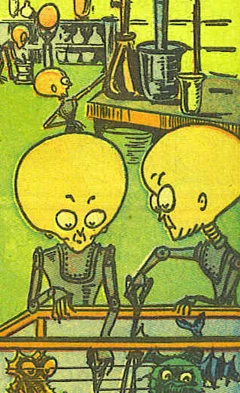
The Brain-Men of Mars (or Skomah) are brilliant humanoids with yellow skin, huge heads and skinny bodies. The Brain-Men are highly intelligent and technologically advanced with an insatiable curiosity concerning new gadgets and the behavior of other races. The Brain Men have a mutually beneficial relationship to Tripods (see Mutant Future page 100) which often act as transport and soldiers for the Brain Men. All Brain Men come equipped with mechanized exoskeletons (see below) to help their small bodies support the weight of their gigantic heads. Brain Men typically come equipped with Laser Pistols (Mark 2), and 1d4 trained Giant Ants or Giant Bats, Giant Lizards or Mansquitos.
In earlier ages of Mars the Brain Men had their own civilization located in underground cities. They ruled over most of Mars only occasionally venturing onto the surface and travelling to other planets (including Earth) to collect samples and victims for experiments. Though they have leaders (called the Great Skomahs), all of which are inventors of great renown, they are not normally an ambitious people. The Brain Men want to conduct research, tinker with new devices, and to be left alone.
Now in the era of Mutant Mars, the Brain Men have surfaced to be technicians for hire, merchants and wandering gadgeteers. These odd creatures can be found in any moderately advanced city, particularly Utopian Domes where they happily trade their knowledge and services for coin and a chance to test out their individual theories.
Mutations: Bizarre appearance (huge heads and tiny bodies), frailty, increased sense (touch), intellectual affinity (tinkerer), quick mind, plus 1d4-2 mental mutations.


Brain Men (Race)
Hit Dice: 1d4 per point of CON
Mutations: Bizarre appearance (huge heads and tiny bodies), frailty, increased sense (touch), intellectual affinity (tinkerer), quick mind, plus 1d4-2 mental mutations.
The Brain-Men of Mars (or Skomah) are brilliant humanoids with yellow skin, huge heads and skinny bodies. The Brain-Men are highly intelligent (+2 INT) and technologically advanced with an insatiable curiosity concerning new gadgets and the behavior of other races.  The Brain Men have a mutually beneficial relationship to Tripods (see Mutant Future page 100) which often act as transport and soldiers for the Brain Men. All Brain Men come equipped with mechanized exoskeletons (see below) to help their small bodies support the weight of their gigantic heads.
Brain Men adventurers and NPCs tend to be technicians for hire, merchants and wandering gadgeteers. These odd creatures can be found in any moderately advanced city, particularly Utopian Domes where they happily trade their knowledge and services for coin and a chance to test out their individual theories.

Mechanized Exoskeleton 
These gadgets act as a Power Beltpack that self-recharges at a rate of 1d4 discharges a day and corrects the effects of the Simian Deformity and Slow Mutant disadvantages. These exoskeletons can be worn under clothing and armor. These exoskeletons can be purchased only from Brain Men and must be specially fitted, costing 200 gp (100 for fellow Brain Men), and weigh a mere 5 lbs.


The Brain Men of Mars are inspired by the adventures of Stardust: The Super Wizard found in Fantastic Comics #6 (page 52-59) published by Fox Feature Syndicate and created by Fletcher Hanks. 

Monday, June 15, 2015

Mutant Future: Gadgeteering For Fun And Profit

Mutant Future is loaded with technological tidbits from the legendary TIME OF THE ANCIENTS. An era
when humanity (and things that look like humanity) created all manner of strange and wondrous devices. These devices, vehicles and robots occasionally surface from buried ruins, hidden Utopian Domes and even mad inventors bent on conquest.
The neverending search for artifacts...
But what about all of those super-smart Pure Humans, Androids and Mutants? Some of these persons (PC or NPC) can be extremely intelligent, and coupled with the right mutations and enough resources, why can they not make some technological wonders of their own?
The following rules are meant to allow particularly clever characters to make their own artifacts, using salvaged parts and what resources a post apocalypse gadgeteer can muster. The resulting items may not look exactly like the original, and in-fact may have very different functions and abilities, but it will work.


Artifact Creation Rules
To create his or her own artifacts, the character must be of at least 9th level and have a Tech Bonus of at least +30%. The character must have successfully identified a sample of the gadget, or one similar to it to attempt to create an item (Mutant Lords discretion).
The more complex an artifact is, the more time consuming and expensive the resulting item is. Use the following rule-of-thumb:

  • Complexity class 1 (Batteries, gadgets, energy weapons, energy-grenades, non-powered armor) cost 5,000gp and 2 months to make. 
  • Complexity class 2 (Vehicles, robots, powered armor) cost 10,000gp and 5 months to make. 
  • Complexity class (Computers, medical technology, other very complex technology) cost 50,000gp and 1 year to make. 
Upon completion of the technological marvel the newly made artifact, robot or vehicle will be of pristine condition and will function perfectly.

Weird Technologies
Some artifacts, robots and vehicles posses abilities that closely mimic mutations. Such items usually incorporate weird crystal arrays, orgone energy or things involving some sort of Unobtanium to make such powers work. Characters and Mutant Lords designing technologies that incorporate psychic powers should add more than a little weirdness to their inventions. A look through the strangeness that-is golden age comic books with give you some great ideas.
Such powers have an added cost, as follows:

Level 1 Powers (+1,000gp)
Echolocation
Night Vision
Thermal Vision
Ultraviolet Vision

Level 2 Powers (+5,000gp)
Ability Boost
Energy Retaining Cell Structure
Fragrance Development
Know Direction
Mental Barrier
Mental Phantasm
Metaconcert
Mind Thrust
Neural Telepathy
Shriek
Toxic Weapon
Unique Sense

Level 3 Powers (+10,000gp)
Chameleon Epidermis
Complete Wing Development
Control Light Waves
Control Weather
Damage Turning
Density Alteration (Others)
Disintegration
Plane Shift
Parasitic Control
Reflective Epidermis
Teleport
Temperature Control

Wednesday, June 3, 2015

Mutant Mars: Map In Progress

Just wanted to post the Mutant Mars map in its present stage of development. There is still a great deal to detail and name, but it is shaping up.

DISNEY & DRAGONS: D&D in Fantasyland

Many times, in recent years I have encountered would-be players of Dungeons and Dragons whose sole experience with the fantasy genre h...