Showing posts with label Pulp Space Opera. Show all posts

Wednesday, August 10, 2016

Mythos Space: The Star Spawn

Star Spawn
Star Spawn and a human rocket-jockey
Type: Outsider
Size: Huge
Intelligence: High (13-18)
Hit Dice: 20
Movement: 50/500 (Fly 60/600)
Armor Class: 26 
Attacks: 4 tentacles (3d8+2 + constrict), 2 claws (2d6+2) and bite (1d10+2)
Saving Throws: F0, R2, W2
Special: Immune to electricity, disease, poison and radiation, resistance to acid, cold and fire, psychic power resistance 90%, telepathy 100’, Vulnerability (Neutronium)
Environment: Any
No. Appearing: 1 (or horde 5d20)
Alignment: Chaotic Evil
XP Value: 1,300 (CL 26)
"Another race - a land race of beings shaped like octopi and probably corresponding to fabulous prehuman spawn of Cthulhu - soon began filtering down from cosmic infinity and precipitated a -monstrous war which for a time drove the Old Ones wholly back to the sea - a colossal blow in view of the increasing land settlements." -H.P. Lovecraft, At the Mountains Of Madness
The Star Spawn are the chief servitor race of Cthulhu and his cosmic kinfolk. They are a species that is built for space, hyperspace and for war. They are huge, tentacle beings whose brutal forms house shrewd and brilliant minds. These creatures are a mish-mash race created from biological "data" acquired by Cthaeghya (Cthulhu's half-sister). Star Spawn do not breath and have a pair of bat-like wings that allow them to propel themselves via the solar winds at 1 million mph through the vacuum of space. Also, once per day, a Star Spawn can plane shift itself (plus 500 pounds of objects) into hyperspace.  This allows these creatures to travel between stars in the same manner as a starship.
Once per minute, the Star Spawn can fire a focused cone of electromagnetic energy that causes all targets to make a Reflex save (or Drive and/or Pilot Aircraft check) or suffer 10d10 points of electrical damage. Electronics must make a save or be destroyed.
Star Spawn have the following supernatural powers: At will—akashic knowledge, blur, clairsentience, create undead, desecrate, dimension door, dominate, matter agitation, negation, polymorph self, putrefy, sensitivity to psychic impressions, speak with dead,transmute liquid, transvection; 3/day—metamorphosis, song of discord; 1/day— astral projection, raise tower.


STAR SPAWN IN MYTHOS SPACE
After the closing of the last Mythos War, the destruction of R'lyeh (and the possible “death” of Cthulhu), the vast legions of Star Spawn were cast adrift across space, and remain a menace to this day. Most Star Spawn serve Cthaeghya, and Idh-yaa (mate of Cthulhu) though a number of them also serve Cthylla, Ghatanothoa, Ythogtha, and Zoth-Ommog. These Old Ones are busy with their family politics as well as their conflicts with the forces of Hastur and Yig, and so are not an active threat to the Empire at the present time. Individual and small groups of Star Spawn can be found on remote worlds, often worshiped by an assortment of minor monsters such as Deep Ones (Lemurians) Gill Monsters,Monster Men, and weirder things. Sometimes they have accumuated a number of human followers in the form of mad cultists, degenerate tribesmen and power hungry politicians and space pirates. In any event, Star Spawn are dangerous and intelligent foes.
In war, Star Spawn emerge from Hyperspace in large hordes, using their natural speed and magic to great effect. They will typically seek to disable defenses and defending vehicles first, and using magic and their mobility to sew fear. Elder One and rival Great Old One temples are primary targets.


These rules use the Grit and Vigor Roleplaying Game by John Stater. An excellent game that uses the best part of old school games and the D20 systems for pulpy adventures. Check it out!

Tuesday, August 9, 2016

Mythos Space: Elderians of the 51st Century

ELDER THING
Type: Aberration
Size: Medium
Intelligence: High (13-15)
Hit Dice: 2 (6-8 hp)
Movement: 30 (Fly 10)
Armor Class: 13
Attacks: 2 slams (1d4) or by weapon.
Skills: Cast Magic Spell*, Chemistry, Communicate, Crack Codes, Display Knowledge, Hypnotize and Search.
Saving Throws: F15, R15, W11
Special: Survive vacuum of space, immune to cold, resistance to electricity and fire
Environment: Any
No. Appearing: Family (1d8)
XP Value: 200 (CL 3) 
“Six feet end to end, three and five-tenths feet central diameter, tapering to one foot at each end. Like a barrel with five bulging ridges in place of staves. Lateral breakages, as of thinnish stalks, are at equator in middle of these ridges. In furrows between ridges are curious growths – combs or wings that fold up and spread out like fans. . . which gives almost seven-foot wing spread. “-H.P. Lovecraft, At the Mountains of Madness
The Elder Things, or Elderians, are an alien species of pseudo-protozoans that colonized Earth one billion years ago, when multicellular life first appeared. These aliens are great planet seeders and terraformers, being responsible to much of the Earth-compatible and Terran analogue species found across known space. Elderians are naturally immortal, and can travel across interstellar distances under their own power, though many use asteroid starship “arks” to carry themselves, equipment and servant creatures (usually Shoggoths) across space and hyperspace.
All Elder Things have all of the abilities of a Scholar of equal level to their hit dice (see Grit and Vigor Rulebook), with many Elderians having the Occultist* Scholar subclass. Because of this, all Elderians can be expected to have a wide range of high tech equipment (see here and here). Chemical and genetic engineering are major sciences of the Elderians, and they will continue to tinker with new life-forms wherever they dwell. They created the shoggoths to be their all-purpose slave race, and though rebellions do sometimes occur, these creatures are still a major servitor of the Elderians.

ELDERIANS IN THE 51st CENTURY
In the 51st Century, the Elderians are still players in the cosmic scheme of things, though they are reclusive and difficult to communicate with. Despite their very different physiology, the Elderians share many psychological traits with mankind. They have families (close acquaintances rather than biological kin), art, scientific curiosity and a sense of compassion. However, they remain aloof and distant due to the habit of some humans to actively collude with the the Outer Gods, Old Ones, the Star Spawn (the species of Cthulhu) and the MiGo, all ancient enemies of the Elderians. The only contact made with the Elderians is by individuals, tramp merchants and small colonial governments.
Elderian colonies can be found hidden in star systems across the galaxy. These worlds are always host to massive stone cities and vibrant ecosystem compatible with Earth life (though rarely safe). Many such worlds with life around a Precambrian to Paleozoic level of development (Ocean or Jungle Planets). Manners are strongly advised.
Most Elderian colony sites found across the Empire and the Fringe are ruins, long since overgrown. Ths is the result of the Elder Things ancient wars with the Star Spawn, Yithians and the MiGo. Such planets are always compatible with Earth-life with a "Lost World", sometimes hosting dinosaur-like beasts and even hominids. Wild Shoggoths and other ooze monsters are also always present.


SHOGGOTH
Type: Ooze 
Size: Huge 
Intelligence: Non- High (13-18)
Hit Dice: 30 (90-120 hp) 
Movement: 30 (Climb 30) 
Armor Class: 13 
Attacks: Slam (3d6) 
Saving Throws: F3, R3, W3 
Special: Immune to mind effects, resistance to weapons 
Environment: Underground or Marine 
No. Appearing: Solitary 
XP Value: 3000 (CL 31) 
“It was a terrible, indescribable thing vaster than any subway train—a shapeless congeries of protoplasmic bubbles, faintly self-luminous, and with myriads of temporary eyes forming and un-forming as pustules of greenish light all over the tunnel-filling front that bore down upon us, crushing the frantic penguins and slithering over the glistening floor that it and its kind had swept so evilly free of all litter.” -H.P. Lovecraft, At the Mountains of Madness
Shoggoths are the primary, all-purpose slave race of the Elderians, and can be found on Elderian asterod ships and colony worlds. While the basic shoggoth is approximately 15-feet in diameter when formed into a sphere, larger specimens exist. Being protoplasmic, shoggoths can form body parts as they need them, though they always have numerous eyes floating in their black, slimy form. 
Most Shoggoths are mindless brutes, controlled by their masters via magic and chemical control. Over time however, shoggoths develop intelligence and seek to rebel against their creators. When this occurs, such creatures are terrible foes, and require great effort to subdue.


These rules use the Grit and Vigor Roleplaying Game by John Stater. An excellent game that uses the best part of old school games and the D20 systems for pulpy adventures. Check it out!

Monday, June 20, 2016

Mythos Space: Planets of The Cosmos


In the universe of Mythos Space, mankind has been settling known space for almost three hundred years, Grit and Vigor RPG for a backdrop. and with abducted Earth hominids, human-like aliens, and Quantum Time Distortion, some of the far flung colonies out there have been out there for quite a long time. These rules use the

MYTHOS SPACE PLANET KEY
Below are the basic rules I will be using in regards to planets in the Mythos Space campaign setting. I am using terms and concepts taken from Planet Adventure stories from the 1920's to the 1970's.
Planet Name: The worlds name. Usually decided by the settlers and/or their corporate backers.
Planet Type: Planets in Mythos Space and Pulp Age fall into broad classifications, as follows:
City Planet (Ecumenopolis): Urban sprawl has taken over the entire surface of a world. Often has a population in the trillions, though not always. Usually has a Garbage Planet in the same system or even in its lower levels. Terrain Types on such worlds include cliffs, hunger, thirst, vermin and wear and tear (see Grit and Vigor pages 83-85). Life-forms on such worlds are usually only in the underworld/sewers.
Cloud Planet: These worlds are entirely made of gas, much like Jupiter or Saturn. If something or someone lives here, either it can float or fly, or there are hover-cities. Either way, watch that first step. Terrain Types on such worlds include cold, poison, falling and getting lost (see Grit and Vigor pages 83-85). Life on such worlds must be capable of flight (and usually huge), like Sawsnarks.
Dark Planet: Like the Desert, but owe their lack of plant life to perpetual night; usually due to constant opaque cloud cover or spooky ominous fog. If inhabited, this might be the product of industrialization run amok, with the clouds being clouds of pollution. Terrain Types on such worlds include cold, thirst, poison, wear and tear and the dangers of getting lost in the dark (see Grit and Vigor pages 83-85).
Death World: Not a biome in and of itself, but can be any of the aforementioned types. This is a world where Everything Is Trying to Kill You, but you still have compelling reasons to go there. Terrain Types on such worlds include all dangers (see Grit and Vigor pages 83-85). These worlds can have any and every sort of monster.
Desert Planet: These look like the cheaper parts of California, and are thus very common. If it can sustain life, a desert planet will have aliens that act like Bedouin or Touareg, and a thriving black market on water. Terrain Types on such worlds include Cold (at night), dry heat, thirst, wear and tear and exposure to radiation (see Grit and Vigor pages 83-85).
Forest Planet: A planet whose land surface is mostly or entirely covered by temperate to sub-tropical forest. Earth several million years ago could be considered a Forest Planet, since the warmer atmosphere and higher atmospheric humidity levels meant much more of the planet was covered in lush forest. Terrain Types on such worlds include cold and ice in the winter, starvation and thirst, storms, vermin and wear and tear (see Grit and Vigor pages 83-85). bbbbb
Garbage Planet
Garbage Planet: The entire planet is being used as a dumping ground for useless waste. Likely to act as home for scavengers looking to make a quick buck, treasure hunters seeking some long-lost treasure, and large numbers of mercenaries and criminals. Terrain Types on such worlds include cliffs, disease, poison, thirst, vermin, wear and tear (see Grit and Vigor pg 83-85).
Ice Planet: Planets whose entire surfaces look like Greenland glaciers. Somewhat justified, as there actually are frozen-over planets and moons (for example, several moons of Jupiter and Saturn). Really cold Ocean Planets can become an Ice Planet. Terrain Types on such worlds include cold, ice, starvation and thirst, storms and wear and tear (see Grit and Vigor pages 83-85). Animals common to the Ice Planets include prehistoric mammal analogs, burrowing monsters and Yetis.
Jungle Planet: Mind the bugs, they are positively enormous. Expect most things that crop up in Hungry Jungle stories. Terrain Types on such worlds include humid heat, starvation and thirst, vermin and wear and tear (see Grit and Vigor pages 83-85). The dangerous animals most associated with jungle planets are insects, giant apes, and reptiles, even dinosaurs.
Ocean Planet: These tend to have just a few, if any, mountains tall enough to breach the surface and make islands; if there are, they're prime beachfront vacation spots. Terrain Types on such worlds include cold, thirst, storms, wear and tear and the possibility of drowning (see Grit and Vigor pages 83-85).
Mountain World: These planets are all or nearly all hills and mountains, with most life (if any) living in nooks and crannys between the peaks or underground. Terrain Types on such worlds include cliffs, cold and ice, dry or humid heat, starvation and thirst, storms, vermin and wear and tear (see Grit and Vigor pages 83-85).
Swamp Planet: Like the Jungle, but easier to lose your shoe. (Or your ship). Terrain Types on such worlds include humid heat, starvation and thirst, vermin and wear and tear (see Grit and Vigor pages 83-85). The dangerous animals most associated with swamp worlds are insect swarms, plant monsters and reptiles, even dinosaurs.
Twilight world (Tidally Locked Planets): While not truly single-biome, they traditionally have only about three: blazing hot desert on the day side, temperate zone of perpetual twilight at the day/night terminator, and sub-freezing wasteland on the night side. Terrain Types on such worlds include cold, heat, thirst, storms, wear and tear and getting lost in the dark (see Grit and Vigor pages 83-85).
Volcano Planet: Defined by earthquakes, smoke, rivers of lava, and lots and lots of unchained mountains you don't want to climb. Terrain Types on such worlds include cliffs, dry heat, poisonous fumes, fire, wear and tear (see Grit and Vigor pages 83-85) and the danger of lava.
Sector: In stellar cartography, a sector, which s referred to as a star sector or space sector, is a region within the Milky Way Galaxy. Sectors are composed of an area and volume encompassing several light years and typically contain several star systems. Some examples are Bai Hu Sector, Crab Nebula, Pleiades Sector, and Sector 8023.
System: The planets Star System or the name of the planets Sun(s).
Atmosphere: The planets atmosphere, if any. The standard classifications are as follows:
None: No atmosphere to speak of. Instantly lethal to anyone without a spacesuit.
Terran Standard: Air suitable for earth life.
Thin: Like high altitudes, such places may require an oxygen tank. Otherwise characters must make a Fortitude save each round of activity, or be fatigued.
Toxic: Character must make a Fortitude save each round or suffer the effects of poison (roll 1d4 for poison intensity, see Grit and Vigor page 62).
Gravity:  A planets gravity is an important factor. Though greater extremes exist, these are the basics:
High Gravity: Item weights doubled, weapon ranges halved, attack rolls at -2 for non-natives, falling damage is doubled.
Low Gravity: Item weights halved, weapon ranges doubled, attack rolls at -2 for non‐natives, falling damage halved.
Standard Gravity (Earth-Like): No changes.
Day Length: In 60 minute hours.
Year Length: In 24 hour days.
Population: Both the numbers (and a percentile breakdown of the planets races).
Government: A planet can have any sort of government, but the following are the most common:
Autocracy: A government under the control of a single leader. Usually a monarch or dictator.
Bureaucracy: A society ruled by rules and paperwork. Its like having the DMV running a planet.
Democracy: A society ruled by the majority of its citizens.
Plutocracy: A society ruled by the rich. Usually has medieval style ranks such as Duke, Earl etc.
Republic: A society ruled by elected officials.
Technocracy: A society ruled by experts such as scientists and engineers.
Theocracy: A society ruled by religious or spiritual institutions.
Tech Level: The level of technological equipment available to the citizens of the planet. Common types are:
Stone-Age: Stone, bone and wood implements or the equivalent.
Pre-Industrial: Everything from Ancient Egyptian to Renaissance level.
Industrial: Industrial Revolution up to WW2 era technology.
Space-faring: Capable of interplanetary travel and space-borne industry.
Hyperspace: Access to hyperspace and its weird energies. Some magic-like powers.
Transcendent/Singularity: Beyond human understanding.

So for example, here is a writeup for our very own Mars in the 51st Century:

Planet Name: Mars
Planet Type: Desert Planet.
Sector: Imperial Space.
System: Sol System. 
Atmosphere: Thin 
Gravity: Imperial Standard (though slightly lower).
Day Length: 23 hours 56 minutes.
Year Length: 687 days.
Population: 8m (20% Human, 30% Mutant, 10% Serpentmen, 25% Android, 10% Aihais, 5% Other)
Government: Autocracy (Duke Guan Yu VIII)
Tech Level: Hyperspace.
Mars is a major world in the Sol System, and the site of a large factory and Imperial Ship-works. Though terraforming has been underway for centuries, the world is still dry, cold and harsh. For Eons the world has been in sharp decline, and the original inhabitants were forced to live underground in the planets abundant lava tubes as well as artificial caverns and tunnels. Since the coming of Earth settlers, several surface towns have been re-settled. Overall Mars has the feel of being bot new and lively and old and tired at the same time. Several places of note are:
Ignarh: The Commercial Metropolis of Mars and seat of the Imperial representative Duke Guan-Yu VIII. It is a bustling city that is mostly underground, but has numerous domes poking up to the surface. Law and order here is brutal and efficient in the rich quarters, but crime and graft are rife in the rest of the city. Gangs of mutants and aliens and the worst sorts of crimes like organlegging, slavery and worse are common. 
Lakkdarol: One of many trade towns on Mars, but one with its own small spaceport. The town is rough-hewn, jumbles slum, though it has a lively market and a number of interesting old temples. Located near the ancient Cydonian ruins, Lakkdarol is especially liked by smugglers, pirates, runaway slaves, exiled Space Patrol officers and more than a few adventurers. 
Ravormos: This is an underground city still ruled primarily by the Martians, and the site of the great Temple of  Sleep, where the Great Old One Vulthoon (Gsarthotegga) sleeps. This temple houses many strange arcane technologies and alien plants, and houses deep arcane knowledge. Imperial forces leave this town mostly to itself, though efforts by the Undying and other mystic societies to establish better relations are underway.

-----------------------------------------------------------------------------------------------

Next: Setting details on several planetary Systems, More Starships, and Rogues Gallery characters. And much MUCH more! So stay tuned.


Sunday, May 22, 2016

Mythos Space: Mutation and Freak Families

Across settled space there are all kinds of isolated colony worlds, asteroid colonies and generation ships. And in such places, especially with hyperspace, radiation, limited gene-pools and alien ecosystems, a number of startling mutations become not only possible, but downright likely! Most mutations are minor things, like harelips, myopia, extra fingers/toes, skin disorders, limb length discrepancies or other medical conditions that can be explained away through unusually low Attributes or just as the players and Venture Masters imagination. But some are far more extreme, and call for greater attention.
Freak Families are bloodlines of people (HUMANS) who have a predominant mutation that is dominant in their bloodline. That-is, they breed true among themselves, or if they mate with people outside of their respective families. These Freak Families often live in larger communities, working in a variety of roles, often used as laborers, entertainers and a number of low-paying positions.
These are not the psychic-powered mutants you get in many sci-fi games. But there is no reason why these people cannot also be Psions or have Psychic Wild Talents as detailed in the Appendix of Grit and Vigor.
A few of the Freak Families of Mythos Space are:


Gigantes
Type: Warrior
Munchkin (left) and Gigante (right)
Size: Large
Intelligence: Average (9-12)
Hit Dice: 4
Movement: 20/80
Armor Class: 16
Attacks: Fists (1d6) or by weapon
Saving Throws: F10, R14, W15
Skills: Bend Bars, Break Down Doors, Lift Gates.
Environment: Any
No. Appearing: 1d8
Alignment: Neutral
XP Value: 200 (CL 4)
Gigantes (Goons, Lugs, Mooks, etc) are humans that are afflicted with Acromegaly or Gigantism, resulting in people between 7 and 9 feet in height. Exaggerated features such as heavy facial bones, big jaws and distorted ears are common. Despite the fact that many of them suffer from all manner of aches and pains, they are usually gentle, soft-spoken people. Regardless of their behavior and abilities, most people see all gigantes as brutish and quickly accuse them of all sorts of wrongdoing, just because of their size.
Gigantes are particularly plentiful on rugged planets, where the harsh climates make their great strength an asset. In the Bai Hu sector, Gigantes are the most plentiful on Skarl in the Kaiwan System and on Mnar of the Bullseye system. They are widely sought out as soldiers, guards, thugs and enforcers wherever they dwell. Along the trade routes, more than a few Gigantes can be found piloting Tramp Freighters and as mercenaries..

GIGANTES CHARACTER CREATION
Gigantes modify their starting ability scores as follows: Str +4 (max 20), Dex -2, Wis -1 and Cha -2. Gigantes are large-sized persons with a base speed of 20 feet. They have a knack for Break Down Doors and Lift Gates. Gigantes have a +25% increased carrying capacity. They are large creatures, and  must pay double the normal price for armor and clothing. Gigantes suffer a -2 penalty on Reflex saving throws due to their distorted legs and bodies. Gigantes speak any language that normal humans can. They are limited to 9th level, except as fighters, at which they can advance to 11th level.


Munchkins
Type: Scoundrel
Size: Small
Intelligence: Average (9-12)
Hit Dice: 1d6
Movement: 45/220
Armor Class: 11 (leather jacket)
Attacks: Switchblade (1d4)
Skills: Hide, Move Silently
Saving Throws: F13, R15, W15
No. Appearing: 1d20
XP Value: 100 (CL 2)
Munchkins are form of mutated human that is of unusually short stature (3-4ft) that is afflicted with hypopituitarism (or pituitary dwarfism). These "little people" are quite numerous both in the Sol system and beyond. And though widely accepted they are often treated with the same affectionate condescension extended to children, a disrespect which they rightfully dislike but will often play up in an effort to catch enemies off-guard. Munchkins are well-proportioned and hearty, and are often possessing of striking features and excellent minds. They are often found in mixed communities and working as entertainers and as assorted clerks and functionaries.
Munchkins can be found across settled space and on colony ships. They are particularly plentiful on asteroid and deep-space colonies. Large numbers of Munchkins can be found on Baktun Station in the Chakumuy system, Ona in the Urizen system and in many other places. Along the trade routes there are many Munchkin captains and pilots, with such "Half-Pint Heroes" often becoming the stuff of folklore.

MUNCHKIN CHARACTER CREATION
Munchkins modify their starting ability scores as follows: Str -1, Dex +2, Int +1, Cha -1. They are small persons and have a movement rate of 30. Munchkins have a knack for hide and move silently and have -25% reduced carrying capacity. They speak any language that normal humans can. Munchkins are limited to 9th level, except as scholars, at which they can advance to 11th level.


Pinheads 
Type: Scoundrel
Size: Medium
Intelligence: Low (3-8)
Hit Dice: 2d8
Movement: 45/220
Armor Class: 11 (Heavy clothes)
Attacks: Club (1d4+2), or fists (1d2+2)
Skills: Bend Bars, Break Down Doors, Endure
Saving Throws: F12, R15, W16
No. Appearing: 1d20
XP Value: 100 (CL 2)
Pinheads are humans that are born with microcephaly, a neurodevelopmental disorder that leave them with a small brain and skull. They stand about four feet in height and usually have protruding noses and ears. Though widely disliked, pinheads are affectionate, exuberant, sociable people who love dancing, singing and spending time with friends and family.
Pinheads are most numerous on industrial worlds, working as low-wage drudges and heavy-laborers. They are well-regarded as hard workers and loyal employees. However they are often paid poorly and given the less pleasant tasks. In the Bai Hu sector, Pinheads are most numerous on the planet Skarl in the Kaiwan system, the planets Khem and Mnar in the Bullseye system and in the Ori star system. Along the trade routes, Pinheads make excellent crews on heavy freight haulers and on mining ships but very few of them ever captain or pilot their own vessels.

PINHEAD CHARACTER CREATION
Pinheads modify their starting ability scores as follows: Str +2, Int -2 and Cha -1. Pinheads are medium-sized persons (though short) with a base speed of 30 feet. They have a knack for Endure. Pinheads are disturbing for most people, and so the reactions of human NPC's always begin as hostile (see Grit & Vigor page 69). They speak any language that normal humans can. Pinheads are limited to 9th level, except as rogues, at which they can advance to 11th level.


Wolfmen 
Type: Warrior
Intelligence: Average (9-12)
Hit Dice: 2d8
Movement: 45/220
Armor Class: 10
Attacks: By weapon or fists (1d2+1)
Skills: Bend Bars, Break Down Doors, Lift Gates
Saving Throws: F12, R15, W15
No. Appearing: 1d6
XP Value: 200 (CL 3)
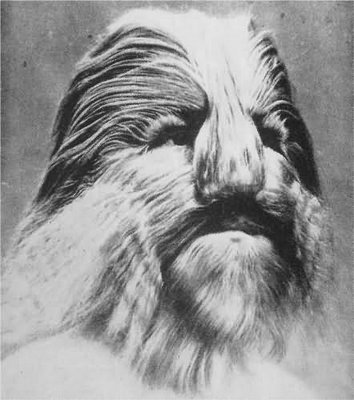
Wolfmen are a type of freak that is afflicted with congenital hypertrichosis (also called Ambras syndrome) and are called Wolfmen because their appearance is similar to the mythical werewolf. Some werewolf families resemble lions or even apes. Of all types of freaks, wolfmen are the healthiest but are still not considered fully human in the eyes of baseline humans. Many play up their animal-like stereotype, using it to gain advantage and to maintain mystique.
In the 51st century, Wolfmen are most numerous on rugged colony worlds, especially ones with cold or temperate climates. They often adhere to many of the stereotypes of Wild Men of the Woods, with more than a few keeping and raising dogs or other wild beasts for hunting and war as well as to confuse their enemies. In the Bai Hu sector, Wolfmen are most numerous on the colder moons of Demhe in the Bullseye system and on Skarl in the Kaiwan system but can be found almost anywhere. A great many Wolfmen work the spacelanes, especially on tramp freighters and even in the Space Patrol as enforcers.

WOLFMAN CHARACTER CREATION
Wolfmen modify their starting ability scores as follows: Str +1, Con +1, Cha -2. Wolfmen have a natural armor class of 12, and suffer only 1/2 damage from cold attacks. They speak any language that normal humans can. Wolfmen can advance in any class to 11th level.


Monday, May 9, 2016

Mythos Space: Eggbot Walker (Mecha)

Eggbot Walker
Class: Light
Size: Large
Hit Dice: 15 (53 hp)
Armor Class: 19 (Steel 0.5)
Speed: 12 mph (100’)
Targeting: +1
Maneuver: +3
Weapons: 2 x light lasers, 1 x heavy machine gun (rifle), 2 x light melee (fist).
Cost: $6,000.00

The Eggbot Walker is a type of mecha that is in wide use on colony worlds, where heavy labor in dangerous environments is common. These vehicles are constructed from kits that make use of sleep-pods and other "leftover" components along with specialized parts. The pilot sits in the vehicles cockpit and can move about as smoothly as a bulky human. These mecha are used as two-legged tractors and as mechanized troops.
As combat units, these 10ft mecha are quite useful in battling the many strange lifeforms found across the far-flung colonies. They are especially appealing to colonists, as they are cheap and relatively easy to repair with scrounged parts (+2 to repair checks). Also, the low-tech aspects of the mecha are fairly resistant to infovore infestation.
All Eggbot Walkers come with the buit-in equivalent of an Advanced Breathing Apparatus (24hrs of air), Communicator and Motion Detector. These devices are integral, and cannot be removed. See Gadgets and Gizmos for details.

These rules make use of the Grit and Vigor RPG. See the vehicle rules on page 53-58 of the Grit and Vigor rulebook for details.

Saturday, April 30, 2016

Mythos Space: The Thuum'ha of Ib

Thuum'ha (Ibians)
Type: Humanoid
Size: Small (2 1/2 to 3 feet)
Intelligence: Average
Hit Dice: 0
Armor Class: 13 (light armor)
Attacks: By weapon
Movement: 30/300
Saving Throws: F14, R 16, W16
Environment: Underground, spaceship, asteroid colony
No, Appearing: Team (2d12)
Alignment: Neutral
XP 25 (CL 0)
"The beings of Ib were in hue as green as the lake and the mists that rise above it.... They had bulging eyes, pouting, flabby lips, and curious ears, and were without voice." -H.P. Lovecraft, The Doom That Came to Sarnak
The Thuum'ha (also called Ibians) are a race of alien beings originally from a lost homeworld called Ib. They dwell almost entirely on starships and asteroid colonies, travelling endlessly and trading their advanced technology with other species. The Ibians are green or green-blue with large heads, bulging eyes and large lips. Their voices are pitched lower that human ears are accustomed, making them a race of low-talkers.
Thuum'ha civilization is centered around study, particularly psionic powers and technology that uses noetic energy. They are completely lacking in empathy for other species, but are nonetheless inquisitive, and so can make an accord with other races on this account. They are also deeply avaricious, and will do just about anything for a profit. These aliens build elaborate devices, cybernetics, starships and robots, but have also been known to experiment in arcane pursuits such as the making of undead or magical and techno-magical devices. They are also notorious slavers.
Ibians organize themselves into research teams of 1d20 x 20 scholars (usually Inventors or Psions) plus additional fighters equal to 100% of the scholars. For every 40 soldiers in a tribe, there is an additional sub-commander with 1 HD. Teams are led by scholars with 2 HD and 2d6 bodyguards with 1+1 HD each.

IBIANS CHARACTERS
Ibians modify their starting ability scores as follows: Str -2, Dex +1, Con -1, Int +1. They are small creatures but have a standard speed of 30 ft. per round. Ibians can see in darkness up to 120 feet and can operate in zero-gravity conditions without any penalty, including combat, saving throws and all task checks. Their rubbery flesh give them a natural +1 bonus to Armor Class. Ibians have a knack for swimming.
Ibians They speak Ibian and may also speak Elderian, Chinese and Naacal languages. They can advance in any class and can multi-class as fighter/scholars, scholar/rogues and fighter/rogues.

This material is using the Grit and Vigor roleplaying Game by John Stater. 

Friday, April 29, 2016

Mythos Space: Mandroids

Man-Droids
Type: Undead
Size: Medium
Intelligence: Low (5-7)
Hit Dice: 2
Movement: 45/220
Armor Class: 14
Attacks: 2 claws (1d3) or by weapon
Saving Throws: F15, R15, W12
Special: Cannibalization, immune to electricity, regeneration
Environment: Underground, sewers, industrial wasteland
No. Appearing: 1d8
Alignment: Chaotic Evil
XP Value: 200 (CL 3)

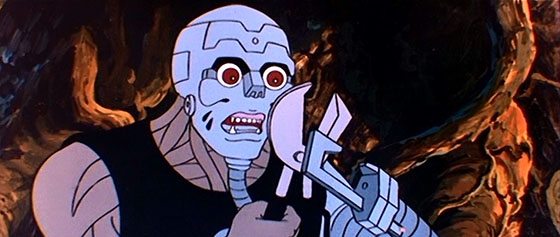
Mandroids are undead monstrosities that are the result of scientific and magical experiments gone awry. While they were once human, their beings have become mingled with cybernetic and robotic parts and they are now demented and evil. These creatures typically haunt the edges of industrial sites, the lower tiers of factory planets, sewers and mining colonies, looking for space parts. Mandroids know whatever languages they knew as human beings and 10% of them can communicate in the binary language of machines as well. It is not uncommon for the speech of a mandroid to be heavily accented or slurred by mechanical and electronic sounds.
When a mandroid slays a humanoid or android opponent, it can cannibalize the corpse for spare parts in the next round, adding the flesh and robot parts to its own body. For every three corpses a mandroid cannibalizes, it gains 1 Hit Die. The mandroid only advances by cannibalizing the corpses of creatures whose Hit Dice or levels are equal to or greater than its own current total. A mandroid that reaches 6 HD it becomes a Greater Mandroid. All mandroids can also attach cyborg and robot body parts in this fashion (VM's discretion).
A Greater Mandroid gains an AC of 21, and is immune to cold and radiation. They have all of the standard mandroid attacks, but 2d4 cybernetic implants (each with 1 or more enhancements). A greater mandroid can reach a maximum of 14 HD through cannibalizing. A humanoid or android slain by a greater mandroid (and not cannibalized) rises as a 2HD mandroid loyal to its creator. The new mandroid becomes an evil creature under the control of its master and murderer.

Dibs on the liver!
Note: These rules are designed for use with the excellent Grit and Vigor RPG by John Stater. Its an excellent game that is based off of the d20 system, but has a strong element of the grittier sort of "old-school" games. The Mandroids are from the 1985 animated film Starchaser: The Legend of Orin. A fun movie that sought to ride on the initial Star Wars craze.

Monday, April 11, 2016

Mythos Space: Arms and Equipment Pt2

As promised, here are some more devices that are useful to adventurers in the universe of Mythos Space. Most of these devices can be purchased in the markets of settled worlds that have a spaceport. All of these rules are designed for use with the Grit and Vigor tabletop roleplaying game by John Stater.

GADGETS AND GIZMOS
These are devices that have use in both industry, policing duties, colonial settlements and adventures! Those devices that list a power source are referring to those found in This Article.
Advanced Breathing Apparatus: These apparatus include a backpack mounted air tank. Tanks are good for 10 hours of use. The apparatus renders the wearer immune to gaseous toxins, including poisonous gas, inhaled radiated dust, and airborne diseases. Cost: $300.00 /$20.00 per additional tank of air
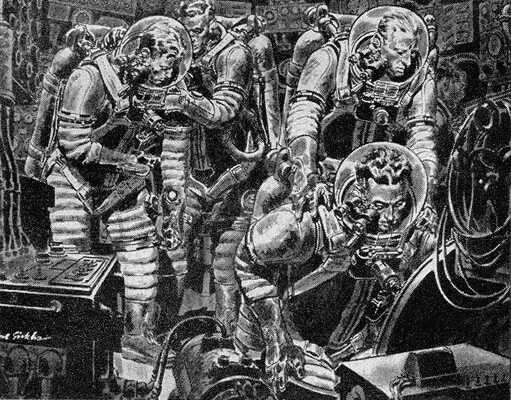
The right tool for the right job.
Antitox: This drug completely dilutes and cleanses poisons and chemical toxins from the system 2 rounds after injection and removes all negative effects. Cost: $2.00.
Communicator: These  communications devices are similar to walkie-talkies, to headset communicators or hand-held gizmos with similar parameters. A typical communicator uses either radio or microwave emitters/receivers, giving a range from 1d10 miles and weighs about 1-2 pounds.
Power Source: Power Cell. Cost: $10.00 (2)
Diagnostic Scanner: This hand-held electronic device, when used within 10 feet of a given subject (the scanner must be directed towards the target), will scan its bloodstream, electric impulses, and general chemical content with a variety of sophisticated sensors. The scanner has a compressed memory bank filled with a large library of diseases and general illnesses, and the information gleaned from the scan is cross-referenced with its memory bank to diagnose whatever disease or sickness (if any) is affecting the target. The diagnostic scanner detects and accurately identifies diseases, chemical contaminant levels, the presence of parasitic infestations, radiation levels, broken bones, degenerative genetic illness, poison, etc. In game terms this device will give anyone with the Treat Injury skill a +10 bonus to all such roles. Power Source: Beltpack. Cost: $50.00
Force Screen Belt: This priceless artifact creates a reactive force field around the wearer. While energized, the shimmering force field resists all forms of damage, absorbing the first 20 points of damage per round. Power is only used when and if the wearer is struck. The energy field negates all other forms of powered shields worn by the user. Power Source: Plutonium clip. Weight: 3 lbs. Cost: $600.00.
Healing Pack: This phenomenal device appears to be a small hand-held pack with dials and lights on it, the size of an old-style calculator. The pack, when held over a serious wound and activated, begins to beep and blink, and almost “magically” heals the wound (in fact, it emits a specialized radiation wave that accelerates cellular regeneration activity); it sutures open cuts, mends bones, replaces tissue, etc. A single discharge of energy heals the subject of 3d10 hit points instantly. The device requires power, however, and it cannot cure diseases, nullify poison, or bring subjects back from the dead. In addition, it has a flat 25% chance of malfunctioning if used on any form of non-terrestrial lifeform (Aliens), instead inflicting 1d10 points of damage from its use. A healing pack weighs 2 pounds. Power Source: Minifusion cell. Cost: $60.00.
Hologram Projector: This item appears similar to a flat black trophy stand, with a button or dial concealed inconspicuously on the front, back, or bottom. When the button is pressed an emitter creates a 3D holographic image, floating roughly three inches to a foot above the unit. The image created rotates a full 360 degrees over the course of thirty seconds. The image programmed into the hologram projector can be virtually anything; a commemorative image of a popular movie star, medical diagrams, flashy advertisements, a flag billowing in the wind, etc. A small port on the side permits a different image card to be inserted if desired. Power Source: Power Cell. Cost: $200.00.
Infra-Red Goggles: These appear as heavy silvered goggles. The lenses are filled with a glycene coating, filtering out all light except for that produced by infra-red. These goggles allow the wearer to clearly discern heat sources in the dark as the mutation thermal vision to a distance of 240’. These goggles weigh 2 pounds. Cost: $100.00.
Medi-Spray (I, II): This magnificent miracle drug is dispensed in small handheld canisters with a nozzle at one end and an activation button on the opposite side. Such canisters come in a variety of colors and shapes, but there are two main medical variations of the basic drug available, wound healing and spore neutralization. The first kind (I) sprays a liquid-form artificial “flesh” onto any wounded area, which quickly bonds and heals the wound (heals 2d8 hit points per dose); the second (II) sprays a white-cell agitator that fights any and all forms of spore infestation or other infections with 100% effectiveness. All Medi-sprays optimally have 10 doses of spray; they cannot usually be reloaded, and are disposable. Cost: $20.00 (type I), $30.00 (type II).
Motion Detector: This item appears to be a fanciful metal device, with a glass T.V. tube on its topside. The device, when activated and pointed in a certain direction, detects all motion in a cone up to 50’ long and 30’ wide at the terminal end. Things that are moving appear as dots on the screen, showing their relative position in the cone and the rate of their speed. The detector will only detect motion by things no smaller than a mouse. A motion detector weighs 4 pounds. Power Source: Beltpack. Cost: $50.00.
Power Fist: This appears to be a single heavy black metal glove, perhaps spiked or studded with a fine chrome trim. The fist is a perfect exoskeletal covering for the human fist, and is, in effect, a power-assisted limb. The power fist allows the wearer to grip far more powerfully than a normal human fist, able to crush the likes of a metal power clip in a single motion. This weapon acts to magnify the strength of the user in melee attacks (or feats of strength), giving an enhancement bonus of +4 to the wearer’s Strength. If two power fists are used, the bonus increases to +8, but only for two-handed operations (such as wielding a two-handed weapon, or using both hands to bend bars). A power fist weighs 8 pounds. Power Source: Beltpack or backpack. Cost: $150.00 each or $250.00 for a set.
Regeneration Tank: This most advanced of all medical devices is a large immovable tank, filled with a special chemical fluid that accelerates the regenerative capabilities of the human body. Any patient submerged in the regen tank is sustained by the chemical. The body is kept alive in much the same manner as in a womb, relying on umbilical support from the tank’s machinery (these automatically attach to a patient). Fluid in the tank causes wounds to heal and ruptured or damaged organs to regenerate. Such devices require a great deal of power to operate, and the patient is effectively unconscious and vulnerable while immersed in the tank. The healing abilities of the tank are dependent on the damage suffered. A person with 50% of his hit points will always be healed (100% chance), with a 25% drop in the chance for every 1/4 of hit points lost from that point on. Fatal injuries are not reversed, but those with potentially fatal consequences, such as diseases, are. Rumors abound about a special type of regen tank that was capable of bringing someone back from the dead if used within 24 hours of death, though such reanimation tanks are likely the inventions of unhinged minds. Power Source: Power pack. Cost: $1000.00.
Robot Dog: These dogs look and act like normal dogs, but are actually robots. They may appear mechanical or natural, depending on the model and mission. Use of these robots requires the Sidekick Feat and the purchase of this robot.  Cost: $300.00
Space Suit: These suits supply complete protection from space, and comes with a Advanced Breathing Apparatus and n air tenk. The suit is not armor, and provides no protection against weaponry of any type. However, the suit is self-sealing. If penetrated, the wearer suffers any damage incurred by weapons, but is still considered protected from the dangers of vacuum, radiation and temperature extremes. Space Suits look much like coveralls and can fit under a jacket or bady armor. Cost: $100.00.
Survival Kit: This type of item was generally only issued to soldiers in the field, but many types are available. The typical kit contains a water-purification bag, a simple sewing kit, a book of 20 waterproof matches, a compass, four gobs of chewing gum, eight pieces of sweet candy (no nutrition, but raises energy level due to sugar content), a razor blade and holder, and a single ten-dose canister of medi-spray. A survival kit weighs 10 pounds. Cost: $15.00.
X-Ray Goggles: This form of super-science advanced eyewear permits the wearer to see into and through solid matter. The wearer can see through a stone wall and up to 30 feet. The wearer may see 60 feet if looking through wood and other low-density material. A 10 foot squared area (100 square feet) can be visually examined each turn, and any secret doors, hidden recesses, or traps will be evident. Lead or gold will block x-ray vision. Power Source: Power Cell. Cost: $100.00.

VEHICLES, LAND
Such vehicles run the gamut of animal-powered carts up to motorcycles, hight-speed cars and land rovers. Most are common thruought the settled worlds of Mythos Space and have the same costs, stats and rules as those found in chapter ??? of the Grit & Vigor RPG.

HOVER VEHICLES
These vehicles are common on any world with an active spaceport. They travel by use of an antigravity inductor engine, fueled by a mini-fusion cell. They come in similar forms to more primitive vehicles, including hoverbikes, hovercars, hovertrucks, and hoverbusses. As these vehicles run for a long time on a single mini-fusion cell and need little maintenance, they are very popular on colony worlds.
Hoverbus.
Most of these vehicles have fairly simple controls, similar to land-vehicles, and can be flown with either the Drive or Pilot skill, whichever is highest. Some vehicles have robotic controls, with programmed behavior or even artificial intelligence, though these are rare since the Mythos Wars (for fear of Infovore Infestation). Vehicles may have armor and other characteristics similar to robots.
Some Hover Vehicles are:
Hoverbike: Like a motorcycle, but able to fly. These vehicles have an open cockpit, requiring special gear and/or an independant air supply. Size: M, HD: 2, AC: 16, SPD: 250 mph, ACC: 125, MVR: +2, CP: 1/0, Wt(t): 0.1, Cost: $1,150.00.
Hoverbus: Like a bus or troop transport, but able to fly. These vehicles are airtight and have oxygen for 24 hours for ten people. Size: L, HD: 10, AC: 16, SPD: 200 mph, ACC: 100, MVR: +0, CP: 1/3, Wt(t): 1.6, Cost: $6,000.00.
Hovercar: Like an automobile, but able to fly. These come in luxury or workaday varieties. These vehicles are airtight and have oxygen for one standard week (7 Earth days). Size: L, HD: 10, AC: 16, SPD: 300 mph, ACC: 150, MVR: -2, CP: 1/5,Wt(t): 1.5 tons, Cost: $5,100.00.
Hovertruck: These are workaday vehicles built to carry cargo and up to two passengers. These vehicles are airtight and have oxygen for one standard week (7 Earth days). Size: L, HD: 14, AC: 16, SPD: 250 mph, ACC: 125, MVR: -3, CP: 1/2, Wt(t): 3.3, Cost: $6,000.00.

Tuesday, January 19, 2016

Pulp Age: Space Patrol

Space Patrol is an organization of peacekeepers in outer space, and central to the security of the United Planets (planets allied with Earth). This organization got its start shortly after the second Martian Invasion of 1932 when the need for patrol craft keeping watch along the space lanes was made apparent. At that time, most Western nations contributed resources to the Patrol, hoping to prevent further invasions and to help protect and supply the colonies.
Unfortunately, even with this effort, the Sarmak did invade again in 1953, and following biological and chemical terrors left by the Invaders and subsequent economic collapse left the earth Patrol to fend for themselves. During the long years of rebuilding the Earth and her allied planets into the United Planets the Space Patrol had its hands full protecting the Lunar and Mars colonies.
Now, in the year 2753, the Space Patrol is central to space travel. Not only does the patrol watch over the space-lanes, but it has the best trained pilots, engineers and ship-builders out there. Also, as the Space Patrol and the Selenites of Luna have control of the largest Hugmetite (needed to create anti-gravity fields) processing plants in the solar system grants them considerable leverage in the politics of space.
Space Patrol agents are a combination of Cops in Space and UN Peacekeepers, answering to the United Planets government (Earth, Luna, Mars and colonies).  They have jurisdiction between planets and in high orbits above planets, and on asteroids, dwarf planets, and on Space Patrol bases. Otherwise, its up to local or corporate police. This has a feel of Wild West Marshals, with agents often having to work alone or in small groups. Agents are frequently outgunned, underfunded and severely taxed.

SHIPS OF SPACE PATROL
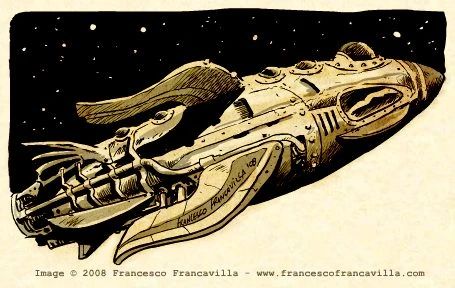
The Space Patrol operates rocketships of nearly every size and description, from the massive new space dreadnoughts coming out of Ceres Shipyards to the tiny, one-man insertion rocketships used by the Space Patrol Intelligence Service to infiltrate enemy worlds for information.
The most often seen vessels of the Space Patrol are small craft such as the Patrol Cruiser and Personal Rocket Flyers, who do their best to watch the spacelanes. These vessels try to maintain a communication web of linked vessels in the hopes of preventing space piracy, and to watch for Sarmak troublemakers.


Patrol Cruiser
Gargantuan Construct
HD: 51 (179 hp)
AC: 17 (DR 12)
SPD: 90 mph
MVR: +1
ATK: 4 x rocket cannons (10d8)
CP: 4/12,
CARGO: 3000 lbs., the equivalent of 15 passengers or six passengers and four personal rocket fliers
WT 500lbs
Roughly 50-feet long, rocket cruisers are fish-shaped armed and armored spacecraft typically painted bright primary colors. Despite their steel plate and rivet appearance, they weigh only a few hundred pounds because of the Cavorite used in their construction. Unlike standard aircraft, they don’t have to expend energy to remain aloft. Their performance more closely resembles that of a dirigible than of an airplane. A cruiser’s cannon are mounted in two forward-facing turrets and two rear-facing ones.
Spindizzy Drive: This specialized engine, based on the work of Nikola Tesla (after studying captured Sarmak equipment), allows spaceships to travel the vast distances between planets at great speed. Simply put, when activated outside of a gravity well (an asteroid, moon or planet), a vehicle equipped with a Spindizzy drive can travel 100 million miles per day, or 4 million mph.


Rocket Flier
Large Construct
HD: 10 (30 hp)
AC: 15 (DR 8)
SPD: 70 mph
MVR: +4
ATK: One light rocket cannon on swivel mount (4d8)
CP: 1/2
CARGO:  400 lbs., the equivalent of two passengers or one gunner and one passenger
WT: 100lbs
Rocket fliers are 12-15 foot torpedo-shaped craft used for both civilian and Space Patrol  purposes. Armed with a swivel-mounted rocket cannon, they are fighter aircraft often used to complement rocket cruisers. Unarmed they serve as flying taxis or personal vehicles. Like rocket cruisers, they can hover in place or drift with the wind without expending power because of the Cavorite used in their construction.


Pulp Age: Space Battles

Space combat in the Pulp Age and Pulp Space Opera settings are dangerous affairs. Rather than the dogfights depicted in Star Wars, spaceship against spaceship combat is more like submarine warfare. Its more about long distance battles, often seen as mere blips on a screen for most gunners. However closer engagements do indeed occur, and are suitably terrifying.
For more information on these rules, check out the Grit and Vigor roleplaying game by John Stater. Its a fun game, and an entertaining read. Check it out.

SPACE BATTLES
Space battles are best handled on either a ship vs. ship basis, or a fleet vs. fleet basis, to keep things simple. The rules are essentially the same as for dogfights and naval battles. Each ship captain (or each fleet commander) makes a Spacemanship task check. The faster ship enjoys a +2 bonus to this task check. The captain that beats his target number by the most (or fails by the least) has the advantage, and can either close with his enemy or increase the distance between them.
If the ship with the advantage beats his opponent’s task check by five or more, he may make a full attack while his opponent may only make a partial attack. Otherwise, both vessels can make a full attack.
For our purposes, a full attack uses all the vessel’s ship-to-ship weapons on turrets, and half of its non-turreted ship-to-ship weapons. A partial attack only permits the vessel to use its forward or rear weapons.
The character on board a vessel with the best Gunnery skill makes the Gunnery task check to fire the weapons. Follow the normal rules for firing artillery (see Tools: Artillery).
Each ship deducts damage from its hit points, and makes a roll on the following table. If the ship has lost less than 25% of its hit points, roll 1d6. If it has lost 25-49% of its hit points, roll 1d8. If it has lost 50-74% of its hit points, roll 1d10. If it has lost 75-99% of its hit points, roll 1d12.


If a ship’s hit points are reduced to 0, it explodes in 1d6 turns. People aboard the ship have to either make their way to a lifepod or die instantly when the ship explodes.
Many ships can enter planetary atmospheres, but are clumsy (-2 to Maneuver) as they are built for space. While a spaceship is in an atmosphere, it is vulnerable to aircraft. Aircraft in the air can attack a ship each round, and in turn can be targeted by the ship’s weapons aboard. Use the normal rules for attacking vehicles to resolve attacks against aircraft, and attacks by aircraft.

Thursday, January 14, 2016

Pulp Age: Pulp Space Opera

With the upcoming release of the Grit and Vigor RPG by John Stater, I thought I would fire up some articles for use with the game. So here is the first article detailing the "Pulp Space Opera" universe. A setting where a number of the works of Jules Verne, Sir Arthur Conan Doyle and H.G. Wells were all TRUE! Particularly the ones about space, aliens and science gone wrong. Into this mix I will be pouring some of my favorite authors of the 20's and 30's,  particularly Doc E. E. Smith, Jack Williamson, Olaf Stapledon, Philip Wylie and Edwin Balmer to name a few.

OVERALL SETTING
The year is 2753 (or thereabouts), and after the Martian Invasions of 1898, 1932 and 1953, the majority of Earth was plunged into a Dark Age of plagues and petty despots. But after a hundred years of civilization building back up, mankind is now stretching out into space. This journey has been through a great many troubles of course. Wars between nations, skirmishes with Martian holdouts (and allies) as well as lots and lots of politics and economic struggles. But now, after all of this, mankind and allies is looking forward.
Technology is that of the interbellum era, which covers the time between the end of World War I and the start of World War II (TL 5-6). So Automobiles, mechanical calculators, telegraph, (telephones for the rich), radio, records, BOOKS, machine guns, railroads (subways included), airships, airplanes, biochemistry, etc, etc. All with the added bonus of Selenite and Martian derived hypertech, fuels and know-how. So spaceships, death rays and advanced power sources mixed with coal and gas powered gadgets and simple computer for a "deiselpunk" feel.
Culturally the world is all about Art Deco, Burlesque, Gangsters, Jazz, Raygun Gothic, Ragtime, and Noir. Despite the troubles looming on the horizon (and right next door), people are optimistic and energetic. Add to this crushing poverty, restrictive government and alien invasion.
The Planets are not as hostile to life as they are in our universe, though they are still dangerous. Mars has a breathable atmosphere, though thin and very dry, and Venus is a sweltering jungle (cross Tarzans Jungle with Skull Island and you get the idea). Of course this means that other things live there too...


EARTH
The Earth has been devestated by the repeated wars with the Sarmak Martians, and in battles between its own nations. These days, most people on Earth live in HUGE megalopolis cities. These super-cities are absolutley enormous. The lower classes live in subterranean dwellings, and the middle and upper classes living in skyscrapers and largely communal accommodations. Moving walkways interconnect the city, with fast air-travel and superhighways available between cities.  Governments as we know them are unknown of, with Mega-Corporations representing governments.
Generally speaking, most of Earth is peaceful and prosperous; many old political rivalries have now moved to the new frontier of space, others are now mainly economic. Naturally there are still dangers; China and parts of Africa are unsafe for anyone who appears to be wealthy or foreign.
In cities public transport uses subways, robo-buses and robo-taxis; monorails and rockets are used for most long distance travel. There are even a few ocean liners left, though their appeal is romanticism and nostalgia, not speed. For the wealthy, gyros were at one time the "must-have" status symbol, but as the price of basic models fall they are becoming more common for the merely well-to-do who need to commute long distances, since they can be flown without a full pilot's license. Most modern cities have flight lanes and landing pads for them.
The landscape of much of Earth will be farms, or wilderness. And much wilderness is choked with the Martian Red Weed. Farmers are constantly fighting off this invasive plant as well as mutated vermin. Still some small towns and communities do exist, but are either corporate holdings or petty warlords and squatter/survivalists.

POWER PLAYERS 

The White Council (The Sleeper Awakes and A Story of the Days to Come): A fascist cadre of technocratic Utopians. These guys rule, but keep mostly to the shadows of Mega Corporations and political puppets. They enforce the law with their G-Men and their Beast-Men (ala Island of Dr Moreau) goons. These guys are the power behind the throne, and don't normally get pushy. But they are a pain when they take notice. They are dogmatic in pursuit of "thought criminals" that are a threat. The White Council holds the secret for Cavorite and many other Martian technologies secret.

Colonies:  A number of colonies exist on Mars the Moon, and Venus many founded by Mega Corporations, existing as city-states. These colonies are often all that remains of what we would see as Americana. Most were built atop the ruins of Aurorean cities, but rebuilt for human and Selenite use. These colonies are pretty Wild West in their ruggedness though a few have achieved a Casablanca like elegance. Some of the older colonies were started in the 1920s and so are well established.

Aurorean Martians(War of The Worlds): These Martians are very different than the Sarmak. They dwell in the Xanthe region of Mars, near Auorae Sinus. The Auroreans (as humans have called them) stand nearly six feet in height, have brown skin, round erect heads, and large yellow eyes. Their society is highly cultured and scientifically advanced, but long warfare with the Sarmak has greatly diminished their numbers and potency. However despite hard times, the Auroreans retain several large cities of startling architecture. Many desire alliances with Earth Men, but others are cautious.

Sarmak Martians (War of The Worlds): The Sarmak Martians are the Invaders that brought so much calamity to Earth in 1898-1901, 1932-1953. These creatures live primarily in the Nodus Gordii region of Mars and are greatly feared by the other peoples of the Red Planet. Some of the aliens have made alliances with human groups, even going so far as creating human/Sarmak hybrids called the Star-Begotten. The Sarmak have a foothold in the South Seas of Earth, the South Pole and are presently working on the conquest of Venus. 

Selenites (The First Men in The Moon): The Selenites are the sapient insectoid inhabitants of the Earth's moon and many asteroids. They are vaguely similar to quasi-humanoid ants, about five feet tall. These creatures are all natural Monarchic Socialists, having a completely communal existance, but are stratified socially and biologically. The Grand Lunar officially allied with the White Council against the Martians, however that doesn't mean that all is friendly. Comparable to dealings with Saudi Arabia during WWII (tension and misunderstandings galore).


 More to come!

DISNEY & DRAGONS: D&D in Fantasyland

Many times, in recent years I have encountered would-be players of Dungeons and Dragons whose sole experience with the fantasy genre h...