Thursday, May 28, 2015

Mutant Mars: A New Campaign Setting for Mutant Future!

New Campaign! Due to an old gaming buddy being back in town I am throwing together a campaign setting for Mutant Future. As I LOVE to tinker with campaign settings, I am not going to be using my Atomic Dawn setting for the game. Rather I am trying something a bit different for our post-apocalyptic fun. As follows:

MUTANT MARS
The game will be set on a Terraformed Mars that was established as a colony world shortly before Earth was plunged into a devastating war that cut off the Mars colonies from the homeworld. Of course as numerous nations and corporate powers worked together (as weird as that is) to terraform the Red Planet, these groups got into fights as well.
So long after the dust has settled, Mars is a savage world. The adapted ecosystem of the planet reacted strangely since the groundwork, and along with cosmic radiation and the uncertainties of bio-engineered life-forms, mutation is rampant. Culturally Mars is dotted with city-states, petty kingdoms and nomads with only a few cities holding to a higher standard of culture.
Players can play any of the races other than Mutant Plants, and will be beginning at 3rd level.
Players of Mutants have the option of using Mutant Packages.
Also, characters have the option of playing Magic Users (call them Wizards, Sorcerers, Priests etc) by using these rules. Such characters will have to have a cool back-story and/or belong to a spellcasting society. More on those very soon.

Below is a map of the beginning campaign region:

Candor: A massive city near Mariners River-Valley. The city is built around a Utopian Dome and is home to a large and diverse populace. The city is mostly composed of tiered slums interspersed with barbarian splendour and advanced technology. The city has many industries, but the largest is the processing of Martian Ore from Nickel-Iron Meteorites.
Ignarh: A barbarian city that maintains a trade route across the plains. It is a rough place full of cutthroats and thieves. Ideal for adventurers.
Lakkdarol: This city-state is a dusty but prosperous trade town.
Lockyer: Industrial town that maintains the other end of the Ignarh trade route. A society of mystics rules here, communing with ancient gods of Mars.
Paleveria: A republican and capitalist state with class divisions. Ruled by a wizard elite and styled much like Roman philosopher-leaders. Thursia - A learning center of Paleveria.
Mariners Valley: A deep gorge larger and more frightening than the Grand Canyon. Cliffs and cave networks are numerous here as are a number of cliff loving monsters and bat-riding madmen. Travelers beware.

Wednesday, May 20, 2015

Mythos Space: Hyperspace

HYPERSPACE (Plane)
Hyperspace (also called the Astral Plane) is an alternative region of space co-existing with our own universe
Two merchant vessels entering hyperspace.
which may be entered using an energy field or other device. Hyperspace is most succinctly described as a "somewhere else" within which the laws of general and special relativity decidedly do not apply, especially with respect to the speed of light being the cosmic speed limit.
Hyperspace is a great, endless "sea" of clear silvery sky, both above and below. Hyperspace has subjective directional gravity. It is also timeless. Age, hunger, thirst, poison, and natural healing do not function in Hyperspace, though they resume when the traveler leaves Hyperspace. Travel through Hyperspace for Starships is relatively easy once an Interstellar Gate is used. Ships find this route between stars quite useful. Unfortunately Hyperspace is haunted by a number of aggressive and dangerous species.
HYPERSPACE TRAVEL
Ships equipped with a Hyperdrive can enter hyperspace once they are out of a planets gravity well, typically ten miles out (GM's discretion). Wormholes, Warp-Gates and some psychic powers can also allow access to hyperspace, but these are pretty rare.
Travelling between solar systems using Hyperspace can be accomplished via a successful Navigation check. Success indicates that the course has been successfully set through the Silver Void. Failure results in the ship running off course to a destination of the DMs choosing.
Ships using Hyperspace to travel to distant star systems take 7d10 ship days to reach their destination, regardless of travel distance. During this time the crew need not eat, drink or sleep, though many still do to repel the sheer alien-ness of the Starry Void.

HYPERSPACE ENCOUNTERS
Hyperspace is a busy place, especially where vessels enter and leave the Starry Void. Every time a ship enters or leaves Hyperspace, there is a chance that something is drawn to the disturbance.

Roll d100 -- and be sure you have numbers and behavior ready.
     1    Terror From Beyond (Solitary)
     2    
Fire Vampire Swarm (2d6)
     3    
Mi-Go Clutch (1d8)
     4    Nug-Soth Explorers (2d4)

     5    Tove Colony* (5d10)
     6    Nightgaunt*
     7    Space Patrol
 -- 2d8 Starfighters
     8    
Space Patrol -- 1d4 Couriers
     9    Merchant Frigate
 -- GM's choice. 
    10    Moon Beast Slavers(1d4 + 2d6 Lengites) 
    11    Asterion Star Mother (Solitary)
    12    
Asterion Star Warrior Gang* (1d8)
    13    
Asterion Starlord Command* (1d4)
    14-20 
Asterion Starling Clutch* (2d6)
    21    Dimensional Horror*
    22    Astral Angler (Solitary)
    23    Phase Spider*
    24    Examiner Cluster* (1d6)
    25    Thuum'ha Trade-Freighter (2d12)
    26    Arkhamer Researchers
 -- GM's choice.
    27    Spirit -- DM's choice.
    28    Sawsnark Cruiser -- 
GM's choice.
    29    Giant Robot -- 
GM's choice.
    30    
Color Out of Space -- 
    31    Wenelian Pirates*
    32    Tove Colony* (5d10)
    33    
Byakhee Swarm* (1d12)
    34    
Elderian Travellers (2d4)
    35    Space Pirates
 -- GM's choice.
    36-00 No encounter 

* Appears in an unocupied section of the nearest ship or space station. The only exception to this rule is a Boojum ship like the Sawsnark Cruiser. 

This material is using the Grit and Vigor roleplaying Game by John Stater. John has been kind enough to allow me to see the playtest version of the rules, and this gives me more than enough to begin work on the Mythos Space setting. 


Monday, May 18, 2015

Pulp Age: CTF Bromion Land Ironclad

Ran across this ship design while sorting some files and remembered that I never finished it. So I thought I would do so and post it here. This vessel is a Land Ironclad originally designed for a concept incorporation the various works of H.G. Wells for making a Steampunk setting.
The overall setting is a version of the future predicted in The Shape of Things to Come. The Earth dominated by a "benevolent dictatorship" after a second dark age, possibly after repeated Martian Invasions (1898, 1932, 1953 etc). Now mankind, along with Selenite allies and Moreuvian Beast-Men (a labor/grunt class) are forging out into space.
Technology of a steampunk / Mad Science sort has aided mankind in other ways. Immense super-crops (The Food of The Gods), spaceships and airships and other gadgets. Unfortunately, these scientific elite are intolerant towards anyone not ascribing to a fanatic form of scientism.

The Land Ironclads Stats:

CTF Bromion
Tremendous Construct
HD: 120 (480 hp)
AC: 12 (DR 300)
SPD: 25 mph, ACC 10 mph
MVR: -2
ATK: 1 x tesla cannon and 3 x cannon 100 mm and 3 x heavy machine guns
CP: 24/5
WT: 2 kilotons

The CTF Bromion is a loud, smoke-belching land frigate that has seen many battles across the plains of Mars as Earth forces seek to dominate the Red Planet.
These ships and ones like it are designed to battle the Sarmak Martians and their Tripods, and have so far been fairly successful. Of particular note is the ships massive Tesla Cannon, a powerful weapon that fires a massive bolt of electromagnetic lightning, dealing damage equal to the ships original hit points in both electrical and fire damage. Targets can attempt to save for half damage.
The CTF Bromion is specially armored against Martian Heat Rays that it only suffers half damage from fire or laser attacks. Furthermore the vessel can be sealed against gas attacks and remain so for 48 hours.
The CTF Bromion is crewed by human officers and human crew, bolstered by Beast-Folk troops and specialists. The ships locker is always amply equipped with firearms, from pistols to rifles and more exotic weaponry dreamt up by the lab boys of the White Council.
Other vehicles such as heavier than air Aeronef, heavy-duty and scout Aerostat airships and smaller Land Ironclads often go into the field with the Bromion, but this vessel has more than once been in tough straits without additional support.


New Race(s)

Beast Folk (The Island of Doctor Moreau)
Creatures made from animals into the shape of men. Though intelligent, they are simplistic creatures who need guidance. Beast Folk serve as laborers and warriors having a social status somewhere between animal and man, with the more attractive animals (Cat and Dog) having an easier time of it. Within society, these creatures are considered second-class citizens, but can often form close bonds with humans who work closely with them. However such friendships are usually less like true friendships and more like a proud pet owner and his or her favorite pet.
Beast Folk retain their base animal form’s attacks (claw, slam, etc) and can go down on all fours, adding +10ft to their movement rate. Beast Folk characters modify their attributes and gain a knack as follows:
Ape (Chimpanzee)-  +1 Str, -1 Cha. Knack for Athletics.
Bear (Black and Brown)- +2 Str, -1 Dex, -1 int. Knack for Search.
Cat (Big)- +1 Dex, -1 Int. Knack for Gymnastics.
Dog (Working)- +1 Con, -1 Int. Knack for Track.
Pig- +2 Con, -1 Int, -1 Cha. Knack for Endure.


Tuesday, May 5, 2015

Mythos Space: Everyday Technology of The 51st Century (part 1)

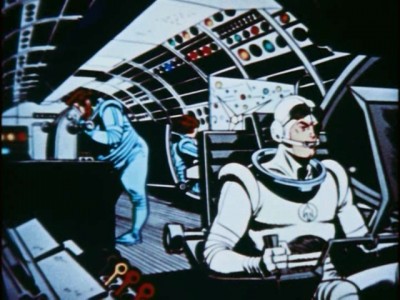
The setting of Mythos Space embraces the views of the "future" from the perspective of the 30's, 40's and 50's as well as inspiration from the French science fiction movement of the 1970s. Its a setting firmly in the "Atomic Rockets" genre, tinged with industrial grit, Cold War style paranoia and fear of Socialist "isms" such as Fascism and Communism, and the can-do attitudes of the post-war boom.
As a part of this, the settings technology incorporates elements from those eras, but don't always include technologies that we take for granted. This is explained away as a result of the rising of R'Lyeh and the war with the awakening Old Ones.
Some thoughts on the settings technology:


RETRO FUTURE TECHNOLOGIES (MAD SCIENCE)
Keep your 'lectric eye on me babe
Put your ray gun to my head
Press your space face close to mine, love
Freak out in a moonage daydream oh yeah!
-David Bowie, The Rise and Fall of Ziggy Stardust and the Spiders from Mars
Most people in the 51st century have access to technology roughly equivalent to the mid to late 20th century (TV, telephones, projectile weapons, automobiles etc) though usually with high tech twists to let you know its the future. So its not just a Car, its a Turbo-Car! Gamemasters and players are encouraged to use as many sci-fi buzzwords that they can.
Out in the colonies such as the Bai Hu Sector and others, tech levels can vary considerably due to availability of resources, environment and other considerations. Colonies must either depend on their corporate employers, or make do. Often colonies adopt a melding of tech levels.
As a part of the Grit and Vigor RPG, characters have an option to play Inventors. As this is a setting for that up-and-coming game, I preset the technologies of the setting to accommodate this. An inventor can create Plausible or otherwise existing technologies on his own given parts, time and money. Implausible Technologies are things that are either mostly theoretical or specialized items normally only available to the super-rich or to Mad Scientists. Modifiers are included as part of rolls required by Inventors.

Plausible Technologies:
Atomic energy, atomic bombs, atomic power plants, biotechnology (drugs), cold-sleep, colonies on planets and moons, data pads, electronic brains (see computers), food pills, starships, vacuum suits, explosive bullets, heat rays, infra-red photography, robots, radar.

Implausible Technologies:
Androids/Gynoids (-2), cloning (-4), virtual reality (-2), flying cars (-2), hyperdrive (-6), digital cameras and small portable video cameras (-4), invisibility ray (-4), touch-screens (-2), unmanned satellites (-4), unobtanium processing (-6), orbital towers (-8), teleportation rays (-8).


ANDROIDS, GYNOIDS AND ROBOTS (OH MY!)
Robots are clunky mechanical beings, made for simple functions and commonly seen in colonies and on larger spaceships. They are form equals function in design and generally look like semi-humanoid vehicles or vending machines. Robots are mindless for all intents and purposes and lacking in any kind of self motivation or discretion. Robots have no rights and can be bought and sold as such.
Androids and Gynoids are a different matter than Robots, though most common folk will often mix the terms (which is seen as racist amongst Androids and Gynoids). The term Android refers to robotic humanoids of apparent male gender, while Gynoid refers to humanoid robots designed to look like a human female. Though these beings are robotic in design, they are extremely sophisticated, and have thoughts and emotions of their own. Such beings are produced via advanced experiments in Computer Technology (see below) and and are considered miraculous, even by their creators.
ANDROID OR GYNOID CHARACTERS
Androids are sentient robots that resemble males, while gynoids are sentient robots that resemble females. Android or Gynoid characters modify their attributes as follows; Str +1, Con +1, Wis -1, Cha -1. They are constructs, and so are immune to mind-affecting effects, poison, sleep effects, paralysis, stunning, disease, death effects, necromantic magic, ability damage and drain and energy damage and drain. They do not need to eat, sleep or breathe. However they do not heal naturally but must be repaired using either the Electronics or Mechanics skill (GM's discretion), the results of which are the same as a Treat Injury roll. An electronics tool kit or mechanical tool kit are required. Androids suffer half damage from electricity, and have a natural armor class of 12. Androids and Gynoids can imbibe potions and receive the benefit of them.
Androids usually speak English and might know virtually any other language. They can advance as Fighting Men, Rogues and Daredevils.


INFORMATION TECHNOLOGY (COMPUTERS)
"Never trust anything that can think for itself if you can't see where it keeps its brain." -Arthur Weasley
The networked computer systems that we take for granted in our present age are not so prevalent in the 51st century. The rising of R'Lyeh and the start of the first Mythos War brought mankind into opposition to powerful hyper-spatial entities that have a distressingly easy time disrupting and exploiting silicon-based electronics (something to do with crystals) and causing no end of trouble. Because of this, computers that are in use can be individually powerful, but are almost never networked with one another. This means NO INTERNET, at least not for average Joe's. Similarly; A.I. is more limited being housed in hardware or in the form of Android or Gynoid form (see above).
So what does this mean for the setting of Mythos Space? Well for starters the characters will have to get up and do real research if them want to learn something.  Personal computers will either be BOOKS or clunky gadgets that are probably attached to a base or spaceship. If a computer IS networked it can be expected to come under assault by things from hyperspace (and de-bugging those will be a BITCH!). Really advanced computers will almost always be the product of mad science and/or sorcery and subsequently alive and free-willed in some way.
Several non-human beings have found ingenious (and often disturbing) ways around this issue. Of special interest to the Tsan-Chan Empire, the Mi-Go augment their computer systems by using organic brains (brains in a jar) that are linked to otherwise normal computers. This along with psionic access to the Akashic records, can produce the equivalent of a supercomputer. Trade agreements with the MiGo has allowed Imperial and Corporate technicians to produce rough equivalents, though the brains in use have a distressing tendency towards megalomania...

This material is using the Grit and Vigor roleplaying Game by John Stater. John has been kind enough to allow me to see the playtest version of the rules, and this gives me more than enough to begin work on the Mythos Space setting. 


Tuesday, April 28, 2015

Dreamlands: MIRI NIGRI (Race)

The Miri Nigri are a strange race of black-skinned dwarves originally mutated into humanoid form by the monstrous Chaugnar Faugn and his "brothers". Since then this race has been largely dominated by these inhuman creatures, though as their creators are often asleep (sometimes for decades), the Miri Nigri have developed their own society. The Miri Nigri have large settlements amongst the Peaks of Thok in the Underworld, but also have several communities in mountainous regions and have permanent neighborhoods in Dylath-Len and Cuppar-Nombo, where they are renowned metalworkers and healers.
Bufo, Miri-Nigri Sorcerer-thief
Miri Nigri are a "grumpy" and greedy people, but they understand the need for allies and trade, and so they are an excellent source of adventurers. All remember their origins, and will see no problem with kidnapping, and slavery as a source of commerce.
Magic is central to the Miri Nigri, though they have few magical schools, seeing their clerics as the scholar mages of choice. Player Character Miri Nigri clerics are usually generalist-priests in service to the Elder Ones, with specialists usually serving Bokrug, Hypnos or Oryxx.

MIRI NIGRI (Race)
"These dark folk were seen in Pompelo only once a year -- in summer, when a few of their number would come down from the hills to trade with the merchants.” -Frank Belknap Long, The Horror From the Hills
The Miri Nigri (also called Dero) are a dwarfish race being about 2½ tall and weigh between 30 and 35 pounds., they are dark skinned with toadish features. Many serve their creator and god, the slumbering Chaugnar Faugn. They are sent forth to steal men and women for the vampiric hunger of their god and his other children. Miri Nigri traders are not so zealous as their kin "back home" and so make more likely adventurers. Still even the most friendly Miri Nigri comes from an inhuman line.
Miri Nigri are small creatures with a base speed of 20 feet. They have darkvision to a range of 90 feet and have a knack for listen at doors and move silently.
Miri Nigri are as rugged little folk, but toadish. They add one point to their starting constitution scores, but lose one point of their starting charisma score. These ability modifications cannot increase a score above 18 or reduce it below 3.
Miri Nigri have a natural affinity for survival magic. A Miri Nigri with a wisdom score of 10 or higher can cast the following spells, each once per day: detect poison, know direction and endure elements.
Miri Nigri speak Common and Miri Nigri. They might also speak Ghoulish, Gug, Goblin, Mnari or Khemish and the language of frogs.
Miri Nigri can multi-class as cleric/thieves, fighter/thieves and sorcerer/thieves.


These rules are made for use with the Blood and Treasure RPG by John Stater.

Friday, April 24, 2015

Dreamlands: Headless Men

Bhlemphroims (Acephali)
A Blemphroim village in the Cairn Hills
Medium Humanoid, Neutral (CN), Low Intelligence; Band (1d10)*
HD 1+1
AC 12 (natural)
Atk 1 weapon or 1 bite (1d4)
MV: 30ft
SV: F 13, R 15, W 15
XP 15 (CL 1)

"Especially was it unwise to rave of the living things that might haunt such a place; of creatures half of the jungle and half of the impiously aged city—fabulous creatures which even a Pliny might describe with scepticism;" -H.P. Lovecraft, Facts Concerning the Late Arthur Jermyn and His Family
Bhlemphroims (also called Acephali or Blemmyes) are a race of headless men and women who have their faces in their chests. They have eyes, mouths and noses in their chests, but are without ears and thus deaf. They live in small bands of 20 to 40 individuals, living by hunting and gathering. They are known to eat sentient humanoids, so one must take care when interacting with them.
The Bhlemphroims come from the distant planet Cykranosh but now occupy a considerable region along the borders of Sydathria and Mnar, but can be found in any warm mountainous land. Bhlemphroim slaves and mercenaries are a frequent sight in the Dreamlands, though they are not widely liked. The weird appearance and coarse manners of these headless folk disturb many city-dwellers, but they have some camaraderie amongst rough laborers and street toughs. All Bhlemphroims are foodies, taking great interest and delight in the preparation and sampling of elaborate and varied foods. Because of this, Bhlemphroims cooks are highly sought after though rumors of strange meat is always a concern.

BLEMPHROIM CHARACTERS
Bhlemphroim characters modify their starting scores as follows: +1 Con, -1 Cha. They have a base land speed of 30ft and have a bite attack that deals 1d4 damage. Bhlemphroim are deaf and so are immune to sonic attacks, but are surprised on a roll of 1-3 on 1d6. Bhlemphroim spellcasters suffer no spell failure risk due to deafness. Bhlemphroims have a natural AC of 12 due to their tough skin. Bhlemphroim cannot wear any armor, but can use shields. Bhlemphroims can speak Blemish and Common. Bonus languages are typically Sarnathi, Ghoulish, and Khemite. Blemmyes can advance as Barbarians, Clerics, Fighters, Rangers, Sorcerers and Thieves. They can multi-class as barbarian/clerics, barbarian/sorcerers and sorcerer/thieves.
Grit and Vigor: Bhlemphroims can speak Blemish and Standard Chinese. Bonus languages are typically Akkadian, English, and Martian. Bhlemphroims can advance as Fighting Men and Rogues.

IN MYTHOS SPACE
Bhlemphroims make for an excellent alien race. These creatures share ancestors with man, they have been bred into their present form through the efforts of an ancient alien race (possibly rogue Elderians) or possibly one or more of the various Great Old Ones such as Atlach-Nacha and Tsathoggua. Some cults dedicated to these Great Old Ones are still in existence amongst the lower castes, and are called Ydheems.
The Cruel Empire of Tsan-Chan officially recognizes the Bhlemphroims as sentient creatures and distant kin to humanity. However in practice, these creatures are treated as second-class citizens and delegated to the lowest types of jobs. Many Bhlemphroims work as grunt laborers, thugs and soldiers for corporations.


These rules are made for use with the Blood and Treasure RPG by John Stater. These creatures are also excellent for the up-and-coming Grit and Vigor RPG.

Tuesday, April 21, 2015

Dreamlands: Ghoul Player Characters


GHOUL (Race)
Mr. Ombro Ghoul Thief
Ghouls are a species of undead living as their own society. Ghouls are white or green-skinned humanoid hairless creatures with sharp teeth, pointed ears, and claws. The feet of some "families" of ghouls have further mutated, almost becoming hooves. They inhabit networks of underground tunnels and crypts, and eat the corpses of dead humans. Despite their favored food and reclusive habits, Ghouls are usually not hostile creatures, and can even be decent in their own way.
Ghouls are medium-sized creatures with a base speed of 30 feet. They are rubbery-strong and agile, and so add one point to their starting strength and dexterity scores. Unfortunately, they are disturbing to look upon and have strange ways, and suffer a two point penalty to their starting charisma score. These modifications cannot put a score above 18 or below 3.
Ghouls have a claws that deal 1d4 damage. Opponents hit by their claws must pass a Fortitude saving throw or be be stunned for 1d6 rounds. This does not work on plants, constructs, undead or elementals.
Ghouls have a natural armor class of 12. They are immune to poison and disease and need not breathe or eat, though they can imbibe magical potions and receive the benefit of them.
Ghouls are immune to illusions and mind-affecting effects, poison, sleep effects, paralysis, disease, stunning attacks and death effects. They are also immune to ability damage and drain and to energy damage and drain, as well as fatigue. Ghouls are damaged by cure wounds spells and healed by inflict wounds spells, and are unaffected by raise dead and reincarnate spells. Ghouls do not breathe, eat (though they want to) or sleep.
Ghouls are subject to clerical turning, but player character ghouls may make a Will save to avoid this effect. A result of Destroy Undead inflicts 3d6 damage to the ghoul on a ghoul character. Similarly, control undead attempts act as the dominate monster spell
Ghouls speak Common and Ghoulish and might have picked up virtually any other language. They can advance as cleric/thieves, fighter/thieves or magic-user/thieves.

Ghoul Breeding
Despite being undead, ghouls still feel a need to raise more ghouls. This is managed by inducting humans and other humanoid species into their ranks. Such new ghouls are often drawn from the ranks of orphans and foundlings, raised on ghoulish milk (*gag!*) and food. Eventually these children transform into true undead upon reaching adulthood. Similarly, those slain by a ghouls bite (and not eaten) will rise as a ghoul.

Mordiggian "The Charnel God"
Mordiggian is a Great Old One and is worshipped by ghouls. Mordiggian does not appear to be especially malevolent and has been known to spare those who have not personally offended him or his followers (the ghouls). A different name for Mordiggian is Morddoth, mentioned as the dark god of the ghouls revered in the city of K’n-yan in the Vale of Pnath and remote villages in the land of Khem.
Mordiggian's cult consists exclusively of ghouls, though other races may offer up their dead to the Charnel God, but only as appeasement and not as actual worship. The ghoul priests of Mordiggian cover themselves in long hooded robes of funeral-purple and silver skull-like masks. A tome known as The Ghoul's Manuscript deals with Mordiggian and his cult.
Cleric Alignments: Any
Cleric Powers: Clerics of Mordiggian can use piercing and slashing weapons and are skilled in survival, but have no special power over undead.

These rules are made for use with the Blood and Treasure RPG by John Stater

Thursday, April 16, 2015

Dreamlands: Thoughts on a Campaign Setting


The Big Map. More fine tuning and details to come.
When pondering possible campaign settings for the Blood and Treasure and Bloody Basic gaming systems, it struck me that I have yet to see a really good treatment of H.P. Lovecraft's Dream Cycle stories for use in an RPG. One used as a self-contained campaign world, and not just as a possible side-quest for Call of Cthulhu or similar. So I figured I would tinker around with this wonderful setting, and see where it takes us.
For those who don't know, the Dream Cycle stories were a fantasy series written by Lovecraft, that thought dark, was far more fanciful than grim as in his later works. The Dreamlands are a parallel dimension to ours, and is peopled with fanciful creatures and exotic extremes of Earthly peoples and societies. However it is fully a world in its own right and not an airy world lacking in peril. Both dreams and nightmares aplenty dwell here.
So I will be posting setting details, peoples, races and monsters. So stay tuned!

Friday, April 10, 2015

Mythos Clerics (The Elder Ones)

The Elder Ones
The Elder Sign
The Elder Ones are immortal entities in the Cthulhu Mythos. They are generally distinguished from the Outer Gods or Great Old Ones by being less unbearable to behold, and by being less generally inimical to humanity. Some Elder Ones are known to help human beings who have dabbled in the Mythos return to relative safety (though never to an untroubled psyche); it would however be a mistake to assume they are inevitably benevolent. At best, they are still vastly superior to humans and have minds and motivations beyond human understanding; their seeming friendliness may well be coincidental, or due to reasons humans cannot fathom.
Clerics of The Elder Ones follow a wide range of creeds and do not have a large united "church", rather they are allied in opposition to the Outer Gods and Great Old Ones. In fact, clerics of the Elder Ones can be of wildly opposing alignments, and often bicker or even out-and-out war with one another over doctrinal differences and personal disputes.
Cleric Alignments: Any
Clerical Powers: Clerics who revere the entire Elder pantheon have the power to turn or control undead creatures by channeling the power of their faith through their holy or unholy symbols. A cleric of Law (LG, CG, NG) can “turn” or destroy undead creatures. A cleric of Chaos (CE, LE, NE) instead rebukes or commands such creatures (see page 57 in the Blood and Treasure PHB). A cleric of Neutrality (N, CN, LN) must be a specialty priest (see below).

Specialty Priests
Clerics can choose to revere a specific deity to revere, losing the power to turn undead and instead gaining a Specialty Domain power based on the deity. An exhaustive list of Elder Ones would be enormous, however below are some notable members of the pantheon (and their respective alignments):

Bokrug (Neutral): Bokrug, The Great Water Lizard is a fearsome god that is primarily revered in the land of Mnar. At one time its only worshipers were the Thuum'ha of Ib who were destroyed by the humans of Sarnath. Bokrug now gets propitiatory worship by the folk of Ilarnek and the Miri Nigri, who correctly credit Bokrug with the destruction of Sarnath. Priests of Bokrug can turn fire elemental creatures and rebuke water elemental creatures instead of turning undead.

Hypnos (Chaotic Neutral): Also called Somnus, the god of sleep is often depicted as a winged youth. He appears most often as a strange mix of nightbird and man, some beautiful, some horrific. Clerics of Hypnos are often poets, musicians and magicians. His symbol is the poppy. Priests of Hypnos can use magic-user scrolls and wands as though they were magic-users equal to their cleric level.

Kib (Chaotic Good): This god is the Sender of Life and the creator of beasts. Kib is a wild trickster god who continually schemes to help life succeed in the universe, seeing it all as a grand game. He appears as a wandering entertainer and permanent sightseer. His symbol is a patchwork hat or coat. Priests of Kib are skilled at hiding, move silently and picking pockets.

Mung (Neutral Evil): Mung is the Lord of all Deaths, and thus is the master of undead spirits and places where the dead are buried. Mung appears as a skeletal human wearing an enormous black coak. His symbol is a skill or a skeletal hand (similar to a hand of glory). Priests of Mung may use a touch of death once per day. They must make a successful melee attack against an opponent and roll 1d6 per cleric level. If the roll is higher than the target’s current hit points, they die.

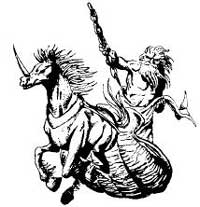
Nodens
Nodens (Lawful Neutral): Also known as Lord of the Great Abyss or Nuada of the Silver Hand, Nodens appears as an elderly, human male with white hair—gray-bearded and hoary yet still vital and strong. As a hunter, he will chase down servants of the Great Old Ones or Nyarlathotep for sport. Priests of Nodens can use edged and piercing weapons and receive a +1 bonus to all attacks.

Orryx (Lawful Evil): Also called The Bright Flame, Orryx manifests as a giant pillar of blinding white and purple flames. It is a fearsome fire entity who rules over other Lawful fire beings, opposing Chaotic fire creatures. Its symbol is an open flame, of a golden representative of flame. Priests of Orryx can turn water elemental creatures and rebuke fire creatures instead of turning undead creatures.

Ulthar (Lawful Good): Also called Uldar or Ultharathotep is a deity sent to hold vigil over the Great Old Ones. This ancient god appears as a mighty Lamassu wearing a crown and adorned with jewels. Cats are sacred to Ulthar and may never be slain by members of his cult. Ulthar's symbol is the unblinking eye. Priests of Ulthar are skilled at decipher codes, find secret doors and tracking.


USE IN MYTHOS SPACE
The Elder Ones are known of in occult circles across the stars and have numerous cults amongst the rich and poor alike. Clerics as understood by players of DnD or Blood and Treasure do not exist, and so the powers over undead and such are not known. However would-be priests of the Elder Ones must have the ability to cast Turn Undead and MUST be of Lawful alignment. Specialty priests (and domains) are unknown in Mythos Space, though most Magic Users may consider themselves as priests of a specific deity.

USE IN THE DREAMLANDS
The Elder Ones are revered far and wide in the Dreamlands, though regional changes are widespread. There are no large religious centers in the Dreamlands, though local temples and high priests are common in cities and large settled regions.

These rules are made for use with the Blood and Treasure RPG by John Stater

Wednesday, April 8, 2015

Mythos Space: Bai Hu Sector

The Bai Hu (White Tiger) Reach is a region of space on the frontier of the Tsan Chan Empire. It is a wild sector rich in resources and rife with remnants of Old One technology and ruins. As the Empire is engaged in its own conflicts elsewhere (primarily with the Great Race of Yith), this region is largely ignored by the Empire so far.
The corporate colonies along with the tramp freighters so common in this sector have a strong independent streak and generally resent overt Imperial control. Space Patrol and local militias keep the peace, and a large number of small "experimental" communities can be found here. As long as they pay their taxes (and bribes) and dont kick up too much of a fuss, the Empire does not care.
Notable Star System on the above map are:

Sol (The Sun)
Sol is the star of our own Solar System and the seat of the mighty Tsan-Chan Empire. From here a steady stream of mining and cargo ships come as far as Kaiwan and Urizen to pick up raw and processed goods and to otherwise trade with colonists and aliens.

Ori (Betelgeuse)
This tired old star is an early colony spot from the days or earliest expansion. The system is composed mostly of a large asteroid field with a subterranean colony on its single (ceres sized) planetoid. Though this was once a great mining system, nowadays it is mostly home to reclusive communities that keep to themselves (space hillbillies).

Kaiwan (Aldebaran)
This system is a major trade hub for this sector and a favored jumping off point for ships heading out to Bullseye and Wu Ju. The single planet Skarl has its own atmosphere and a large spaceport/city that is overgrown and renowned as a fleshpot and decadent pleasure port. Orbital repair facilities and the sale of refurbished starships are major industries here.

Urizen (HD 24496)
This binary star system has a gas giant with 20 moons. Three of the moons; Eleth, Uveth, and Ona all have colonies, though only Ona has its own breathable atmosphere (though with lighter gravity). The Urizen system hosts a number of Arkhamer research sites exploring strange energies and select Hyperspace technologies.

Tseih She (Algol)
This trinary star system is home to a small Elderian colony that mostly keeps to themselves. Little is known of the system beyond a single planet that may by artificial. Some trade does exist between the Elderians and Tramp Freighters, but nothing large scale.

Wǔ Ju (Beta Tauri)
This double star system is home to a single desert planet called Elnath. This planet has a thin, but breathable atmosphere and hosts a single Arkhamer town/research center. The closeness of the Crab Nebula makes the sky here particularly beautiful, with particularly powerful psychics and Saturnian Cats claim the storms of the Nebula are somehow alive.

Zaoth (Delta Tauri)
This system is actually a cluster of three star systems comprised of a total of seven stars. Despite the abundance of radiation, there is at least one planet to be found here. This planet (Abbith) is controlled by the MiGo and ruled by a society of cyborgs who maintain a vast library. Other species are said to dwell here as well, hosts to the Metal Brains of Zaoth. Elderians, Nug-Soth Insectoids, MiGo and Yithians are all confirmed to dwell here.

Bullseye (Epsilon Tauri)
The Bullseye System circles an Orange Giant star and hosts a large number of rocky moons and a Gas Giant planet. This system is rich in natural resources and has several habitable worlds, and so is quite valuable. Ruins once belonging to the Shaggai race and other beings are to be found here. The gas giant (Demhe) is a prime breeding site for Boojum and a number of hyperspatial species can be found on the many moonlets of this system.

Chakumuy (Theta Tauri)
This double star system is host to a large number of asteroids. Its sole space habitat (Baktun Station) is a rough frontier town ideal for miners, miscreants and criminals. It is rich however, and is a state of the art facility with its own defence fleet (The Black Fleet).

Tien-Kwan (Zeta Tauri)
This binary star system is highly unstable, but is host to a large artifact of unknown origin called simply "The Celestial Gate" by Kuen Yuin sorcerers. An Imperial research outpost is to be found here and takes a dim view of interlopers of any kind.

This material is using the Grit and Vigor roleplaying Game by John Stater. John has been kind enough to allow me to see the playtest version of the rules, and this gives me more than enough to begin work on the Dark Space setting. 

Friday, April 3, 2015

Atomic Dawn: Technomancers!

TECHNOMANCERS
A technomancer is a magician that uses a weird melding of science and superstition to attain objectives or acquire knowledge (and, or) wisdom using the arcane arts of the ancients. Such practitioners describe their "magic" in rational terms, using mathematical formulas, technobabble and pseudoscience to achieve their goals.
Technomancers throw around words like "quantum," "tachyon" and "string theory" to explain away just about anything. (And any player character Technomancer had better do the same!)
History: Even before the Apocalypse, most of the scientific lore of the Ancients was so couched in obscure terminology that each branch of science was only really understood by a small number of "specialized" individuals. It had all become so academically arcane and hard to decipher, that the vast majority of scientists kept mostly to their own departments. So when the Apocalypse came, knowledge was thrown to the wind, and the already weird sciences of the Ancients became all the more arcane and weird.
In the "modern" era of Atomic Dawn, Technomancers are the wizards and weird scientists (is there a difference?) that wander the wastelands and serve communities. Many of these magicians are part charlatan, part sooth-sayer and part mechanic.
Benefit: Technomancer characters can use Ritual Magic, beginning play with 1d4 rituals (Mutant Lords discretion). Furthermore, technomancers who reach 9th level can create their own artifacts.
Prerequisites: Technomancers MUST have an INT of at least 14, and choose Technobabble as a starting language. 

Ritual Magic
These rules were originally put down here at the OSR Library. I will be expanding on the concept of technomantic rituals in future articles.

Casting Ritual Spells
To cast a Spell the following steps must be achieved:

Format
The Spell must be found or taught. Grimoires, scrolls, writings carved on walls, alien tutors, mad hermits, magical lodges, etc.

Learning New Spells
Learning how to cast the spell takes eight hours per spell level. A fifth level spell would take forty hours of study and practice to learn.

Material Components
Technomantic rituals require components such as assorted relic junk, computer components, power sources, pentagrams, crystals, specific manuals, A.I. intervention, etc.

Casting Time
Casting requires ten (10) minutes per spell level. A fifth level Spell takes fifty minutes minimum to cast. The DM may require materials to be used as well. The main cost of this type of casting is time. Time can be incredibly valuable in a dungeon or during a Mythos incident.

The Casting Roll.
To actually cast the Spell requires an Int check with a penalty equal to the Spell Level. A character with an Int of 13 attempts to cast the fifth level spell. The Spell will succeed if he rolls a 1-8 on a 1d20.
Extra casting time can increase this chance. For each full casting time increment past the minimum the caster can add a + 2 to the roll.
Four times the minimum is the most that this method can be used.
For the fifth level spell: if the time taken is 50 minutes the roll is still an 8.
If 100 minutes is taken the roll is now 10.
For 150 Minutes the roll is 12.
For 200 minutes the roll is 14.

If the Casting Roll fails:
Time and consumable materials are lost. The caster can attempt the Spell again with an additional -4 penalty to the total Casting Roll or he can wait 24 hours and avoid this penalty.

Multiple Casters:
The person leading the ritual uses his Casting Roll. For each additional caster add a +1 to the roll. The maximum bonus is equal to the Spell's level. The fifth level Spell would have a maximum of a +5 bonus no matter how many actually participated in the ritual.
Used in conjunction with extra casting time this option can really increase the chance of the casting roll's success.

SAMPLE SPELLS 
Ritual spells are typically pretty powerful, so I suggest spells of at least 4th level, taken from Labyrinth Lord. Spells such as Magic Missile are much less powerful that a laser pistol, and so should not be converted into a ritual (it would take too long to cast to be useful in combat).
So, taken from Labyrinth Lord, here are a handful of sample rituals:

Animate Walking Dead
Level: 5
Duration: Permanent
Casting Time: 50 minutes
Range: 60ft
This spell turns the bodies of dead creatures into Walking Dead that follow the caster's spoken
commands. The undead can follow the caster, or they can remain in an area and attack any creature (or just a specific kind of creature) entering the place. They remain animated until they are destroyed or until a dispel magic spell is cast upon them.
The caster may animate a number of hit die worth of walking dead equal to the caster's level. For example, a 10th level technomancer can animate 2 walking dead. These creatures are unintelligent, and do not retain
any abilities that they had in life.
Material Component: A fully charged power pack.

Cybernetic Graft
Level:
Duration: Permanent
Casting Time: 30 minuted
Area of Effect: 1 creature
Range: See below 
Through the ritual cybernetic graft a magician may graft robot or android parts to himself or another creature. The parts to be grafted must be in working order and clean. Normally, a recipient of Cybernetic Graft will have lost a limb or other body part (eye, ear, etc) thus requiring a replacement. This is not always the case however, with creatures lacking useable limbs or other circumstances being fairly common.
Cybernetic parts require an additional power source, usually a battery pack to function for 1d4 weeks, after which the robotic limb will cease working.
Material Component: In-tact and fully functioning robotic part. For arms I suggest pinchers or basic hands (see page 127 in Mutant Future).  

Simulacrum
Level: 7
Duration: Permanent
Casting Time: 70 minutes
Range: Touch
Simulacrum creates a pseudo duplicate of any creature. The spell is cast over a rough mechanical form, and some piece of the creature to be duplicated (blood, brain matter, etc) must be placed inside robot. The simulacrum appears to be the same as the original, but it has only one-half of the real creature's hit points. The duplicate has a faulty memory of the original's life, but will remember most details 30% of the time.
At all times the simulacrum remains under the caster's absolute command. No special telepathic link exists, so command must be exercised in some other manner. A simulacrum has no ability to become more powerful. It cannot increase its level or abilities. If reduced to 0 hit points or otherwise destroyed, a simulacrum reverts to a machine and collapses instantly into a pile of plastic and metal.
Material Component: A (blank) mechanical body, and a piece of the creature to be duplicated.


DISNEY & DRAGONS: D&D in Fantasyland

Many times, in recent years I have encountered would-be players of Dungeons and Dragons whose sole experience with the fantasy genre h...