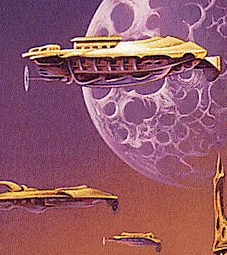
Doomite Freighter
Awesome Vehicle
HD: 124, hp 832
AC: 24, Hardness 10
Speed: As Helmsman’s Int x’s 10 in Wildspace, fly 60 ft. in a gravity well.
Atk: Blunt ram (3d8), or 3 Medium Cannons (10d6)
SV: 3
----------
Crew: 4/40
Air Capacity: 13,888 man-days
Landing: Land
Power Type: Major Helm (see Helms)
Cargo: 30 Tons
Keel/Beam Length: 250ft/60 ft
Cost: 257,000 gp
The Doomite Freighter is the workhorse of the Galran Blueskins. but can sometimes be found operating as a pirate ship or independent trade-ship. These ships serve often as slaver ships, but also transport other goods, troops and Robeasts and other creatures. All Doomite Freighters are adorned with the skull of a Space Demon used as a blunt ram and a smaller demon skull for use as a crows nest/scrying tower.
Doomite Freighters are equipped with at least six Doomite Fighter-Craft (Large Vehicle), and can hold similar sized vehicles. Ships are launched through doors that open in the skull-rams eyes. These ships are the primary defense of the freighter, though the ship also has three aft-facing cannons in case of trouble.
Crows Nest: These ships are equipped with a special chamber that comes equipped with a immovable crystal ball (normal type). The ships wizard typically uses the crows nest as his or her lab room.
Speaking Tubes: Doomite freighters are equipped with speaking tubes that allow all decks to instantly communicate with one another.
This ship and the setting it is designed for uses the Blood and Treasure RPG rules. Its a melding of Old School gaming and the newer, smoother-running games rules. Its a game that is fairly rules light, but has just enough crunch to satisfy my gaming appetite. All the cool kids are doing it.
Showing posts with label Voidships. Show all posts
Thursday, August 14, 2014
Friday, August 1, 2014
The Psychic Class
This class, along with the Scientist , and the Leech is posted here with permission by John Stater over at The Land of Nod. It and other excellent classes are detailed in The Nod Companion along with spells, races and other features for use in the Blood and Treasure RPG.
THE PSYCHIC
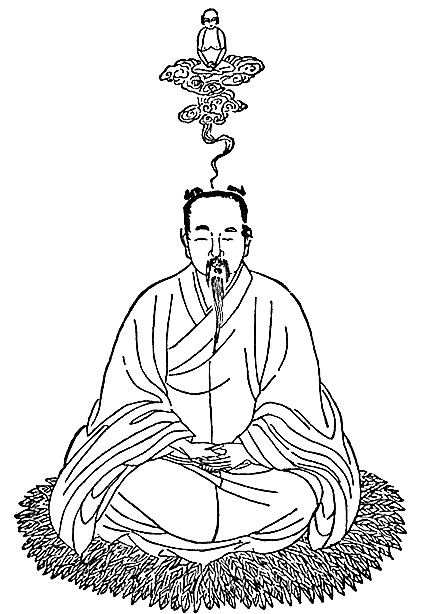
The inclusion of a psychic character class is often a controversial one in fantasy role‐playing. Magic‐users who command several spells based on psychic phenomenon make sense, but psychics are often viewed as a distraction, something more fit to science fantasy than the traditional fantasy genre.
Voidjammer (and Spelljammer) deals with such a wide range of possibilities for race, locations, magic and mystery, that the Psychic class can be an easy fit. However, even in Spelljammer, Psychics stand out, the powers they exhibit are in many ways more powerful than spells of similar nature (at lower levels at least), and so psychics can expect to be held in as much suspicion as Sorcerers.
Psychics in fiction are widespread, particularly in the "softer" sort of science fiction, though even the hardest science fiction can sometimes shoehorn in Psychic like beings. But in fiction more familiar to fantasy fans, several excellent sources spring to my mind.
The Mars and Venus books by Edgar Rice Burroughs have loads of psychic powers along with lots of derring-do and weird technology. The Talents Universe by Anne McCaffrey is chock full of psychics and psychic powers. Madeleine L'Engle's Time Quartet has a range of Psychic powers in it, and has an interesting angle on psychic powers. But for that fantasy feel the Dune books by Frank Herbert (not the ones by his son) are hard to beat for weird psychics and how they might be used in a civilization.
NausicaƤ of the Valley of the Wind is a marvellous Manga, and has a number of excellent examples of the Psychic class, as all of the settings spiritual leaders are Psychics. The manga (and if you must; the Anime) is excellent inspiration for a desolate planet in Voidjammer. But in American comics, its hard to beat the Tales of The Jedi by Dark Horse comics.
The psychic learns to focus her innate mental powers to create astounding psychic phenomena. Psychics must go through a training regimen not dissimilar to monks. But where monks train their bodies, psychics train their minds. In-fact Psychics and Monks might make excellent companions and might even have monasteries in common. Dual Classed Monk/Psychics would not be out of place by any means.
REQUIREMENTS
- Intelligence, Wisdom and Charisma must total at least 35
ARMOR ALLOWED
- Padded and leather armor, bucklers and shields
WEAPONS ALLOWED
- Club, dagger, dart, hand axe, light crossbow, quarterstaff, short bow, sling, spear
SKILLS
- Find Secret Doors, Trickery
CLASS ABILITIES
-The most basic ability a psychic has is her sixth sense, which warns her of danger. Because of their sixth sense, psychics are only surprised on a roll of 1 on 1d8. Psychics receive a +1 bonus on saving throws made to avoid traps.
-Psychics train their minds to be veritable fortresses. This gives them a +1 bonus on saving throws against mental magic and the powers of other psychics. At 6th level, this bonus improves to +2.
-Psionic powers are divided into two types, Psi‐Gamma and Psi‐Kappa. Psi‐Gamma powers are telepathic, and mostly associated with knowledge and the senses. Psi‐Kappa powers are telekinetic
and have an impact on the physical world.
At each level, the psychic opens the door to a new psionic power. The psychic can choose any minor power from the psi‐kappa or psi‐gamma list. The psychic can only have one major power for every three minor powers she has from a list (i.e. a psychic with six minor psi‐kappa powers is permitted to know two major psikappa powers).
To use a minor psychic power, the psychic must succeed at a Will saving throw, and her subject (if there is a subject) must fail a saving throw, the type varies. The subject of a psychic power must be within the psychic’s field of vision unless the power’s description says otherwise. Activating major powers uses the
same rules, but the psychic must succeed at two checks.
If a psychic fails a saving throw to activate a power, that power closes to her for 24 hours and until she spends one hour in meditation the next day.
-A 9th level psychic can choose to establish a stronghold in the wilderness and gain followers. A psychic who becomes a psi‐lord or psi‐lady attracts 1d6 men‐at‐arms per level, 1d6 first level psychics who wish to train under them and one 3rd level psychic to serve as a lieutenant.
Apopsi: Activating this power is done at a ‐10 penalty. It completely suppresses 1d4 psionic powers of a single opponent, who receives a Will saving throw for each of these powers to resist. The powers suppressed are chosen by the user of apopsi, who also learns of his opponent’s full complement of powers. The powers are all suppressed for the next 24 hours.
Astral Projection: The psychic can enter a trance and project his astral spirit from his physical body. This astral spirit is incorporeal and unable to interact with the physical world. Astral spirits can only communicate using the power of telepathy. An astral spirit can travel freely over the physical world, and can enter the
ethereal and astral planes at will. The astral spirit can interact with objects and creatures on the ethereal and astral planes, and can communicate normally therein. If a psychic’s astral spirit is killed, his physical body dies as well.
Aura Sight: This power allows you to discern auras. Auras are invisible to the naked eye, but to a psychic viewer manifesting this power they appear as glowing halos or envelopes of colored light that surround all objects. The color of each aura reveals information to the psychic. The amount of information revealed
depends on how long you study a particular area. In the first round, you discern auras of Law (Good) and Chaos (Evil), even if the owner of the aura is otherwise invisible. In the second round, you discern magical auras. In the third round, you discern how powerful (hit dice or level) individuals are, and if they are near
death (less than 10% of their hit points remaining).
Biofeedback: With biofeedback, you toughen your body and ignore pain, reducing physical damage by 2 points per hit for 1 minute per psychic level.
Body Adaptation: With this power, your body adapts to hostile environments: Underwater, extremely hot or cold, or airless environments. You can survive as if you were a creature native to that environment. You can breathe and move (though environmental penalties to movement and attacks still apply) and you take no damage simply from being in that environment. You need not specify what environment you are adapting to when you manifest this power. Extreme environments: Acid, lava, fire and electricity, can be adapted to enough to halve damage from the environment by half.
Body Adjustment: This power allows you to adjust your body at the cellular level, healing yourself of 1d6 points of damage.
Catapsi: By activating this power you generate psychic static that infers with the ability of other psionic characters to activate their powers. All psionic activation rolls within a 20‐ft. radius centered on you suffer a ‐4 penalty.
Channeling: By opening his mind to the cosmos, the psychic can commune with higher planes (as the magic‐user spell contact other plane). Channeling is a difficult power to control, and imposes a ‐5 penalty on the psychic’s activation saving throw. A failure to activate this power results in the psychic’s personality
(or alignment) changing (as determined by the TK) for 1d6 days.
Choke: You cause the victim’s throat to tighten until he begins to choke. The victim must make an immediate Fortitude save in order to hold his breath. The save must be repeated each round, with the difficulty increasing by 1 for each previous success. When the character fails one of these saves, he begins to choke. A choking victim is stunned and suffers 1d3 points of damage per round.
Clairsentience: A psychic with these abilities can see or hear the going’s on in a distant place. If the psychic has never been in this place, or does not know somebody present, his activation roll to activate this ability is made at a ‐5 penalty.
Cloud Minds: With this ability, a psychic can cloud people’s minds, making him invisible to them. Just as with the magic‐user spell invisibility, an attack by the psychic spoils the effect. If used on multiple subjects, the psychic suffers a ‐1 penalty to his roll to activate the power for each subject beyond the first.
Dimension Door: Dimension door is a weak form of teleportation. Using this power, the psychic may teleport himself, an object, or another person with perfect accuracy to the stated location, as long as it is within the spell’s range.
Dominate: With this power, you can control the actions of any humanoid creature through a telepathic link that you establish with the subject’s mind. Once you have given a dominated creature a command, it continues to attempt to carry out that command to the exclusion of all other activities except those necessary for day‐to‐day survival. Subjects resist this control with a Will save, and any subject forced to take actions against its nature receives a new saving throw with a +2 bonus. Obviously self‐destructive orders are not carried out. Once control is established, the range at which it can be exercised is unlimited, as long as you and the subject are on the same plane. Dominating non‐humanoids is done with a ‐5 penalty to the psychic’s
activation roll.
Dowsing: Using a dowsing rod, the psychic can find the nearest source of fresh water. He can also use this power to discover the location of precious metals and gems, but suffers a ‐3 penalty to his activation roll to do so.
Ego Whip: This is the psychic’s ability to stun another sentient creature by causing terrible pain and trauma in their mind. A stunned creature remains stunned for a number of rounds equal to the psychic’s level. An ego whip can only be used on a single creature.
Empathic Projection: This is the ability to project powerful emotions (anger, joy, sorrow, fear) in the mind of a subject. It is up to the TK to determine the effects these emotions might have on a situation. A psychic who fails his roll to activate this power must make an additional activation roll or be struck with the
emotions himself.
ESP: With this ability, the psychic can read a subject’s mind, as with the magic‐user spell detect thoughts.
Etherealness: This power functions like the spell ethereal jaunt, except that you and other willing creatures that are joined by linked hands become ethereal. Besides yourself, you can bring one creature per three levels to the Ethereal Plane. Once ethereal, the subjects need not stay together. When the spell expires, all affected creatures on the Ethereal Plane return to their material existence.
Id Insinuation: By insinuating his own thoughts and memories in an opponent’s mind, the psychic causes either confusion (per the magic‐user spell) or insanity (likewise). Attempting to cause insanity imposes a ‐10 penalty on the psychic’s activation roll. A failure to activate this power forces the psychic to pass a saving
throw or suffer from insanity himself.
Illusion: The psychic can use this ability to plant powerful illusions inside a person’s mind. In general, these illusions correspond to the following magic‐user spells: Phantasmal force, spectral force, and improved phantasmal force. Activation rolls for this power suffer a penalty equal to the spell’s level.
Inertial Barrier: You create a skin‐tight psychokinetic barrier around yourself that resists blows, cuts, stabs, and slashes, as well as providing some protection against falling. You gain a +5 bonus to AC and suffer half damage from falls.
Intellect Fortress: You encase yourself and your allies in a shimmering fortress of telekinetic force. All damage from mind-affecting effects, including those that deal charisma, intelligence or wisdom damage, is halved. You can activate this power when it is not your turn with a single thought, including just before an
opponent attacks you.
Matter Agitation: This is the ability to cause objects to burst into flames. The ability can only be used on flammable objects, and inflicts 1d4 points of damage per psychic level. Activating the power requires a full round of concentration on the part of the psychic. Failure to this activate this power requires the psychic to
make an additional Will save to avoid being damaged himself.
Matter Manipulation: With this power, you can weaken or strengthen the substance of an object or structure. You can affect both mundane and magical inanimate material. Weakening an object’s substance gives it a penalty of ‐3 on any item saving throw it is forced to make. Naturally, the opposite is true if you fortify the object.
Mental Barrier: A mental barrier is a field of improbability that surrounds you (and you alone), creating a fleeting protective shell that increases your Armor Class by +4. You can activate this power instantly, quickly enough to gain its benefits in an emergency. You can use this power even when it’s not your turn; however, you must manifest it prior to an opponent’s attack roll in order to gain this power’s benefit against that attack.
Mesmerism: This is the ability to put others into a trance, thus gaining the ability to question them truthfully or implant suggestions in their mind. Implanting a suggestion works as the magic‐user spell of the same name and imposes a ‐5 penalty on the psychic’s activation roll.
Metamorphosis: With metamorphosis, you assume the form of a creature of the same type as your normal form, or any other type except construct, elemental, outsider, and undead or a form that is incorporeal or gaseous. In all other respects, this power works like the spell polymorph self. You can also use this power to
assume the form of an inanimate object, though not a complex mechanism unless you understand how such a mechanism functions. While in the form of an object, you retain your normal senses and your ability to speak, and can only activate other powers by accepting a ‐5 penalty on those rolls. Damage sustained while in object form is also sustained by your body.
Mindlink: You forge a telepathic mind link with a chosen target. This bond functions over any distance.
Mind Switch: You can attempt to take control of a nearby living creature, forcing your mind and soul into its body, and its mind and soul into your body. You can target any creature whose Hit Dice are equal to or less than your level. If the target fails a Will saving throw, you possess their body, essentially replacing its
mentality (and mental ability scores) with your own, including your psionic powers. Its mind and mental ability scores are shifted to your body. This state lasts for 1 turn per level. While in the other body, you retain your own hit points, saves, skills and feats, and vice versa. If you fail an activation roll to use this power
you are stunned for 1d6 rounds.
Mind Thrust: With a sharp thrust of his mental powers into the mind of one sentient opponent, the psychic inflicts 1d6 points of damage plus one point of damage for every point difference between his own and his opponent’s intelligence scores. If an opponent’s intelligence score is unknown, assume that it is a 10.
For sentient monsters, use the following intelligence scores:
Plane Shift: You move yourself or some other creature to another plane of existence or alternate dimension. If several willing persons link hands in a circle, as many as eight can be affected by the plane shift at the same time. Precise accuracy as to a particular arrival location on the intended plane is nigh
impossible. From the Material Plane, you can reach any other plane, though you appear 5 to 500 miles (1d100 x 5) from your intended destination.
Precognition: Precognition allows your mind to glimpse fragments of potential future events. What you see will probably happen if no one takes action to change it, but your vision is incomplete and it makes no real sense until the actual events you glimpsed begin to unfold. In practice, activating this power grants you a
“precognitive edge” for 10 minutes per level. During this period, you can apply a +1 bonus to any one attack roll, damage roll or saving throw. You can elect to apply the bonus to the roll after you determine that your unmodified roll is lower than desired.
Psionic Blast: A psionic blast works like an ego whip, but instead stuns creatures in 30‐ft cone emanating from the psychic’s forehead. A psychic suffers a ‐5 penalty to activate a psionic blast.
Psychic Crush: Your will abruptly and brutally crushes the mental essence of any one creature, debilitating its acumen. The target must make a Will saving throw with a +4 bonus or collapse unconscious at 0 hit points. If the target succeeds on the save, it takes 3d6 points of damage.
Psychic Surgery: Psychic surgery can be used to double a creature’s natural healing or to grant a subject a +1 bonus to save against diseases. It can also be used to heal or inflict 1d6 points of damage. This requires the psychic to physically touch the subject, and the psychic’s saving throw to activate the power is made at a
‐5 penalty. At 5th level, the psychic can heal or inflict 2d6 points of damage. At 10th level, 3d6 points of damage.
Psychofeedback: You can readjust your body to boost one physical ability score at the expense of one or more other scores. Select one ability score you would like to boost, and increase it by the same amount that you decrease one or more other scores. This boost lasts for 1 minute, but the lowered ability scores only regenerate at the natural rate of healing; i.e. one point per day.
Psychometry: This is the psychic’s ability to read the vibrations given off by an object or place, allowing him to learn elements of its history such as who last held the device, how it is used or traumatic events that took place there. In effect, it works like the magic‐user spell legend lore. The TK might impose penalties on
the psychic’s saving throw to activate this power depending on the age and provenance of the object or place being read.
Reddopsi: Activating this power is at a ‐5 penalty on the activation roll. With reddopsi, powers used against you rebound on the activator if they fail a Will saving throw.
Schism: Your mind splits into two independent parts. Each part functions in complete autonomy, like two characters in one body.
Your new “second mind” does not control your body physically but is free to take one action in each round if the action is purely mental, such as activating a power. Your second mind does not gain any advantages if you are subject to a haste effect, although you gain the overall standard benefits.
Suspend Life: You can place yourself into a trance so deep that you are almost in suspended animation. Even powers that detect life or thought are incapable of determining that you are alive. While you are suspended, a year feels as though it were a day.
Telekinesis: This is the ability to move small objects with one’s mind. For precise telekinetic control of a small object, a ‐5 penalty is imposed on the psychic’s saving throw to activate this power. Otherwise, impose a penalty of ‐2 per 20 pounds of the object being moved.
Telepathy: With this ability the psychic can project his thoughts into the minds of other creatures. Penalties may be applied to this ability based on the distance of the psychic’s target or when he tries to communicate with several people at once. If communicating with non‐sentient creatures, the psychic suffers a ‐5 penalty. A like penalty is suffered when communicating with the alien minds of aberrations.
Teleportation: This power allows a psychic to teleport (as the magic‐user spell) objects. The psychic can teleport creatures, but suffers a ‐5 penalty to his saving throw to activate the power. Teleporting multiple objects or creatures imposes a ‐1 penalty to his activation roll per creature or object beyond the first.
Temporal Acceleration: You enter another time frame, speeding up so greatly that all other creatures seem frozen, though they are actually still moving at normal speed. You are free to act for 1 round of apparent time. You can activate powers, cast spells, move, etc. While your temporal acceleration is in effect, other
creatures are invulnerable to your attacks and powers. This means you cannot target a creature with any attack or power.
However, a power you activate that affects an area and has a duration longer than the remaining duration of your temporal acceleration has its normal effect on creatures in the area once this power ends. You can affect an unattended object but not an object held, carried, or worn by another creature. You are undetectable by any means while temporal acceleration lasts.
Thought Shield: You fortify your mind against intrusions, gaining magic resistance 15% against all mind‐affecting spells and special abilities. You can activate this power when it is not your turn, including just before an opponent attacks you.
Tower of Iron Will: You generate a bastion of thought so strong that it offers protection to you and everyone around you, improving the self‐control of all. You and all creatures in the spell’s area gain magic resistance 45% against all mind‐affecting spells and special abilities. You can activate this power when it is not your turn, including just before an opponent attacks you.
Transvection: A psychic can use transvection to cause himself to levitate (as the magic‐user spell). It can also be used to fly (as the magic‐user spell), but such use imposes a ‐5 penalty to the psychic's activation saving throw.
True Seeing: You gain the ability to see all things as they actually are, seeing through normal and magical darkness, noticing secret doors hidden by magic, seeing the exact locations of creatures or objects under blur or displacement effects, seeing invisible creatures or objects normally, seeing through illusions, and
seeing the true form of polymorphed, changed, or transmuted things. You can focus your vision to see into the Ethereal Plane, but not into extra‐dimensional spaces.
Ubiquitous Vision: You have metaphoric “eyes in the back of your head” for 1 hour after activating this power. In effect, you have a 360‐degree sphere of sight and cannot be back stabbed. You are only surprised on a roll of 1 on 1d10, but you take a ‐2 penalty on saves against all gaze attacks during the power’s duration.
THE PSYCHIC

The inclusion of a psychic character class is often a controversial one in fantasy role‐playing. Magic‐users who command several spells based on psychic phenomenon make sense, but psychics are often viewed as a distraction, something more fit to science fantasy than the traditional fantasy genre.
Voidjammer (and Spelljammer) deals with such a wide range of possibilities for race, locations, magic and mystery, that the Psychic class can be an easy fit. However, even in Spelljammer, Psychics stand out, the powers they exhibit are in many ways more powerful than spells of similar nature (at lower levels at least), and so psychics can expect to be held in as much suspicion as Sorcerers.
Psychics in fiction are widespread, particularly in the "softer" sort of science fiction, though even the hardest science fiction can sometimes shoehorn in Psychic like beings. But in fiction more familiar to fantasy fans, several excellent sources spring to my mind.
The Mars and Venus books by Edgar Rice Burroughs have loads of psychic powers along with lots of derring-do and weird technology. The Talents Universe by Anne McCaffrey is chock full of psychics and psychic powers. Madeleine L'Engle's Time Quartet has a range of Psychic powers in it, and has an interesting angle on psychic powers. But for that fantasy feel the Dune books by Frank Herbert (not the ones by his son) are hard to beat for weird psychics and how they might be used in a civilization.
NausicaƤ of the Valley of the Wind is a marvellous Manga, and has a number of excellent examples of the Psychic class, as all of the settings spiritual leaders are Psychics. The manga (and if you must; the Anime) is excellent inspiration for a desolate planet in Voidjammer. But in American comics, its hard to beat the Tales of The Jedi by Dark Horse comics.
The psychic learns to focus her innate mental powers to create astounding psychic phenomena. Psychics must go through a training regimen not dissimilar to monks. But where monks train their bodies, psychics train their minds. In-fact Psychics and Monks might make excellent companions and might even have monasteries in common. Dual Classed Monk/Psychics would not be out of place by any means.
- Intelligence, Wisdom and Charisma must total at least 35
ARMOR ALLOWED
- Padded and leather armor, bucklers and shields
WEAPONS ALLOWED
- Club, dagger, dart, hand axe, light crossbow, quarterstaff, short bow, sling, spear
SKILLS
- Find Secret Doors, Trickery
CLASS ABILITIES
-The most basic ability a psychic has is her sixth sense, which warns her of danger. Because of their sixth sense, psychics are only surprised on a roll of 1 on 1d8. Psychics receive a +1 bonus on saving throws made to avoid traps.
-Psychics train their minds to be veritable fortresses. This gives them a +1 bonus on saving throws against mental magic and the powers of other psychics. At 6th level, this bonus improves to +2.
-Psionic powers are divided into two types, Psi‐Gamma and Psi‐Kappa. Psi‐Gamma powers are telepathic, and mostly associated with knowledge and the senses. Psi‐Kappa powers are telekinetic
and have an impact on the physical world.
At each level, the psychic opens the door to a new psionic power. The psychic can choose any minor power from the psi‐kappa or psi‐gamma list. The psychic can only have one major power for every three minor powers she has from a list (i.e. a psychic with six minor psi‐kappa powers is permitted to know two major psikappa powers).
To use a minor psychic power, the psychic must succeed at a Will saving throw, and her subject (if there is a subject) must fail a saving throw, the type varies. The subject of a psychic power must be within the psychic’s field of vision unless the power’s description says otherwise. Activating major powers uses the
same rules, but the psychic must succeed at two checks.
If a psychic fails a saving throw to activate a power, that power closes to her for 24 hours and until she spends one hour in meditation the next day.
-A 9th level psychic can choose to establish a stronghold in the wilderness and gain followers. A psychic who becomes a psi‐lord or psi‐lady attracts 1d6 men‐at‐arms per level, 1d6 first level psychics who wish to train under them and one 3rd level psychic to serve as a lieutenant.
Apopsi: Activating this power is done at a ‐10 penalty. It completely suppresses 1d4 psionic powers of a single opponent, who receives a Will saving throw for each of these powers to resist. The powers suppressed are chosen by the user of apopsi, who also learns of his opponent’s full complement of powers. The powers are all suppressed for the next 24 hours.
Astral Projection: The psychic can enter a trance and project his astral spirit from his physical body. This astral spirit is incorporeal and unable to interact with the physical world. Astral spirits can only communicate using the power of telepathy. An astral spirit can travel freely over the physical world, and can enter the
ethereal and astral planes at will. The astral spirit can interact with objects and creatures on the ethereal and astral planes, and can communicate normally therein. If a psychic’s astral spirit is killed, his physical body dies as well.
Aura Sight: This power allows you to discern auras. Auras are invisible to the naked eye, but to a psychic viewer manifesting this power they appear as glowing halos or envelopes of colored light that surround all objects. The color of each aura reveals information to the psychic. The amount of information revealed
depends on how long you study a particular area. In the first round, you discern auras of Law (Good) and Chaos (Evil), even if the owner of the aura is otherwise invisible. In the second round, you discern magical auras. In the third round, you discern how powerful (hit dice or level) individuals are, and if they are near
death (less than 10% of their hit points remaining).
Biofeedback: With biofeedback, you toughen your body and ignore pain, reducing physical damage by 2 points per hit for 1 minute per psychic level.
Body Adaptation: With this power, your body adapts to hostile environments: Underwater, extremely hot or cold, or airless environments. You can survive as if you were a creature native to that environment. You can breathe and move (though environmental penalties to movement and attacks still apply) and you take no damage simply from being in that environment. You need not specify what environment you are adapting to when you manifest this power. Extreme environments: Acid, lava, fire and electricity, can be adapted to enough to halve damage from the environment by half.
Body Adjustment: This power allows you to adjust your body at the cellular level, healing yourself of 1d6 points of damage.
Catapsi: By activating this power you generate psychic static that infers with the ability of other psionic characters to activate their powers. All psionic activation rolls within a 20‐ft. radius centered on you suffer a ‐4 penalty.
Channeling: By opening his mind to the cosmos, the psychic can commune with higher planes (as the magic‐user spell contact other plane). Channeling is a difficult power to control, and imposes a ‐5 penalty on the psychic’s activation saving throw. A failure to activate this power results in the psychic’s personality
(or alignment) changing (as determined by the TK) for 1d6 days.
Choke: You cause the victim’s throat to tighten until he begins to choke. The victim must make an immediate Fortitude save in order to hold his breath. The save must be repeated each round, with the difficulty increasing by 1 for each previous success. When the character fails one of these saves, he begins to choke. A choking victim is stunned and suffers 1d3 points of damage per round.
Clairsentience: A psychic with these abilities can see or hear the going’s on in a distant place. If the psychic has never been in this place, or does not know somebody present, his activation roll to activate this ability is made at a ‐5 penalty.
Cloud Minds: With this ability, a psychic can cloud people’s minds, making him invisible to them. Just as with the magic‐user spell invisibility, an attack by the psychic spoils the effect. If used on multiple subjects, the psychic suffers a ‐1 penalty to his roll to activate the power for each subject beyond the first.
Dimension Door: Dimension door is a weak form of teleportation. Using this power, the psychic may teleport himself, an object, or another person with perfect accuracy to the stated location, as long as it is within the spell’s range.
Dominate: With this power, you can control the actions of any humanoid creature through a telepathic link that you establish with the subject’s mind. Once you have given a dominated creature a command, it continues to attempt to carry out that command to the exclusion of all other activities except those necessary for day‐to‐day survival. Subjects resist this control with a Will save, and any subject forced to take actions against its nature receives a new saving throw with a +2 bonus. Obviously self‐destructive orders are not carried out. Once control is established, the range at which it can be exercised is unlimited, as long as you and the subject are on the same plane. Dominating non‐humanoids is done with a ‐5 penalty to the psychic’s
activation roll.
Dowsing: Using a dowsing rod, the psychic can find the nearest source of fresh water. He can also use this power to discover the location of precious metals and gems, but suffers a ‐3 penalty to his activation roll to do so.
Ego Whip: This is the psychic’s ability to stun another sentient creature by causing terrible pain and trauma in their mind. A stunned creature remains stunned for a number of rounds equal to the psychic’s level. An ego whip can only be used on a single creature.
Empathic Projection: This is the ability to project powerful emotions (anger, joy, sorrow, fear) in the mind of a subject. It is up to the TK to determine the effects these emotions might have on a situation. A psychic who fails his roll to activate this power must make an additional activation roll or be struck with the
emotions himself.
ESP: With this ability, the psychic can read a subject’s mind, as with the magic‐user spell detect thoughts.
Etherealness: This power functions like the spell ethereal jaunt, except that you and other willing creatures that are joined by linked hands become ethereal. Besides yourself, you can bring one creature per three levels to the Ethereal Plane. Once ethereal, the subjects need not stay together. When the spell expires, all affected creatures on the Ethereal Plane return to their material existence.
Id Insinuation: By insinuating his own thoughts and memories in an opponent’s mind, the psychic causes either confusion (per the magic‐user spell) or insanity (likewise). Attempting to cause insanity imposes a ‐10 penalty on the psychic’s activation roll. A failure to activate this power forces the psychic to pass a saving
throw or suffer from insanity himself.
Illusion: The psychic can use this ability to plant powerful illusions inside a person’s mind. In general, these illusions correspond to the following magic‐user spells: Phantasmal force, spectral force, and improved phantasmal force. Activation rolls for this power suffer a penalty equal to the spell’s level.
Inertial Barrier: You create a skin‐tight psychokinetic barrier around yourself that resists blows, cuts, stabs, and slashes, as well as providing some protection against falling. You gain a +5 bonus to AC and suffer half damage from falls.
Intellect Fortress: You encase yourself and your allies in a shimmering fortress of telekinetic force. All damage from mind-affecting effects, including those that deal charisma, intelligence or wisdom damage, is halved. You can activate this power when it is not your turn with a single thought, including just before an
opponent attacks you.
Matter Agitation: This is the ability to cause objects to burst into flames. The ability can only be used on flammable objects, and inflicts 1d4 points of damage per psychic level. Activating the power requires a full round of concentration on the part of the psychic. Failure to this activate this power requires the psychic to
make an additional Will save to avoid being damaged himself.
Matter Manipulation: With this power, you can weaken or strengthen the substance of an object or structure. You can affect both mundane and magical inanimate material. Weakening an object’s substance gives it a penalty of ‐3 on any item saving throw it is forced to make. Naturally, the opposite is true if you fortify the object.
Mental Barrier: A mental barrier is a field of improbability that surrounds you (and you alone), creating a fleeting protective shell that increases your Armor Class by +4. You can activate this power instantly, quickly enough to gain its benefits in an emergency. You can use this power even when it’s not your turn; however, you must manifest it prior to an opponent’s attack roll in order to gain this power’s benefit against that attack.
Mesmerism: This is the ability to put others into a trance, thus gaining the ability to question them truthfully or implant suggestions in their mind. Implanting a suggestion works as the magic‐user spell of the same name and imposes a ‐5 penalty on the psychic’s activation roll.
Metamorphosis: With metamorphosis, you assume the form of a creature of the same type as your normal form, or any other type except construct, elemental, outsider, and undead or a form that is incorporeal or gaseous. In all other respects, this power works like the spell polymorph self. You can also use this power to
assume the form of an inanimate object, though not a complex mechanism unless you understand how such a mechanism functions. While in the form of an object, you retain your normal senses and your ability to speak, and can only activate other powers by accepting a ‐5 penalty on those rolls. Damage sustained while in object form is also sustained by your body.
Mindlink: You forge a telepathic mind link with a chosen target. This bond functions over any distance.
Mind Switch: You can attempt to take control of a nearby living creature, forcing your mind and soul into its body, and its mind and soul into your body. You can target any creature whose Hit Dice are equal to or less than your level. If the target fails a Will saving throw, you possess their body, essentially replacing its
mentality (and mental ability scores) with your own, including your psionic powers. Its mind and mental ability scores are shifted to your body. This state lasts for 1 turn per level. While in the other body, you retain your own hit points, saves, skills and feats, and vice versa. If you fail an activation roll to use this power
you are stunned for 1d6 rounds.
Mind Thrust: With a sharp thrust of his mental powers into the mind of one sentient opponent, the psychic inflicts 1d6 points of damage plus one point of damage for every point difference between his own and his opponent’s intelligence scores. If an opponent’s intelligence score is unknown, assume that it is a 10.
For sentient monsters, use the following intelligence scores:
Plane Shift: You move yourself or some other creature to another plane of existence or alternate dimension. If several willing persons link hands in a circle, as many as eight can be affected by the plane shift at the same time. Precise accuracy as to a particular arrival location on the intended plane is nigh
impossible. From the Material Plane, you can reach any other plane, though you appear 5 to 500 miles (1d100 x 5) from your intended destination.
Precognition: Precognition allows your mind to glimpse fragments of potential future events. What you see will probably happen if no one takes action to change it, but your vision is incomplete and it makes no real sense until the actual events you glimpsed begin to unfold. In practice, activating this power grants you a
“precognitive edge” for 10 minutes per level. During this period, you can apply a +1 bonus to any one attack roll, damage roll or saving throw. You can elect to apply the bonus to the roll after you determine that your unmodified roll is lower than desired.
Psionic Blast: A psionic blast works like an ego whip, but instead stuns creatures in 30‐ft cone emanating from the psychic’s forehead. A psychic suffers a ‐5 penalty to activate a psionic blast.
Psychic Crush: Your will abruptly and brutally crushes the mental essence of any one creature, debilitating its acumen. The target must make a Will saving throw with a +4 bonus or collapse unconscious at 0 hit points. If the target succeeds on the save, it takes 3d6 points of damage.
Psychic Surgery: Psychic surgery can be used to double a creature’s natural healing or to grant a subject a +1 bonus to save against diseases. It can also be used to heal or inflict 1d6 points of damage. This requires the psychic to physically touch the subject, and the psychic’s saving throw to activate the power is made at a
‐5 penalty. At 5th level, the psychic can heal or inflict 2d6 points of damage. At 10th level, 3d6 points of damage.
Psychofeedback: You can readjust your body to boost one physical ability score at the expense of one or more other scores. Select one ability score you would like to boost, and increase it by the same amount that you decrease one or more other scores. This boost lasts for 1 minute, but the lowered ability scores only regenerate at the natural rate of healing; i.e. one point per day.
Psychometry: This is the psychic’s ability to read the vibrations given off by an object or place, allowing him to learn elements of its history such as who last held the device, how it is used or traumatic events that took place there. In effect, it works like the magic‐user spell legend lore. The TK might impose penalties on
the psychic’s saving throw to activate this power depending on the age and provenance of the object or place being read.
Reddopsi: Activating this power is at a ‐5 penalty on the activation roll. With reddopsi, powers used against you rebound on the activator if they fail a Will saving throw.
Schism: Your mind splits into two independent parts. Each part functions in complete autonomy, like two characters in one body.
Your new “second mind” does not control your body physically but is free to take one action in each round if the action is purely mental, such as activating a power. Your second mind does not gain any advantages if you are subject to a haste effect, although you gain the overall standard benefits.
Suspend Life: You can place yourself into a trance so deep that you are almost in suspended animation. Even powers that detect life or thought are incapable of determining that you are alive. While you are suspended, a year feels as though it were a day.
Telekinesis: This is the ability to move small objects with one’s mind. For precise telekinetic control of a small object, a ‐5 penalty is imposed on the psychic’s saving throw to activate this power. Otherwise, impose a penalty of ‐2 per 20 pounds of the object being moved.
Telepathy: With this ability the psychic can project his thoughts into the minds of other creatures. Penalties may be applied to this ability based on the distance of the psychic’s target or when he tries to communicate with several people at once. If communicating with non‐sentient creatures, the psychic suffers a ‐5 penalty. A like penalty is suffered when communicating with the alien minds of aberrations.
Teleportation: This power allows a psychic to teleport (as the magic‐user spell) objects. The psychic can teleport creatures, but suffers a ‐5 penalty to his saving throw to activate the power. Teleporting multiple objects or creatures imposes a ‐1 penalty to his activation roll per creature or object beyond the first.
Temporal Acceleration: You enter another time frame, speeding up so greatly that all other creatures seem frozen, though they are actually still moving at normal speed. You are free to act for 1 round of apparent time. You can activate powers, cast spells, move, etc. While your temporal acceleration is in effect, other
creatures are invulnerable to your attacks and powers. This means you cannot target a creature with any attack or power.
However, a power you activate that affects an area and has a duration longer than the remaining duration of your temporal acceleration has its normal effect on creatures in the area once this power ends. You can affect an unattended object but not an object held, carried, or worn by another creature. You are undetectable by any means while temporal acceleration lasts.
Thought Shield: You fortify your mind against intrusions, gaining magic resistance 15% against all mind‐affecting spells and special abilities. You can activate this power when it is not your turn, including just before an opponent attacks you.
Tower of Iron Will: You generate a bastion of thought so strong that it offers protection to you and everyone around you, improving the self‐control of all. You and all creatures in the spell’s area gain magic resistance 45% against all mind‐affecting spells and special abilities. You can activate this power when it is not your turn, including just before an opponent attacks you.
Transvection: A psychic can use transvection to cause himself to levitate (as the magic‐user spell). It can also be used to fly (as the magic‐user spell), but such use imposes a ‐5 penalty to the psychic's activation saving throw.
True Seeing: You gain the ability to see all things as they actually are, seeing through normal and magical darkness, noticing secret doors hidden by magic, seeing the exact locations of creatures or objects under blur or displacement effects, seeing invisible creatures or objects normally, seeing through illusions, and
seeing the true form of polymorphed, changed, or transmuted things. You can focus your vision to see into the Ethereal Plane, but not into extra‐dimensional spaces.
Ubiquitous Vision: You have metaphoric “eyes in the back of your head” for 1 hour after activating this power. In effect, you have a 360‐degree sphere of sight and cannot be back stabbed. You are only surprised on a roll of 1 on 1d10, but you take a ‐2 penalty on saves against all gaze attacks during the power’s duration.
Wednesday, July 30, 2014
Voidjammer: Horde Void Cruiser
The Evil Horde from the classic He-Man and She-Ra franchise is so delightfully grim-n-Goofy that I think it is PERFECT for Voidjammer and Spelljammer. So expect more ships, weapons and monsters from the Filmation/Kenner cartoons and toys as well as many others from other old favorites.
Below is a general transport ship for The Horde, that showed up in numerous episodes of the cartoon(s). They are tough, versatile, and tough enough to make for worthy foes or even useful ships for adventurers.
This conversion uses the Blood and Treasure RPG system. Check it out! All the cool kids are doing it...
Horde Void Cruiser
Colossal Vehicle
HD: 22, 181 hp
AC: 18, Hardness 10
Speed: As per Helm and Helmsman
Atk: 2 Fireball Cannons (10d6) or 1 Lightning Gun (3d6)
SV: 3 (Metal)
----------
Crew: 1/2
Air Capacity: 2,400 man-days
Landing: Land
Power Type: Major Helm (see Helms)
Cargo: 20 tons
Keel/Beam Length: 180ft by 30ft
Cost: 42,000gp
The Horde Void Cruiser is a mass produced voidship used extensively by The Horde and its allies, though a number of these vessels are sold on the open market. The Void Cruiser is primarily a cargo hauler and troop transport for the Horde war effort, as its cargo bay is spacious enough to hold two Large Vehicles (usually Batmeks) one Huge Vehicle (usually a Destructo Tank) or up to 50 Horde Troopers. If stacked properly, a Horde Void Cruiser can hold a great deal of cargo with only a minimum of crew.
Though the standard Void Cruiser is fairly standard individual units are often stylized after the whims of the ships owner. Leering faces, eye-slit windows and other personal touches are common. All of these ships are combat ready and are typically accompanied by large numbers of Batmeks.
Weapons Helm: Alongside the ships standard Helm is the Weapons Helm. This seat can control the ships weapons and ramp doors remotely, allowing the Void Cruiser to rain destruction of the enemies of the Horde without additional crewmembers.
Airtight: Not only is a Void Cruisers deck covered, but the entire interior of the Voidship is airtight, and temperature controlled. This makes the Void Cruiser capable of flying through poisonous atmospheres without endangering any living crewmemebers and prevents the ships air from being fouled.
MOTU Examples: Annihilator, Doom Buster
Below is a general transport ship for The Horde, that showed up in numerous episodes of the cartoon(s). They are tough, versatile, and tough enough to make for worthy foes or even useful ships for adventurers.
This conversion uses the Blood and Treasure RPG system. Check it out! All the cool kids are doing it...
Horde Void Cruiser
Colossal Vehicle
HD: 22, 181 hp
AC: 18, Hardness 10
Speed: As per Helm and Helmsman
![]() |
| Hordaks Personal Cruiser |
----------
Crew: 1/2
Air Capacity: 2,400 man-days
Landing: Land
Power Type: Major Helm (see Helms)
Cargo: 20 tons
Keel/Beam Length: 180ft by 30ft
Cost: 42,000gp
Though the standard Void Cruiser is fairly standard individual units are often stylized after the whims of the ships owner. Leering faces, eye-slit windows and other personal touches are common. All of these ships are combat ready and are typically accompanied by large numbers of Batmeks.
Weapons Helm: Alongside the ships standard Helm is the Weapons Helm. This seat can control the ships weapons and ramp doors remotely, allowing the Void Cruiser to rain destruction of the enemies of the Horde without additional crewmembers.
Airtight: Not only is a Void Cruisers deck covered, but the entire interior of the Voidship is airtight, and temperature controlled. This makes the Void Cruiser capable of flying through poisonous atmospheres without endangering any living crewmemebers and prevents the ships air from being fouled.
MOTU Examples: Annihilator, Doom Buster
Tuesday, July 29, 2014
Voidjammer: Talon Fighter
Talon Fighter
Large Vehicle
HD: 15, 94 hp
AC: 15, Hardness 10
Speed: As Minor Helm and Helmsmen
Atk: 2 Talons (2d8), 2 Energy Missile Cannons (4d6+4)
SV: 4 (Steel)
----------
Crew: 1/2
Air Capacity: 100 man-days
Landing: Land Only
Power Type: Minor Helm*
Cargo: 2 tons
Keel/Beam Length: 12ft/20ft
Cost: 8,000gp
The Talon Fighter is a winged flying vehicle, which can carry two people on board, styled to resemble a bird of prey in flight. These voidships are still rare in the Spheres, but have already made a stir due to their versatility.These vessels have seen considerable action in recent days in battling The Horde during its advancement across the spheres. The Talon Fighter is extremely useful in battling the Batmek fighters employed by The Horde with one Talon Fighter being the equivalent of five Batmeks in battle.
In combat the Talon Fighter often relies on its Energy Missile Cannons and its great speed. In a pinch, these vehicles can employ their landing gear to claw ships and creatures in melee range.
Ether Wings*: The Talon Fighters wings allow it to fly at a speed equal to a Major Helm while equipped with only a Minor Helm (see Helms). The fighters tonnage is not affected.
Scrying Array: This marvelous device allows the helmsman or passenger to send messages to scry as per the spell cast by an tenth level magic user. See Scrying (see Blood and Treasure PHB page 141) for details.
Large Vehicle
![]() |
| Look at that thing! |
AC: 15, Hardness 10
Speed: As Minor Helm and Helmsmen
Atk: 2 Talons (2d8), 2 Energy Missile Cannons (4d6+4)
SV: 4 (Steel)
----------
Crew: 1/2
Air Capacity: 100 man-days
Landing: Land Only
Power Type: Minor Helm*
Cargo: 2 tons
Keel/Beam Length: 12ft/20ft
Cost: 8,000gp
The Talon Fighter is a winged flying vehicle, which can carry two people on board, styled to resemble a bird of prey in flight. These voidships are still rare in the Spheres, but have already made a stir due to their versatility.These vessels have seen considerable action in recent days in battling The Horde during its advancement across the spheres. The Talon Fighter is extremely useful in battling the Batmek fighters employed by The Horde with one Talon Fighter being the equivalent of five Batmeks in battle.
In combat the Talon Fighter often relies on its Energy Missile Cannons and its great speed. In a pinch, these vehicles can employ their landing gear to claw ships and creatures in melee range.
Ether Wings*: The Talon Fighters wings allow it to fly at a speed equal to a Major Helm while equipped with only a Minor Helm (see Helms). The fighters tonnage is not affected.
Scrying Array: This marvelous device allows the helmsman or passenger to send messages to scry as per the spell cast by an tenth level magic user. See Scrying (see Blood and Treasure PHB page 141) for details.
Wednesday, July 23, 2014
Voidjammer: Citadel Ships
Citadels are asteroids (celestial bodies) that have been converted into voidships. The process of conversion is a long one, requiring the installation of a massive helm of one kind or another, and the hollowing out of tunnels, living spaces and other features. Several races construct Citadel Ships, each with a slightly different look to the overall design. But the end result is much like a mobile, mini-world that is as much home as vessel.
Azer Citadels
The fiery Azer are close cousins to the Dwarves, and so it is small wonder that they have access to Dwarven Forges. Azer citadels are often found close to a crystal spheres sun (see Hot Orbital Zones), or near volcanic planets. Such citadels have shining towers and relatively smooth surfaces.
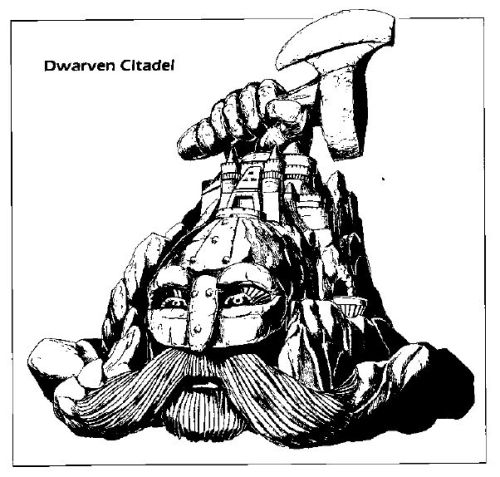
Dwarven Citadels
These flying mountains are similar in look and appearance as any number of Dwarf strongholds in most campaign worlds. These vessels all sport beautiful and functional craftsmanship and are home of entire Dwarf clans, often with room for other races for the purposes of trade. Glow moss and other subterranean plants are cultivated on Dwarven Citadels to help supply air, as well as a potential food source.
Fraal Citadels
The mysterious Fraal have their own citadels which they call Nationships. Such vessels are covered in observatories, greenhouse domes and all manner of wonderful structures, though these are always utilitarian rather than flamboyant. The forges themselves are replaced with laboratories, meditation chambers (for psychic discipline), and lecture halls. Weaponry on Fraal Nationships should be replaced with gadgets devised via the scientist class, firing a nasty assortment of weird energies rather than cannonballs and such.
Gnomish Citadels
The Minoi Gnomes of Wildspace also build citadels. However, while dwarf citadels are awe-inspiring structures of exquisite craftsmanship, Gnomish citadels are a riot of ungainly mechanisms and structures. Often, very little of the original asteroid is visible on a Gnomish Citadel, being liberally covered in elaborate devices, domes, spired and other attachments.
Citadel, Lesser
Awesome Vehicle
HD: 150, 800 hp
AC: 20, Hardness 25
Speed: As Helm
Atk: 4 Heavy Catapults (6d6), 8 Heavy Cannon (10d6), 12 Light Cannon (5d6), 3 Heavy Jettisons (3d8)
SV: 10 (Stone)
----------
Crew: 100/300
Air Capacity: 36,000 man-days
Landing: N/A
Power Type: Forge Helm or Gnomish Helm (see Helms)
Cargo: 150 tons
Keel/Beam Length: 150ft/120ft
Cost: 1,230,000 gp
These (max 300-ton) citadel is the smallest that a forge can power, and as a result, the most frequently encountered citadel in space. The majority of a citadel's space is taken up by the forge and the living quarters for the crew. Lesser citadels are usually mining ships, roving asteroid belts of the less hospitable regions of the spheres, harvesting ores and other treasures. Lesser citadels are usually outer colony ships serving a Greater Citadel or a stationary asteroid base.
Deckplans of any citadel ship should be handled as though mapping out a dungeon, and should be handled with care.
Citadel, Greater
Titanic Vehicle
HD: 350, 2,100 hp
AC 20, Hardness 40
Speed: As Helm
Atk: 8 Heavy Cannon (6d6), 16 Light Cannon (5d6), 24 Ballista (3d8), 6 Heavy Jettisons (3d8)
SV: 10 (Stone)
----------
Crew: 235/700
Air Capacity: 84,000 man-days.
Landing: N/A
Power Type: Forge Helm or Gnomish Helm (see Helms)
Cargo: 350 tons
Keel/Beam Length: 150ft/250ft
Cost: 2,870,000 gp
Greater Citadels are truly immense vessels, more like small mobile moons that voidships. At a maximum of 3,000 tons, Greater Citadels are amongst the largest and most powerful vessels in space. Like the Lesser Citadel, the majority of a citadel's space is taken up by the forge and the living quarters for the crew. However, these vessels sport even more elaborate structures both inside and outside its main body. Massive domes of glassteel, stout towers and a terrifying array of weapons all cover these ships.
Deckplans of any citadel ship should be handled as though mapping out a dungeon, and should be handled with care.
Azer Citadels
The fiery Azer are close cousins to the Dwarves, and so it is small wonder that they have access to Dwarven Forges. Azer citadels are often found close to a crystal spheres sun (see Hot Orbital Zones), or near volcanic planets. Such citadels have shining towers and relatively smooth surfaces.
Dwarven Citadels
These flying mountains are similar in look and appearance as any number of Dwarf strongholds in most campaign worlds. These vessels all sport beautiful and functional craftsmanship and are home of entire Dwarf clans, often with room for other races for the purposes of trade. Glow moss and other subterranean plants are cultivated on Dwarven Citadels to help supply air, as well as a potential food source.
Fraal Citadels
The mysterious Fraal have their own citadels which they call Nationships. Such vessels are covered in observatories, greenhouse domes and all manner of wonderful structures, though these are always utilitarian rather than flamboyant. The forges themselves are replaced with laboratories, meditation chambers (for psychic discipline), and lecture halls. Weaponry on Fraal Nationships should be replaced with gadgets devised via the scientist class, firing a nasty assortment of weird energies rather than cannonballs and such.
Gnomish Citadels
The Minoi Gnomes of Wildspace also build citadels. However, while dwarf citadels are awe-inspiring structures of exquisite craftsmanship, Gnomish citadels are a riot of ungainly mechanisms and structures. Often, very little of the original asteroid is visible on a Gnomish Citadel, being liberally covered in elaborate devices, domes, spired and other attachments.
Citadel, Lesser
Awesome Vehicle
HD: 150, 800 hpAC: 20, Hardness 25
Speed: As Helm
Atk: 4 Heavy Catapults (6d6), 8 Heavy Cannon (10d6), 12 Light Cannon (5d6), 3 Heavy Jettisons (3d8)
SV: 10 (Stone)
----------
Crew: 100/300
Air Capacity: 36,000 man-days
Landing: N/A
Power Type: Forge Helm or Gnomish Helm (see Helms)
Cargo: 150 tons
Keel/Beam Length: 150ft/120ft
Cost: 1,230,000 gp
These (max 300-ton) citadel is the smallest that a forge can power, and as a result, the most frequently encountered citadel in space. The majority of a citadel's space is taken up by the forge and the living quarters for the crew. Lesser citadels are usually mining ships, roving asteroid belts of the less hospitable regions of the spheres, harvesting ores and other treasures. Lesser citadels are usually outer colony ships serving a Greater Citadel or a stationary asteroid base.
Deckplans of any citadel ship should be handled as though mapping out a dungeon, and should be handled with care.
Citadel, Greater
Titanic Vehicle
HD: 350, 2,100 hp
AC 20, Hardness 40
Speed: As Helm
Atk: 8 Heavy Cannon (6d6), 16 Light Cannon (5d6), 24 Ballista (3d8), 6 Heavy Jettisons (3d8)SV: 10 (Stone)
----------
Crew: 235/700
Air Capacity: 84,000 man-days.
Landing: N/A
Power Type: Forge Helm or Gnomish Helm (see Helms)
Cargo: 350 tons
Keel/Beam Length: 150ft/250ft
Cost: 2,870,000 gp
Greater Citadels are truly immense vessels, more like small mobile moons that voidships. At a maximum of 3,000 tons, Greater Citadels are amongst the largest and most powerful vessels in space. Like the Lesser Citadel, the majority of a citadel's space is taken up by the forge and the living quarters for the crew. However, these vessels sport even more elaborate structures both inside and outside its main body. Massive domes of glassteel, stout towers and a terrifying array of weapons all cover these ships.
Deckplans of any citadel ship should be handled as though mapping out a dungeon, and should be handled with care.
Wednesday, July 9, 2014
Voidjammer: The Evil Horde
The Evil Horde is a vast, interstellar empire bent on the domination of various spheres across the universe. The centre of the empire is called Hordespace where the infernal House of Kur (see below) reigns supreme. The Horde possesses vast resources and has a great deal of highly sophisticated technology.
The Evil Horde (Horde for short) is a growing Empire whose forces have been spreading across the known spheres at an alarming rate.
The Horde is happy to make use of all manner of creatures, as long as they are of use to the eventual goals of The Horde. From Humanoids, Giants and Undead to the most bizarre and alien Aberrations and Outsiders. Only those deemed to unstable are rejected as the Horde is primarily Lawful Evil in alignment.
Worlds subjugated by The Horde are completely dominated. All planetary resources are devoured by the Hordes war machine. Strip mining, manufacture, agriculture and the gathering of slaves are all managed with brutal efficiency. Monstrous servants of the Horde are bolstered by enormous numbers of Horde Troopers (see below) and weapons.
The House of Kur (Nobles)
At the core of The Horde is an elite family of Tieflings and Half-Fiends known as the House of Kur. Though evil, members of The House of Kur are all fiercely loyal to one another and are firm believers in the goals of The Horde (conquest). This does not mean that all is friendly, far from it, but rather than outright infighting, the assorted members and branches of the family resort to political maneuverings, back-room deals and assassination.
The absolute rulers of the Horde are Half-Fiends (see Blood and Treasure GMG page 175) and should be created as fully detailed NPCs. Most are high level Assassins or Magic-Users, with the truly powerful amongst them are the equivalent of Demon Lords in power.
Horde Prime: Horde Prime (aka Anillus Kur) is the ruler of the vast Evil Horde. Nobody living knows the full extent of Horde Primes powers, but it is known that he is a master of Transmutation magic as well as being physically potent in battle. The Cult of The Horde reveres The Emperor and the goals of The Horde as a profane god. Clerics of The Horde are generalist (Chaos) clerics and not specialists.
Hordelings (Macabre)
Hordelings compose the majority of the extended Kur family, and can be found primarily in Crystal Spheres controlled by The Horde. This fiendish family resemble elf-like humanoids with pointed ears, pugnacious noses and a tendency to snort. Bright clothing and flamboyantly gruesome accoutrements are worn by hordelings, with bat and skill motifs being common. As members of this family advance in rank, further mutations are common, with members embracing various forms of magical mutation such as cybernetics, lycanthropy and the more powerful forms of undead (particularly vampirism).
Hordelings have been raised to see other races and cultures as naturally inferior. Even those rare few who are not Chaotic in alignment still see humanoid races as not-quite people.
HORDELING CHARACTERS
Hordelings are possessed of strange powers. All of them have rather special powers of regeneration, healing at double the normal human rate (i.e. 2 hp per day). Hordelings can see in the dark up to 120 feet. They speak common and might also know Infernal, Dwarf, Elf, Gnome, Goblin, Halfling and Orc. Hordelings can advance as assassin/fighters, assassin/clerics or assassin/magic‐users, or they can pursue a single class.
Each Hordeling has an additional extraordinary ability rolled on the following table:
D20 EXTRAORDINARY POWER
1 Can boost strength once per day per the strength spell
2 Resistance to fire
3 Resistance to acid
4 Resistance to electricity
5 +3 bonus to save vs. poison
6 +3 bonus to save vs. disease
7 Menagerie (commands a swarm of spiders, a swarm of bats a giant rat or a vulture)
8 Cast prestidigitation three times per day
9 Two Heads (surprise rolled on 1d8 instead of 1d6)
10 Has an imp or dretch as a boon companion.
11 Swordsman (+1 to hit with swords and +1 Armor Class while fighting with a sword)
12 Explosives (can mix and set off alchemist’s fire)
13 Inhumanly tall (-1 to dexterity, +2 to strength)
14 Inhumanly short (-3 to movement, +2 to strength)
15 Inhumanly fat (+3 to movement, +2 to constitution)
16 Inhumanly thin (-1 to constitution, +2 to dexterity)
17 Snarl (once per day, all within earshot must save vs. fear or be frightened for 1d6 rounds)
18 Regenerate 1 hit point per round up to half normal hit points unless reduced to 0 hit points
19 Covered in thick hair or scales (+2 to Armor Class)
20 Has a burrowing speed of 6
Horde Trooper
Medium Construct, Chaotic (LE), Low-Intelligent; Warband (4d6)
HD 4
AC 18
ATK 2 fists (1d8) or Energy Rod (1d6+1)
MV 10
SV F 14, R 15, W 14
XP 400 (CL 5)
A Horde Trooper is a member of the regular army of the Horde Empire. Although each trooper is individually unremarkable, in large numbers they are used to great effect in the occupation of conquered worlds. Vast armies of Horde Troopers are also used during invasion of a Crystal Sphere and planets. When not on the ground, Horde Troopers pilot Glondas, Bat Meks, and other vehicles.
All Horde Troopers come equipped with an Energy Rod that fires an energy missile (see page 83 of the Blood & Treasure PHB). For melee, most troopers use their fists, or have other weapons. As an added feature, Horde Troopers are capable of operating Series Helms as though they possessed spell-like abilities. This allows them to pilot Voidships equipped with such helms without endangering a magic user.
Horde Troopers are often deployed in large numbers as they are, hollow servants to the will of the Horde. However, Hordlings with rank within the Horde can wear these constructs as suits of Full Plate, which also grant darkvision 120ft and the benefits of a Necklace of Adaptation (see page 224 of the Blood and Treasure GMG) allowing humanoid troops to survive in space and other hostile environments. Such troopers are often elite soldiers and officers who adorn their armor with additional items and adornments.
VOIDSHIPS OF THE HORDE
Voidships are plentiful in The Horde, and range from the small Bat Mek fighter to vast warships that are comparable in size and power to Dwarven Citadels.
Notes
The Evil Horde (Horde for short) is a growing Empire whose forces have been spreading across the known spheres at an alarming rate.
The Horde is happy to make use of all manner of creatures, as long as they are of use to the eventual goals of The Horde. From Humanoids, Giants and Undead to the most bizarre and alien Aberrations and Outsiders. Only those deemed to unstable are rejected as the Horde is primarily Lawful Evil in alignment.
Worlds subjugated by The Horde are completely dominated. All planetary resources are devoured by the Hordes war machine. Strip mining, manufacture, agriculture and the gathering of slaves are all managed with brutal efficiency. Monstrous servants of the Horde are bolstered by enormous numbers of Horde Troopers (see below) and weapons.
The House of Kur (Nobles)
The absolute rulers of the Horde are Half-Fiends (see Blood and Treasure GMG page 175) and should be created as fully detailed NPCs. Most are high level Assassins or Magic-Users, with the truly powerful amongst them are the equivalent of Demon Lords in power.
Horde Prime: Horde Prime (aka Anillus Kur) is the ruler of the vast Evil Horde. Nobody living knows the full extent of Horde Primes powers, but it is known that he is a master of Transmutation magic as well as being physically potent in battle. The Cult of The Horde reveres The Emperor and the goals of The Horde as a profane god. Clerics of The Horde are generalist (Chaos) clerics and not specialists.
Hordelings (Macabre)
Hordelings compose the majority of the extended Kur family, and can be found primarily in Crystal Spheres controlled by The Horde. This fiendish family resemble elf-like humanoids with pointed ears, pugnacious noses and a tendency to snort. Bright clothing and flamboyantly gruesome accoutrements are worn by hordelings, with bat and skill motifs being common. As members of this family advance in rank, further mutations are common, with members embracing various forms of magical mutation such as cybernetics, lycanthropy and the more powerful forms of undead (particularly vampirism).
Hordelings have been raised to see other races and cultures as naturally inferior. Even those rare few who are not Chaotic in alignment still see humanoid races as not-quite people.
HORDELING CHARACTERS
Hordelings are possessed of strange powers. All of them have rather special powers of regeneration, healing at double the normal human rate (i.e. 2 hp per day). Hordelings can see in the dark up to 120 feet. They speak common and might also know Infernal, Dwarf, Elf, Gnome, Goblin, Halfling and Orc. Hordelings can advance as assassin/fighters, assassin/clerics or assassin/magic‐users, or they can pursue a single class.
Each Hordeling has an additional extraordinary ability rolled on the following table:
D20 EXTRAORDINARY POWER
1 Can boost strength once per day per the strength spell
2 Resistance to fire
3 Resistance to acid
4 Resistance to electricity
5 +3 bonus to save vs. poison
6 +3 bonus to save vs. disease
7 Menagerie (commands a swarm of spiders, a swarm of bats a giant rat or a vulture)
8 Cast prestidigitation three times per day
9 Two Heads (surprise rolled on 1d8 instead of 1d6)
10 Has an imp or dretch as a boon companion.
11 Swordsman (+1 to hit with swords and +1 Armor Class while fighting with a sword)
12 Explosives (can mix and set off alchemist’s fire)
13 Inhumanly tall (-1 to dexterity, +2 to strength)
14 Inhumanly short (-3 to movement, +2 to strength)
15 Inhumanly fat (+3 to movement, +2 to constitution)
16 Inhumanly thin (-1 to constitution, +2 to dexterity)
17 Snarl (once per day, all within earshot must save vs. fear or be frightened for 1d6 rounds)
18 Regenerate 1 hit point per round up to half normal hit points unless reduced to 0 hit points
19 Covered in thick hair or scales (+2 to Armor Class)
20 Has a burrowing speed of 6
CREATURES OF THE HORDE
The Horde will use any monster or race as troopers that is capable of taking orders. Even the weirdest and most vicious monsters has found a home in the forces of the Horde. Araneae, Bat Monsters, Bugbears, Ogres, Orcs, Goblins, Dwarves, Humans, Elves, or any other creature is of potential use. But the most common soldier in The Horde are the Horde Troopers (see below).
Horde Trooper
Medium Construct, Chaotic (LE), Low-Intelligent; Warband (4d6)
HD 4
AC 18
ATK 2 fists (1d8) or Energy Rod (1d6+1)
MV 10
SV F 14, R 15, W 14
XP 400 (CL 5)
A Horde Trooper is a member of the regular army of the Horde Empire. Although each trooper is individually unremarkable, in large numbers they are used to great effect in the occupation of conquered worlds. Vast armies of Horde Troopers are also used during invasion of a Crystal Sphere and planets. When not on the ground, Horde Troopers pilot Glondas, Bat Meks, and other vehicles.
All Horde Troopers come equipped with an Energy Rod that fires an energy missile (see page 83 of the Blood & Treasure PHB). For melee, most troopers use their fists, or have other weapons. As an added feature, Horde Troopers are capable of operating Series Helms as though they possessed spell-like abilities. This allows them to pilot Voidships equipped with such helms without endangering a magic user.
Horde Troopers are often deployed in large numbers as they are, hollow servants to the will of the Horde. However, Hordlings with rank within the Horde can wear these constructs as suits of Full Plate, which also grant darkvision 120ft and the benefits of a Necklace of Adaptation (see page 224 of the Blood and Treasure GMG) allowing humanoid troops to survive in space and other hostile environments. Such troopers are often elite soldiers and officers who adorn their armor with additional items and adornments.
VOIDSHIPS OF THE HORDE
Voidships are plentiful in The Horde, and range from the small Bat Mek fighter to vast warships that are comparable in size and power to Dwarven Citadels.
Bat Meks
Large Vehicle
HD: 2, 30 hp
AC 15
Speed: As Helmsman
Atk: 2 Energy Missile Guns (2d4+2 force damage)
SV: 4 (Steel)
----------
Crew: 1/2
Air Capacity: 84 man-days
Landing: Land
Power Type: Series Helm or Minor Helm
Cargo: 1 ton
Keel/Beam Length: 30ft by 5ft
Cost: 1,875 gp
Bat Meks are commonly flown by Horde Troopers and some living soldiers. They are designed to attack in large numbers, overwhelming the enemy craft. They are also very cheap to produce, reflecting the Horde philosophy of quantity over quality. More or less are expendable, like Robot Horde Troopers.
When Bat Meks show up, it is usually in overwhelming numbers. Sometimes they are accompanying a larger ship, but most often they are sent into regions to "soften up" an area. The low intelligence of Horde Troopers make most encounters with Bat Meks of limited danger, but when piloted by living pilots, these vessels can be a serious threat indeed.
HD: 2, 30 hp
AC 15
Speed: As Helmsman
Atk: 2 Energy Missile Guns (2d4+2 force damage)
SV: 4 (Steel)
----------
Crew: 1/2
Air Capacity: 84 man-days
Landing: Land
Power Type: Series Helm or Minor Helm
Cargo: 1 ton
Keel/Beam Length: 30ft by 5ft
Cost: 1,875 gp
Bat Meks are commonly flown by Horde Troopers and some living soldiers. They are designed to attack in large numbers, overwhelming the enemy craft. They are also very cheap to produce, reflecting the Horde philosophy of quantity over quality. More or less are expendable, like Robot Horde Troopers.
When Bat Meks show up, it is usually in overwhelming numbers. Sometimes they are accompanying a larger ship, but most often they are sent into regions to "soften up" an area. The low intelligence of Horde Troopers make most encounters with Bat Meks of limited danger, but when piloted by living pilots, these vessels can be a serious threat indeed.
Notes
So here is my first stab into using The Evil Horde in Voidjammer and the Blood and Treasure RPG. These goofy but dangerous villains were a delight to me as a kid, though they were not nearly as scary in the cartoons as they seemed as toys. But to me, the serious but goofy is what RPGs is all about.
I will be posting additional forces of The Horde and other beings from the MOTU line of creatures and characters. So stay tuned!
Friday, July 4, 2014
Voidjammer: Helms
Voidjammer Helm (Wondrous Item)
The primary method of moving through space is by Voidjamming, which converts magical energy into motive force. This is accomplished by the use of Voidjamming Helms. The standard Voidjammer Helm takes the form of a large, heavy throne-like chair, though how the helm appears and where it is placed on the ship varies considerably.
There are many variations of Voidjammer Helms, but all can be broadly categorized as follows:
Minor Helm
A minor helm can be used to move up to 500 tons. A ship with a Minor Helm onboard can fly at a rate (in feet) equal to 5 times the pilot’s Intelligence score. When the ship passes within a gravity well, such as that generated by a large chunk of drifting matter, it slows to a speed of 30 feet. A Voidship can move at double speed and running speed. Standard Minor Helms can only be used by spellcasters.
When travelling away from any gravity wells, a ship with a minor helm allows a ship to travel between adjacent planets in 2d6+2 days.
Major Helm
A major helm can be used to move up to 1,000 tons. A ship with a Major Helm onboard can fly at a rate (in feet) equal to 10 times the pilot’s Intelligence score. When the ship passes within a gravity well, such as that generated by a large chunk of drifting matter, it slows to a speed of 60 feet. A Voidship can move at double speed and running speed. Standard Major Helms can only be used by spellcasters.
When travelling away from any gravity wells, a ship with a minor helm allows a ship to travel between adjacent planets in 1d6+1 days.
Major Voidjammer Helms cost 250,000 gps.
Other Helms
For one reason or another, variant types of helms have been developed. This is mostly due to some cultural or racial need or lack, but can often be just the fruit of whimsy. Whatever the reason, below are some different types of helms.
Gnomish Helms
As with so many things created by the Minoi Gnomes, by all logic, Gnomish helms should not be able to function, as they defy the very laws of nature. These Helms are created by innovative Minoi Scientists (multi-class Scientist/Magic Users or Scientist/Clerics) and are composed of a dizzying array of joined devices. As with most other Gnomish creations, they include an incredibly large number of moving parts, bells and whistles, that create much commotion, but do very little.
Gnomish Helms function the same as Minor and Major Helms (see above), but are always considered cursed. For every day that a Gnomish Helm is in use, there is a 5% chance that something breaks down, requiring repairs. Such repairs take 2d6 hours, and often include "improvements" to the original.
They are the object of scorn and ridicule among the larger spacer population, and often at the epicenter of some of the void's most legendary pranks.
Minor Gnomish Helms cost: 50,000gp
Major Gnomish Helms cost: 125,000 gps
Lifejammer Helms (Evil)
The preferred type of helm of slavers and monstrous races, these vile helms literally suck the life-force out of living creatures as a power source. These helms function the same as Major Helms (see above), but can be piloted by anyone with an INT of 6 or higher. They resemble a standard helm, but come equipped with a chair or other chamber (sometimes resembling an Electric Chair or Gas Chamber) into which a living person can be secured to act as fuel.
Every day of operation sucks 1d8 hit points from the creature within the helm, and requires a FORT save. These hit points cannot be regenerated while the creature remains within the helm. A failed saving throw results in 1 point of CON lost. If CON reaches 0 in this way the character cannot be raised or resurrected save through true resurrection of wish.
Lifejammer Helms cost: 80,000 gps
Series Helms (Alien Thulids)
These helms, invented by the Alien Thulids ("Mind Eaters" from Blood and Treasure GMG page 121), have been adapted for use by many other races with natural spell-like abilities. They resemble major and minor helms, but their primary difference is that they can be linked together, increasing their overall power, and can be used by non-mages, provided they have natural spell-like abilities available to them.
Each helm in the series can move a up to 50 tons, each additional helm increases the tons that can be moved by 50 tons. Generally, series helms contain between three and five active helms at any one time. Series helms otherwise function as Minor Helms, using the most intelligent helmsmans INT to determine speed.
Series Helm Cost: 75,000gp (per linked helm)
Pool Helms (Alien Thulids)
Another development of the Alien Thulids, the pool helm uses the natural life-pool of the Alien Thulids to power the ship, rather than the individual Alien Thulids themselves.
These helms are all considered Major Helms. It is not known, currently, what the maximum tonnage of ship that can be moved by this helm is, but rumors hold it to be 2,000 tons.
Pool Helm Cost: 500,000gp (Alien Thulids only)
Forge Helm (Dwarves)
Dwarves, long known for being one of the least-magical races in the void, power their Citadel ships through magical engines known as Forges. The Forge is found in a large foundry room, generally in the base of the ship, where Dwarves work around the clock, crafting and forging. Instead of using magical energy to create motive force, the Forge uses the creative energy of the Dwarves working within it.
Forge Helms can move a number of Tons equal to the number of dwarf craftsmen working in the forge x's 10. This has a minimum 100 tons (10 dwarves) up to a maximum of 3,000 tons (300 dwarves). Additional passengers, pets and docked craft add to the overall tonnage normally.
The Foreman (Forge-Priest) on duty is considered the Helmsman. A Dwarven Citadel with a Forge Helm onboard can fly at a rate (in feet) equal to 5 times the Forman's Intelligence score. When the ship passes within a gravity well, such as that generated by a large chunk of drifting matter, it slows to a speed of 30 feet.
The only races capable of replicating this technology are the the Azer, Monoi Gnomes, and the Fraal. Other races cannot make or use a Forge Helm, though many have tried.
As a side effect of the crafting and forging taking place in the foundry of ships powered by this type of helm, they are home to a huge amount of trade goods, and an even larger armoury.
Pump Helm
The Pump is a voidjamming helm that must be fed material in order to function. The pump furnace is a large, rune-covered iron sphere 15' in diameter. Two pipes lead out from the furnaces, one on the top and the other at the bottom. They lead to the tail of the ship, spewing the smoke generated by the burning of material inside the furnace.
In game terms, a pump furnace requires one pound of fuel every hour,and can move a voidjamming ship of up to 1,000 tons for one hour. After that, absolutely nothing is left of the material placed in the helm. Otherwise these Helms function as Major Helms, though non-spellcasters can pilot them.
A particularly gruesome contraption, The Pump is a creation of the unhumans; basically for the goblins and goblinkin races. Since the latest Unhuman Wars began, The Pump has increased in potency as well as popularity. Now, every captain in the goblin fleets wants one for his ship.
Pump Helm Cost: 600,000
Both Major and Minor helms work in the same way - by converting magical energy into movement. Because the motive power of the ship comes from the conversion of spell energy, only mages and clerics are able to power this type of helm. While this provides movement, it is primarily used to push the ship forward; maneuvering is primarily accomplished through use of the ship's sails and oars.
A Helm installed on a ship maintains gravity (preset between No Gravity, Light Gravity, Normal Gravity, and Heavy Gravity), and creates the atmosphere envelope around the ship. It does NOT produce breathable air or heat the atmosphere on the ship, requiring other measures to do so.
A pilot seated in the helm receives a 360-degree mental picture of the area around the ship, out to normal visibility range. The pilot feels as if he or she is flying directly over the ship and able to look in all directions at once. Piloting the ship is always considered a full-round action, and the pilot cannot engage in other activities while controlling the ship. The voidjammer helm may be operated by any spellcaster seated upon it.
TONNAGE
All helms whether Minor or Major must take the ships overall Tonnage into account. Tonnage represents the overall weight and mass of the vehicle, including everyone and everything onboard. To determine a ships tonnage, use the following formula:
SHIPS HIT DICE + CARGO + LIVING CREW = TONNAGE
Living crew means a crewmember, and all of the things he, she or it will require to stay alive such as food, water and living space. Each such crewmember counts as one ton. Its not exact for everyone, but close enough for game purposes.
HELMS
TONNAGE
All helms whether Minor or Major must take the ships overall Tonnage into account. Tonnage represents the overall weight and mass of the vehicle, including everyone and everything onboard. To determine a ships tonnage, use the following formula:
SHIPS HIT DICE + CARGO + LIVING CREW = TONNAGE
Living crew means a crewmember, and all of the things he, she or it will require to stay alive such as food, water and living space. Each such crewmember counts as one ton. Its not exact for everyone, but close enough for game purposes.
HELMS
Minor Helm
A minor helm can be used to move up to 500 tons. A ship with a Minor Helm onboard can fly at a rate (in feet) equal to 5 times the pilot’s Intelligence score. When the ship passes within a gravity well, such as that generated by a large chunk of drifting matter, it slows to a speed of 30 feet. A Voidship can move at double speed and running speed. Standard Minor Helms can only be used by spellcasters.
When travelling away from any gravity wells, a ship with a minor helm allows a ship to travel between adjacent planets in 2d6+2 days.
Minor Voidjammer Helms cost 100,000 gps.
Major Helm
A major helm can be used to move up to 1,000 tons. A ship with a Major Helm onboard can fly at a rate (in feet) equal to 10 times the pilot’s Intelligence score. When the ship passes within a gravity well, such as that generated by a large chunk of drifting matter, it slows to a speed of 60 feet. A Voidship can move at double speed and running speed. Standard Major Helms can only be used by spellcasters.
When travelling away from any gravity wells, a ship with a minor helm allows a ship to travel between adjacent planets in 1d6+1 days.
Major Voidjammer Helms cost 250,000 gps.
Other Helms
For one reason or another, variant types of helms have been developed. This is mostly due to some cultural or racial need or lack, but can often be just the fruit of whimsy. Whatever the reason, below are some different types of helms.
Gnomish Helms
Gnomish Helms function the same as Minor and Major Helms (see above), but are always considered cursed. For every day that a Gnomish Helm is in use, there is a 5% chance that something breaks down, requiring repairs. Such repairs take 2d6 hours, and often include "improvements" to the original.
They are the object of scorn and ridicule among the larger spacer population, and often at the epicenter of some of the void's most legendary pranks.
Minor Gnomish Helms cost: 50,000gp
Major Gnomish Helms cost: 125,000 gps
Lifejammer Helms (Evil)
The preferred type of helm of slavers and monstrous races, these vile helms literally suck the life-force out of living creatures as a power source. These helms function the same as Major Helms (see above), but can be piloted by anyone with an INT of 6 or higher. They resemble a standard helm, but come equipped with a chair or other chamber (sometimes resembling an Electric Chair or Gas Chamber) into which a living person can be secured to act as fuel.
Every day of operation sucks 1d8 hit points from the creature within the helm, and requires a FORT save. These hit points cannot be regenerated while the creature remains within the helm. A failed saving throw results in 1 point of CON lost. If CON reaches 0 in this way the character cannot be raised or resurrected save through true resurrection of wish.
Lifejammer Helms cost: 80,000 gps
Series Helms (Alien Thulids)
These helms, invented by the Alien Thulids ("Mind Eaters" from Blood and Treasure GMG page 121), have been adapted for use by many other races with natural spell-like abilities. They resemble major and minor helms, but their primary difference is that they can be linked together, increasing their overall power, and can be used by non-mages, provided they have natural spell-like abilities available to them.
Each helm in the series can move a up to 50 tons, each additional helm increases the tons that can be moved by 50 tons. Generally, series helms contain between three and five active helms at any one time. Series helms otherwise function as Minor Helms, using the most intelligent helmsmans INT to determine speed.
Series Helm Cost: 75,000gp (per linked helm)
Pool Helms (Alien Thulids)
Another development of the Alien Thulids, the pool helm uses the natural life-pool of the Alien Thulids to power the ship, rather than the individual Alien Thulids themselves.
These helms are all considered Major Helms. It is not known, currently, what the maximum tonnage of ship that can be moved by this helm is, but rumors hold it to be 2,000 tons.
Pool Helm Cost: 500,000gp (Alien Thulids only)
Forge Helm (Dwarves)
Dwarves, long known for being one of the least-magical races in the void, power their Citadel ships through magical engines known as Forges. The Forge is found in a large foundry room, generally in the base of the ship, where Dwarves work around the clock, crafting and forging. Instead of using magical energy to create motive force, the Forge uses the creative energy of the Dwarves working within it.Forge Helms can move a number of Tons equal to the number of dwarf craftsmen working in the forge x's 10. This has a minimum 100 tons (10 dwarves) up to a maximum of 3,000 tons (300 dwarves). Additional passengers, pets and docked craft add to the overall tonnage normally.
The Foreman (Forge-Priest) on duty is considered the Helmsman. A Dwarven Citadel with a Forge Helm onboard can fly at a rate (in feet) equal to 5 times the Forman's Intelligence score. When the ship passes within a gravity well, such as that generated by a large chunk of drifting matter, it slows to a speed of 30 feet.
The only races capable of replicating this technology are the the Azer, Monoi Gnomes, and the Fraal. Other races cannot make or use a Forge Helm, though many have tried.
As a side effect of the crafting and forging taking place in the foundry of ships powered by this type of helm, they are home to a huge amount of trade goods, and an even larger armoury.
Forge Helms Cost: 500,000gp (initially) + 100,000gp/year
Pump Helm
In game terms, a pump furnace requires one pound of fuel every hour,and can move a voidjamming ship of up to 1,000 tons for one hour. After that, absolutely nothing is left of the material placed in the helm. Otherwise these Helms function as Major Helms, though non-spellcasters can pilot them.
A particularly gruesome contraption, The Pump is a creation of the unhumans; basically for the goblins and goblinkin races. Since the latest Unhuman Wars began, The Pump has increased in potency as well as popularity. Now, every captain in the goblin fleets wants one for his ship.
Pump Helm Cost: 600,000
Tuesday, July 1, 2014
Voidjammer: Dragonfly and Tradesman
Below are two favorite ships of mine from the Spelljammer setting. They are both mainstays in my home campaign and amongst the most versatile vessels in space. Light cannon and weirder weapons devised by Magic-Users and Scientists often replace ballistae and catapult in my home campaign.
TRADESMAN
Gargantuan Vehicle
HD: 17 (164 hp)
AC: 15, Hardness 5
Speed: Varies with Helm (see Helms)
Atk: 3, 2 ballistae (3d8), 1 light catapult (4d6)
SV: 14 (Wood)
----------
Crew: 6/17
Air Capacity: 1,904 man-days
Landing: Water
Power Type: Major or Minor Helm (see Helms).
Cargo: 2 ½ Tons
Keel/Beam Length: 120ft/30ft
Cost: 22,950 gp
The standard tradesman is the most common ship in civilized space, varying in weaponry and added features across fantasy space. It is used by nearly all races that can be found in wildspace (including races not typically found in wildspace such as halflings).
The tradesman is a common short range merchant ship, plying its way between the planets, not equipped to deal with much more than a similarly equipped vessel that has turned pirate. The tradesman is often a first ship for deep-space adventurers.
Deckplans
DRAGONFLY
Huge Vehicle
AC: 15, Hardness 5
Speed: As Helmsman’s Int x’s 5 in Wildspace, fly 30 ft. in a gravity well.
Atk: 1, 1 Light Catapult (4d6) OR 1 Ballistae (3d8)
SV: 14 (Wood)
----------
Crew: 2/5
Air Capacity: 560 man-days
Landing: Land
Power Type: Minor Helm (see Helms)
Cargo: 2 ½ Tons
Keel/Beam Length: 95ft/20ft
Cost: 6,750 gp
The dragonfly, with the tradesman (below) is one of the workhorses of wildspace. Its small size and good maneuverability make it ideal for transporting small groups, very important persons, and small packages. These features also make the dragonfly the idea ship for smuggling and fast exploration.
The dragonfly also is highly recommended as a wizard's ship. A truly antisocial mage can load most of his supplies on board and turn the dragonfly into a mobile laboratory and workshop, placing himself literally millions of miles from nowhere. There he can work in relative peace. A large number of dragonfly hulks found in various systems were once used for this purpose, abandoned when their masters moved on or died as a result of their experiments.
The dragonfly is capable of being handled (badly) by a single man, but operates best with a three-man crew, not including any men required to man the spelljamming helm. The captain is usually the navigator and the quartermaster. The first officer doubles as the helmsman and the cook.
TRADESMAN
Gargantuan Vehicle
HD: 17 (164 hp)
AC: 15, Hardness 5
Speed: Varies with Helm (see Helms)
Atk: 3, 2 ballistae (3d8), 1 light catapult (4d6)
SV: 14 (Wood)
----------
Crew: 6/17
Air Capacity: 1,904 man-days
Landing: Water
Power Type: Major or Minor Helm (see Helms).
Cargo: 2 ½ Tons
Keel/Beam Length: 120ft/30ft
Cost: 22,950 gp
The standard tradesman is the most common ship in civilized space, varying in weaponry and added features across fantasy space. It is used by nearly all races that can be found in wildspace (including races not typically found in wildspace such as halflings).
The tradesman is a common short range merchant ship, plying its way between the planets, not equipped to deal with much more than a similarly equipped vessel that has turned pirate. The tradesman is often a first ship for deep-space adventurers.
Deckplans
These rules are derived from the Blood and Treasure RPG.
Monday, June 30, 2014
Voidjammer: New Ship Statistics!
After much internal debate and discussion with my co-GM Jeremy, I have decided to scrap the Voidship stat and combat system that I posted here. The modified ship combat system from the Blood and Treasure RPG is great mind you, but Voidjammer (and Spelljammer) ships are more likely to run afoul of really big monsters, and so monster-esq stats are called for.
So the Ship Stats I will be using are comparable to Constructs and the Apparatus of The Crab magic item (see page 212 of the Blood and Treasure GMG). In essence they are enormous magic items made so by the presence of a Helm (see below).
I will be posting a selection of classic and new vessels soon.
Galleon
Gargantuan Vehicle
HD: 18 (164 hp)
AC: 13, Hardness: 5
Speed: As Helmsman's Int x's 10 in Wildspace, fly 60 ft. in a gravity well
Atk: 3, 2 Ballista (3d8), Light Cannon (5d6)
SV: 14 (Wood)
----------
Crew: 9/18
Air Capacity: 2,016 man-days
Landing: Water
Power Type: Major Helm (see Helms)
Cargo: 7 tons
Keel/Beam Length: 130/30 feet
Cost: 24,300 gp
The galleon is the best ocean going craft that groundling nations can bring into space. It is nothing more than a sailing ship with the voidjammer helm-purchased or salvaged from some wreck-attached. Other nations dabble, though, and the most thoughtful of them use the galleon as their vessel of choice. Bulky and slow, it still gets the job done, and its large cargo hold carries a great deal of spoils from other lands.
In my home campaign, the vast majority of voidjamming ships in operation in the sphere are Galleons or smaller, converted sea vessels. Their use in space has encouraged shipwrights to modify these vessels to better ply the spacelanes, giving rise to an ever-evolving standard of ships. This is a basic Galleon, with many having modifications such as glassteel domed decks, coldfire thrusters, and advanced weapons.
Deckplans may be seen here.
So the Ship Stats I will be using are comparable to Constructs and the Apparatus of The Crab magic item (see page 212 of the Blood and Treasure GMG). In essence they are enormous magic items made so by the presence of a Helm (see below).
I will be posting a selection of classic and new vessels soon.
Galleon
Gargantuan Vehicle
HD: 18 (164 hp)
AC: 13, Hardness: 5
Speed: As Helmsman's Int x's 10 in Wildspace, fly 60 ft. in a gravity well
Atk: 3, 2 Ballista (3d8), Light Cannon (5d6)
SV: 14 (Wood)
![]() |
| A Minoi ship approaches a Galleon. |
Crew: 9/18
Air Capacity: 2,016 man-days
Landing: Water
Power Type: Major Helm (see Helms)
Cargo: 7 tons
Keel/Beam Length: 130/30 feet
Cost: 24,300 gp
The galleon is the best ocean going craft that groundling nations can bring into space. It is nothing more than a sailing ship with the voidjammer helm-purchased or salvaged from some wreck-attached. Other nations dabble, though, and the most thoughtful of them use the galleon as their vessel of choice. Bulky and slow, it still gets the job done, and its large cargo hold carries a great deal of spoils from other lands.
In my home campaign, the vast majority of voidjamming ships in operation in the sphere are Galleons or smaller, converted sea vessels. Their use in space has encouraged shipwrights to modify these vessels to better ply the spacelanes, giving rise to an ever-evolving standard of ships. This is a basic Galleon, with many having modifications such as glassteel domed decks, coldfire thrusters, and advanced weapons.
Deckplans may be seen here.
Wednesday, May 21, 2014
Voidjammer: Galleon
GALLEON

SPEED: 150 feet per TS of helm
DEX: Helmsman's Dex modifier -1
WEAPONS: 3 Large weapons
HULL AC: 13
RIGGING AC: 12
CREW: 9/18
AIR CAPACITY: 2,016 man-days
POWER TYPE: Major Helm
CARGO: 7 Tons
KEEL/BEAM LENGTH: 130ft/30ft
COST: 24,300gp
The galleon is the best ocean going craft that groundling nations can bring into space. It is nothing more than a sailing ship with the voidjammer helm-purchased or salvaged from some wreck-attached. Other nations dabble, though, and the most thoughtful of them use the galleon as their vessel of choice. Bulky and slow, it still gets the job done, and its large cargo hold carries a great deal of spoils from other lands.
In my home campaign, the vast majority of voidjamming ships in operation in the sphere are Galleons or smaller, converted sea vessels. Their use in space has encouraged shipwrights to modify these vessels to better ply the spacelanes, giving rise to an ever-evolving standard of ships. This is a basic Galleon, with many having modifications such as glassteel domed decks, coldfire thrusters, and advanced weapons.
These rules are derived from the Blood and Treasure game. Voidjammer ships use the modified space combat rules found here.

![]() |
| Galleon setting sail from one of Torremor's floating islands. |
DEX: Helmsman's Dex modifier -1
WEAPONS: 3 Large weapons
HULL AC: 13
RIGGING AC: 12
CREW: 9/18
AIR CAPACITY: 2,016 man-days
POWER TYPE: Major Helm
CARGO: 7 Tons
KEEL/BEAM LENGTH: 130ft/30ft
COST: 24,300gp
The galleon is the best ocean going craft that groundling nations can bring into space. It is nothing more than a sailing ship with the voidjammer helm-purchased or salvaged from some wreck-attached. Other nations dabble, though, and the most thoughtful of them use the galleon as their vessel of choice. Bulky and slow, it still gets the job done, and its large cargo hold carries a great deal of spoils from other lands.
In my home campaign, the vast majority of voidjamming ships in operation in the sphere are Galleons or smaller, converted sea vessels. Their use in space has encouraged shipwrights to modify these vessels to better ply the spacelanes, giving rise to an ever-evolving standard of ships. This is a basic Galleon, with many having modifications such as glassteel domed decks, coldfire thrusters, and advanced weapons.
These rules are derived from the Blood and Treasure game. Voidjammer ships use the modified space combat rules found here.
Subscribe to:
Posts (Atom)
DISNEY & DRAGONS: D&D in Fantasyland
Many times, in recent years I have encountered would-be players of Dungeons and Dragons whose sole experience with the fantasy genre h...
-
Waaay back in the 80's, TSR put out an awesome (and strange) role-playing campaign setting called Spelljammer . Its all about space trav...
-
MANGANI (ORIGIN) The Mangani (aka Alma, Squatch) are a species of higher apes that can be found around the world where they are tradi...