Showing posts with label Voidjammer. Show all posts

Friday, January 2, 2015

Aetherverse: A Steampunk Campaign Setting Blood & Treasure

The Aetherverse setting is to be a short series of blog posts dedicated to a space-going universe with a definite Steampunk feel to it. The setting is inspired by the Larklight Series by Philip Reeve, The Leviathan Trilogy by Scott Westerfield, as well as numerous Sword and Planet and Steampunk novels, short stories, comics and films. I will be borrowing heavily from Larklight, as it is a well thought out setting with a great deal of room for expansion. Note: This is a campaign setting designed to be used with the Blood and Treasure RPG by John Stater

THE BASICS
It is the 19th century, Queen Victoria sits upon the throne of Britain. Yes, the history of this setting took something of a detour from our own when Sir Isaac Newton discovered the secret of space travel. Thanks to him, the British Empire has expanded across the solar system, borne on flapping wooden ships powered by mysterious alchemical reactions. Space itself is also a bit different, what with vestigial amounts of atmosphere suffusing the near-void, fish taxonomically dubbed Aetheric Icythyomorphs that swim through the emptiness, and native populations on Venus, Mars and many of the moons of Jupiter.

THE BRITISH EMPIRE IN SPACE!
The Empire is every bit as dreadful in space as it was in our own world. Entire planets, some with eons-old civilizations on them, have been conquered by the British Empire. At present, the Empire has subjugated The Moon, Mars, Venus (though it is a wild frontier) and has more-or-less dominated the Jovian Moons through economic means. The cruelty instigated by White Mans Burden is expanded to include alien races. Player characters might consider this process as GOD intended, or they might be revolutionaries.
Needless to say that the British Empire is surrounded by enemies both on and off the planet. Even a nation as mighty and devious as Britain, cannot protect all of Her borders at the same time. Of course that is is where plucky adventurers come in!
Other Earth Nations: These are in the background, but still relevant. The American Revolution never happened due to the existence of British Airships. Other European powers exist, but are somewhat behind Britain in the building and manning of Aetherships. However various Empires have their own technologies and alchemy such as Tsarist Russia, The Chinese Empire and the Austro-Hungarian Empire. More on these in later articles.


WEIRD PHYSICS
The physics of Aetherverse setting operates in nearly the same manner as that found in the classic setting of Spelljammer and my Voidjammer setting with only minor changes. Basically it follows the basic rules imagined in Aristotelian physics, particularly that concerning the Luminiferous Aether. For the most part, Gravity is either nonexistent, light or normal (Earth-like). Without a gravity pump, ships and space monsters have no gravity. Aetherverse uses the "Heliocentric Sphere" option found in Crystal Sphere Layout article AND the option found in Another Cosmology for the Aetherverse setting.

GLOSSARY OF TERMS 
Aether: This refers to both Wildspace and the Etheric Plane (see Another Cosmology).
British Standard Gravity (BSG): This refers to gravity similar to that on Earth, and to a lesser extent- Mars and Venus.
First Ones: A hostile race of giant spiders that dwell among the icy moons and rings of Saturn.
Georgium Sidus: Proper name for the Seventh Planet from the Sun. Vulgar people know it as Uranus.
Golden Roads, The: The Astral Plane (see Another Cosmology).
Goblin/Hobgoblin: Generic term for the denizens of the outer moons and asteroids near Jupiter.
Io: Major moon of Jupiter and home to the world-city of Farpoo and to the stocky, trustworthy Ionians.
Jupiter: Vast Gas Giant (Elemental Air) ruled by immensely powerful air elementals. Jupiter gives off enough light and heat to nurture life to its moons.
Jupiter System: The Moons and Planetoids that circle Jupiter, forming their own solar system.
Mars: Cold desert world and fourth planet from the Sun. Home to an ancient race of humanity or human-kin who are decidedly "Elfin" in appearance.
Mercury: First planet from the sun. A dry, desert world where many strange ruins can be found.
Venus: Second planet from the sun. A steamy jungle world dominated by dangerous plant creatures.

NEXT
Character Creation, Ships and Creatures!

Tuesday, September 2, 2014

Voidjammer: The New Drule Empire

The New Drule Empire is a vast, interstellar empire ruled by Drule Blueskins. This empire is presently seeking complete control of a region of space known as The Shadow Nebula, an interstellar cloud of dust, hydrogen, helium and other ionized gases and magic-enhancing substances. Within The Shadow Nebula, a large number of habitable worlds are known to exist, as well as ample amounts of magical substances such as Corite (positive energy) and Haggarium (negative energy) and other substances.
Also known as the Galran Empire, The New Drule Empire is an attempt by the Drule Blueskins to re-establish the ancient and scattered Drule Empire. In this effort, the Empire is seeking to control potent magics so as to construct a massive fleet of ships and a vast army of troops and Robeasts to conquer all of space. The Empire is centered on the planet Galra (see below), but has conquered numerous worlds across the Nebula.

Politics and Government
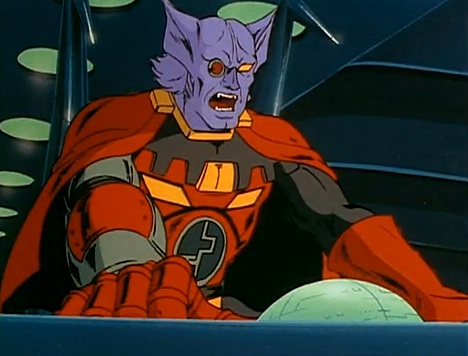
The planet is ruled by a kingdom, headed by the quarrelsome and evil Daibazaal family from the massive Castle Doom on Galra. The King serves as the head of state, presiding over a council of Drule noblemen. Each of the noblemen are in charge of vast resources, planets and factions of the Empire.
A steady policy of infighting, assassination and arguments is common in The Empire, resulting in only the most vicious, cunning and paranoid retaining leadership positions for any time. Because of this, the Empire has no use for mercy, or justice. But they do operate under a legal system presided over by the King and the clerics of the goddess Honerva (Chaotic Clerics) and their Drule Antipaladin enforcers.

Military
Under the command of the king, the military conducts combat operations. The Doom military has fleets of spacecraft, wings of combat and support aircraft, and armies. The mainstay of the kingdom's ground forces are Doomite Undead (see below), who are "created" from the life-force of slaves using the planets negative energy properties. In addition to conventional forces, Robeasts provide extra muscle.

Slavery
The Empire relies heavily on slave labor, sending Doomite Freighters to the far reaches of the universe looking for slaves. Though many slaves are sent to labor in the mines, the more interesting sorts are made to fight in the Arena at Castle Doom. In the arena, slaves must battle Robeasts and other foes for the amusement of the nobles and Doomites. Those who die are used as feed for the robeasts, and their souls captured to make Doomites. Those who survive will eventually be transformed into Robeasts.


Galra (aka Planet Doom)
Galra, also known as Planet Doom, is the seat of The New Drule Empire. It is a harsh, unforgiving world that is nonetheless quite rich in material wealth. The mines of Galra have a seemingless endless amount of ferrous metals, possibly due to a number of elemental gates leading to the Elemental Plane of Earth and Fire. The negative-energy ore known as Haggarium is in great abundance.
Galra is a dark and gloomy world yet there is always enough light to see by due to the nearly continuous fires and eerie magical lights. 
Some areas on the planet have only the minor negative-dominant trait, and these regions tend to be inhabited by Drule Blueskins and their favored slaves. The rest of the planet is major negative-dominant trait. Some areas on the planet have only the minor negative-dominant trait, and these regions tend to be inhabited by Drule Blueskins and their favored slaves. The rest of the planet is major negative-dominant trait. 
Spells and special abilities that use negative energy have all their variables maximized.Spells that use positive energy, including cure wounds spells have a 50% chance of spell failure. Characters on this planet take a -5 penalty on Fortitude saves made to regain lost levels from energy drain.


Doomite   
Medium Humanoid, Chaotic (LE), Average Intelligence; Warband (4d6)*
HD 1+1
AC 15 (breastplate)
ATK By weapon
MV 30
SV F 13, R 15, W 15
XP 75 (CL 1)
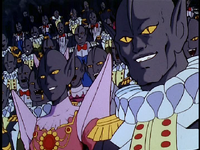
Doomites  are large cousins of goblins with no hair and charcoal grey skin color. Large males have pronounced ridges on the top of their heads and large eyes. Doomite eyes are either yellowish or black, while their teeth are yellow or black fangs. Doomite soldiers wear simple armor, but when off-duty these goblinoids dress in foppish finery such as frilled colars and sleeves. Their weaponry is kept polished and in good repair. Doomite speak Drule and Common. Doomite hate humans and attack them first, in preference to other opponents.
Doomites live primarily on Galra, but can be found wherever the Galran Empire has spread. When encountered in the field, Doomites are  organized into units of 1d10 x 20 warriors. Each unit is led by a great Doomite with 5+1 HD. There is a 30% chance the tribe dwells with one of the following: 2d6 Large Robeasts or 1d6 Huge Robeasts. Doomite army composition can be determined randomly.

25% DRONES: Leather armor (AC 13), scimitar, whip
20% TROOPER: Breastplate (AC 15), scimitar, pistol
30% DOOMITE: Breastplate (AC 15), scimitar, rifle
15% ELITE: Chitin Plate (AC 18), glaive, short sword, rifle, pistol
10% PILOT: Leather Armor (AC 13), scimitar, rifle, Drule Fighter Ship

Special Qualities: Immune to disease and poison, resistance to cold. 

GALRANIAN AS CHARACTERS
Doomites modify their starting ability scores as follows: Str +1, Dex +1, Int -1 and Cha -1. Doomites have dark-vision to a range of 120 feet. Spells that cure hit point damage act as harm spells, and negative energy spells such as harm spells and ray of enfeeblement have the opposite effect on Doomites.
Doomites speak Drule and Common, but might also know Infernal, Ghoul or Orc. Doomites can advance to a maximum of 9th level in most classes, but have unlimited advancement as Assassins. 


This campaign setting uses the Blood and Treasure RPG rules. Its a melding of Old School gaming and the newer, smoother-running games rules. Its a game that is fairly rules light, but has just enough crunch to satisfy my gaming appetite. All the cool kids are doing it.

Thursday, August 14, 2014

Voidjammer: Doomite Freighter

Doomite Freighter
Awesome Vehicle
HD:  124, hp 832
AC: 24, Hardness 10
Speed: As Helmsman’s Int x’s 10 in Wildspace, fly 60 ft. in a gravity well.
Atk: Blunt ram (3d8), or 3 Medium Cannons (10d6)
SV: 3
----------
Crew: 4/40
Air Capacity: 13,888 man-days
Landing: Land
Power Type: Major Helm (see Helms)
Cargo: 30 Tons
Keel/Beam Length: 250ft/60 ft
Cost: 257,000 gp

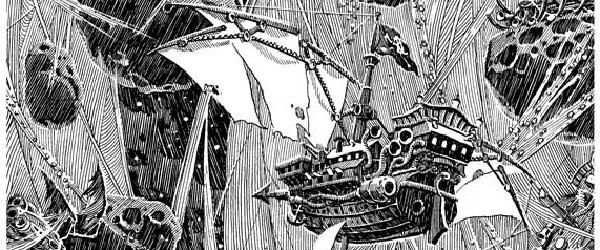
The Doomite Freighter is the workhorse of the Galran Blueskins. but can sometimes be found operating as a pirate ship or independent trade-ship. These ships serve often as slaver ships, but also transport other goods, troops and Robeasts and other creatures. All Doomite Freighters are adorned with the skull of a Space Demon used as a blunt ram and a smaller demon skull for use as a crows nest/scrying tower.
Doomite Freighters are equipped with at least six Doomite Fighter-Craft (Large Vehicle), and can hold similar sized vehicles. Ships are launched through doors that open in the skull-rams eyes. These ships are the primary defense of the freighter, though the ship also has three aft-facing cannons in case of trouble.
Crows Nest: These ships are equipped with a special chamber that comes equipped with a immovable crystal ball (normal type). The ships wizard typically uses the crows nest as his or her lab room.
Speaking Tubes: Doomite freighters are equipped with speaking tubes that allow all decks to instantly communicate with one another.


This ship and the setting it is designed for uses the Blood and Treasure RPG rules. Its a melding of Old School gaming and the newer, smoother-running games rules. Its a game that is fairly rules light, but has just enough crunch to satisfy my gaming appetite. All the cool kids are doing it.

Saturday, August 9, 2014

Voidjammer: Another Cosmology

Below is an alternate cosmology for a Voidjammer campaign. It is actually the default cosmology of my home campaign. Crystal Spheres do not exist, and the Phlogiston is just another transitive plane, and one unused by most space-faring races.
For my home campaign, I want a universe with Black Holes (and White Holes), Nebulae, Quasars, Pulsars and Stellar Nurseries. Also, I like the concept of navigation by stars, and that Suns are stars. So this is the cosmology for me.


ASTRAL PLANE (Hyperspace, Firmament)
The Astral Plane is the space between the planes. When a character moves through an interstellar gate or projects her spirit to a different plane of existence, she travels through the Astral Plane. Spells that allow instantaneous movement across a plane briefly touch the Astral Plane.
The Astral Plane is a great, endless "sea" of clear silvery sky, both above and below. Occasional bits of solid matter can be found here, but most of the Astral Plane is an endless, open domain. Both planar travelers and refugees from other planes call the Astral Plane home.
The Astral Plane has subjective directional gravity. It is also timeless. Age, hunger, thirst, poison, and natural healing do not function in the Astral Plane, though they resume when the traveler leaves the Astral Plane. Travel on the Astral Plane for Voidships is relatively easy once an Astral Gate is used. Ships find this route between stars quite useful. Unfortunately the Astral Plane is haunted by a number of aggressive and dangerous species, not least of which are the Astral Pirates.

CELESTIAL BODIES (Asteroids, Planets, Stars, Etc)
The celestial body that is most familiar to typical player characters is their home planet, be it Barsoom, Mongo, Eternia, or any one of countless others that populate the multiverse. Celestial bodies extend upward in size to that of the largest sun, and downward to the size of asteroids and planetoids. The tremendous variety that is possible (and proven) in celestial bodies mandates that the only accurate definition for the term is any significantly large conglomeration of matter that is wheeling about in wildspace.
Celestial Bodies can have any gravity, elemental and energy traits, or magic rules, depending on the concept of the world in question. Alignment of Celestial Bodies are usually some variation on Mildly Neutral (Lawful Neutral, True Neutral, Chaotic Neutral), but some few are more strongly aligned. Celestial bodies can have any shape, though the most common is spherical. Still, there are flat worlds, elliptical worlds, cubic worlds, amorphous worlds, ring-shaped worlds, hollow worlds. Some astronomers from have even theorized the existence of a mobius world.
Large orbiting clusters of Celestial Bodies are called Solar Systems (sometime Crystal Spheres), and function almost like mini universes. A primary, core celestial body is always at the center of a Solar System, around which the other bodies "dance". Solar Systems vary greatly in size with some being only large enough for a primary Sun and a cluster of asteroids to massive systems full of immense worlds. See Planetary Zones for a more indepth description of a Solar System.

ETHERIC PLANE (Aether, The Rainbow Ocean, The Phantom Zone)
The Ethereal Plane overlaps with the Material Plane. The Material Plane is visible from the Ethereal Plane, but appears muted and indistinct, its colors blurring into each other and its edges fuzzy. While it is possible to see into the Material Plane from the Ethereal Plane, the Ethereal Plane is usually invisible to those on the Material Plane. Normally, creatures on the Ethereal Plane cannot attack creatures on the Material Plane, and vice versa. A traveler on the Ethereal Plane is invisible, incorporeal, and silent to someone on the Material Plane. The Ethereal Plane is mostly empty of structures and impediments. However, the plane has its own inhabitants. Some of these are other ethereal travelers, but the ghosts found here pose a particular peril to those who walk the fog. The plane has no gravity.
Spells function normally on the Ethereal Plane, though they do not cross into the Material Plane. The only exceptions are spells of force (magic missile, wall of force, etc.) and abjuration spells that affect ethereal
beings. Spellcasters on the Material Plane must have some way to detect foes on the Ethereal Plane before targeting them with force spells, of course. While it’s possible to hit ethereal enemies with a force spell cast
on the Material Plane, the reverse isn’t possible. No magical attacks cross from the Ethereal Plane to the Material Plane, including force attacks.

WILDSPACE (Starry Sea, Space)
Wildspace is the "space" between celestial bodies (planets, suns, etc) and between solar systems. It is considered coterminous with the Material Plane, the Astral Plane and the Etheric Plane. Wildspace is also coexistent with the Ethereal Plane, The Astral Plane, and the Plane of Shadow. Wildspace doesn't have an atmosphere of any kind and is a perfect vacuum. Conventional interplanetary journeys around a solar system take place within wildspace. It is the first obstacle that must be conquered by would-be space travelers.
Wildspace has no gravity, and is infinite, stretching out between the stars themselves (see The Void below). It is neutral in alignment, and has no elemental or energy traits. While, for the most part, magic works normally in wildspace there are some limits. Magical fire doesn't need air to work properly but if the end result a spellcaster wants requires an atmosphere (i.e. oxygen) then that end result cannot occur. For example, a Fireball spell will work but it hasn’t any chance of lighting an object or person on fire.
THE VOID: The Void is the region of wildspace beyond the edges of a solar system, and so it is a dark and deadly place. It is an airless, lifeless void so huge that distance here is measured in centuries. The Void has no gravity and has strong negative energy traits and cold dominant traits.
Spells are maximized and extended in The Void. Undead in The Void are always powerful, having maximum hit points and regenerate special abilities, with only positive energy attacks dealing permanent damage.


NAVIGATING THE SPACELANES
Travelling between planets functions as describes in Helms, however traversing the distances between Stars is another matter. The distances between stars (ie Suns) is so vast that it is measures in years rather than miles, and so even with a really fast helm, it would take centuries to manage. So some magic is needed.
The Astral Plane and The Etheric Plane are both used to travel these distances, but the Astral is the most common to Voidships. This is because the Astral is timeless, and passengers need not eat, drink or sleep. Ships with a proper course set can make it to even the farthest reaches in days, though there are dangers.

GETTING ONTO THE ASTRAL OR ETHERIC
Getting onto one of these planes can be managed via several ways. Naturally occurring gates (called Wormholes) can be found by canny navigators and pilots. Such natural gates are highly prized when discovered and those along established routes will often have asteroid bases nearby. Use of the Create Portal spell (see below) is another common means by which to use these planes. Many space creatures have a natural form of this ability.
Some enterprising species have created artificial gates for use by Voidjammers. The Fraal in particular have an affinity for creating Astral gates, even being able to do so closer to habitable worlds and subsequently easier to get to.

SETTING THE COURSE
Setting a course through The Astral Plane can be accomplished via a successful Decipher Codes check*. Success indicates that the course has been successfully set through the Silver Void. Failure results in the ship running off course to a destination of the DMs choosing.
Ships using the Astral Plane to travel to distant star systems (Spheres) take 7d10 ship days to reach their destination, regardless of travel distance. During this time the crew need not eat, drink or sleep, though many still do to repel the sheer alien-ness of the Starry Void.
*Certain spells might grant bonuses on this roll. Such as Divination, Commune, Find the Path, Scrying, Vision and similar.


NEW SPELL

Create Portal
Transmutation
Level: Cleric 5, Sor/Wiz 5
Range: Long (400 ft. + 40 ft. /level)
Duration:10D12 minutes

This spell can be cast only in the outer regions of a solar system (at the Oort Cloud). The spell causes a large area of space to become a temporarily gate onto the Astral or Etheric Plane, allowing a ship (or anything else) of suitable size to pass through. The effect lasts up to 2 hours, during which time any other ships or items may pass through, DM rolls 10d12 to determine how many minutes the portal remains open.
It takes but a fraction of a round for a ship to pass through a portal opened in this fashion. However, if the portal is dispelled or otherwise prematurely closed, roll 1d10 to determine the fate of the object passing through the opening as it closes (see table).

Roll Result
1–5 Portal closes before ship reaches the portal.
6 Portal closes on the ship. Ship is cut in half.
7–10 Portal closes after ship passes through.

Portals created by this spell are magical and temporary, and can be dispelled. Portals that appear naturally cannot be dispelled.


This campaign setting uses the Blood and Treasure RPG rules. Its a melding of Old School gaming and the newer, smoother-running games rules. Its a game that is fairly rules light, but has just enough crunch to satisfy my gaming appetite. All the cool kids are doing it.

Wednesday, August 6, 2014

Voidjammer: Blueskins (Race)

The Blueskins of Wildspace are a widespread and varied race. They all possess blue or bluish colored skin, vivid eye-color, and features that are usually considered attractive to humans, elves and halflings. All blueskins share a natural skill with magic and arcane sciences, and so are amongst the most renowned magic-users and scientists in the Known Spheres. Blueskin ears naturally come to a point and continue to grow over their entire lives, potentially becoming quite large (and even bat-like in some cases). Most Blueskins trim their ears regularly, some allowing only a moderate point while others keep them rounded like human ears.
Blueskins  are graceful and slim, and stand about 5 to 6 feet tall. They count as medium-sized creatures and have a base movement rate of 40 feet per round. They have darkvision to a range of 120 feet and have a knack for picking pockets and trickery.
Blueskin's lithe form gives it a bonus of one point to its starting dexterity score. Their silver tongues also give them a one point bonus to their starting charisma score. Unfortunately, they lack in muscle mass and must deduct one point from their starting strength score. These ability modifications cannot increase a score above 18 or reduce it below 3.
Blueskins enjoy a +3 save vs. cold and cold spells. They have a +2 bonus to save vs. magic, and can see magical auras (per the detect magic spell). They enjoy a +1 bonus to hit with daggers and darts.
Blueskins speak Common and Drule (see below). They might also speak Celestial, Infernal, Elvish, Orc, Sylvan and Dragon.
Blueskins can multi-class as assassin/magic-users, cleric/scientists, cleric/sorcerers, leech/sorcerers, sorcerer/thieves or sorcerer/fighters.


BLUESKIN CULTURES
While many Blueskins intermix with other races freely, a few are culturally distinct and highlighted below.


THE DRULE (Voltron)
Commander Yurak. 
The Drule are a race of Blueskins who are widespread across the stars, with some Drule arrogantly claiming that the Drule are the original Blueskin people. Many ages ago, the Drule ruled over a vast empire that was shattered when their homeworld Drule was destroyed in a magical catastrophe. Now the Drule are a scattered people, and can be found virtually anywhere. Most Drule trim their ears as other Blueskins, and have red eyes that can be startling. While hair is predominant amongst the Drule, though many dye their hair out of a sense of style and vanity.
The New Drule Empire: One of the most powerful remaining aspects of the old Drule Empire can be found on the planet Galran in Doomspace, once an outpost for the Empire, it has now become a main center of that ancient Empire. Ruled by the cruel Daibazaal family (rumored to have some infernal blood in its veins), this "Doomite" Drule Empire is a growing threat to all peace-loving civilization. The Doomite Empire is very organized and employs particularly effective war monsters called "Robeasts" in its assaults, which have proven to be exceedingly difficult to stop.
Doomite Drule have e tendency towards yellow eyes and cat-like pupils, lending them a particularly frightening appearance. More than other Blueskin people, male Doomite Drule consider the cultivation of large pointed ears to be a sign of virility and power. And so warriors and nobles of accomplishment can be expected to have exaggerated ears.
DRULE CHARACTERS
Drule characters are created as standard Blueskins (see above), with all of the differences being thematic and cultural. Drule are viewed with awe and often a bit of fear even when they are heroic persons.


THE GAR (MOTU)
Shokoti.
The Gar are a species of blue-skinned humanoids who live on Eternia, possibly descended from Drule refugees. On Eternia the Gar created an advanced civilization on the island of Anwat Gar. The island sunk centuries ago, leaving the remaining Gar to live in isolated regions. The Gar are known on Eternia as a noble race of philosophers and craftsmen, and are still regarded with great awe for their past accomplishments. .
The Gar civilization collapsed due to infighting and constant political upheavals on Eternia, and the remnants of the Gar are quarrelsome and paranoid to this day. Whenever Gar surface onto the greater Eternian stage or in Wildspace, it is often a sign of something significant. Many who know of the Gar see them as an accursed race.
GAR CHARACTERS
Gar Blueskins are close kin of normal blueskins who dwell elsewhere in the multiverse. Their hair color ranges from yellow to a deep black and they are more muscular than other blueskins. Their clothing is in dark colors offset with splashes of bright color. Gar Blueskins have the same racial traits as normal blueskins, except that they modify their starting ability scores as follows: Str +1, Wis -1. Gar may multi-class as cleric/fighters, fighter/magic-users and fighter/thieves.


ZOTRIANS (Ulysses 31)
Zotrians are a peaceful offshoot of the Drule line, being a race of healers, spiritual leaders, and scientists. Zotrians, aside from blue skin, have snow-white hair, pointed ears and slanted eyes with cat-like vertical pupils; they are considered extremely beautiful.
Culturally, the Zotrians are reminiscent of of ancient Greek civilization, revering primordial deities either individually as specialty priests or as general "Lawful" Clerics. More humanocentric gods and goddesses are of little interest to the Zotrians.
There is no known Zotrian homeworld as this race prefers dwelling in beautifully crafted voidships, space-stations and on small moon-based colonies. They are revered as expert terraformers, though they rarely dwell for long on the worlds they nurture. Many Zotrians lead a nomadic life, travelling across the Spheres in "Space Caravans," generally keeping to the Cool Orbital Zone of a Crystal Sphere, visiting cool moons and asteroids.
ZOTRIAN CHARACTERS
Zotrian Blueskins are created as normal Blueskins (see above), except that they may multi-class as cleric/sorcerers, druid/sorcerers, leech/sorcerers, sorcerer/thieves or sorcerer/fighters.


Friday, August 1, 2014

The Psychic Class

This class, along with the Scientist , and the Leech is posted here with permission by John Stater over at The Land of Nod. It and other excellent classes are detailed in The Nod Companion along with spells, races and other features for use in the Blood and Treasure RPG.


THE PSYCHIC
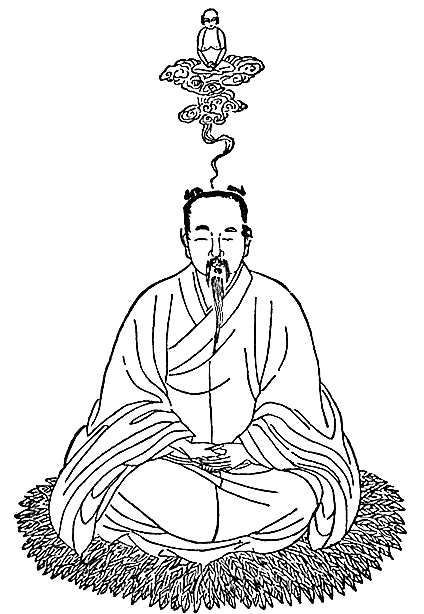
The inclusion of a psychic character class is often a controversial one in fantasy role‐playing. Magic‐users who command several spells based on psychic phenomenon make sense, but psychics are often viewed as a distraction, something more fit to science fantasy than the traditional fantasy genre.
Voidjammer (and Spelljammer) deals with such a wide range of possibilities for race, locations, magic and mystery, that the Psychic class can be an easy fit. However, even in Spelljammer, Psychics stand out, the powers they exhibit are in many ways more powerful than spells of similar nature (at lower levels at least), and so psychics can expect to be held in as much suspicion as Sorcerers.
Psychics in fiction are widespread, particularly in the "softer" sort of science fiction, though even the hardest science fiction can sometimes shoehorn in Psychic like beings. But in fiction more familiar to fantasy fans, several excellent sources spring to my mind.
The Mars and Venus books by Edgar Rice Burroughs have loads of psychic powers along with lots of derring-do and weird technology. The Talents Universe by Anne McCaffrey is chock full of psychics and psychic powers. Madeleine L'Engle's Time Quartet has a range of Psychic powers in it, and has an interesting angle on psychic powers. But for that fantasy feel the Dune books by Frank Herbert (not the ones by his son) are hard to beat for weird psychics and how they might be used in a civilization.
Nausicaä of the Valley of the Wind is a marvellous Manga, and has a number of excellent examples of the Psychic class, as all of the settings spiritual leaders are Psychics. The manga (and if you must; the Anime) is excellent inspiration for a desolate planet in Voidjammer. But in American comics, its hard to beat the Tales of The Jedi by Dark Horse comics.
The psychic learns to focus her innate mental powers to create astounding psychic phenomena. Psychics must go through a training regimen not dissimilar to monks. But where monks train their bodies, psychics train their minds. In-fact Psychics and Monks might make excellent companions and might even have monasteries in common. Dual Classed Monk/Psychics would not be out of place by any means.


REQUIREMENTS
- Intelligence, Wisdom and Charisma must total at least 35
ARMOR ALLOWED
- Padded and leather armor, bucklers and shields
WEAPONS ALLOWED
- Club, dagger, dart, hand axe, light crossbow, quarterstaff, short bow, sling, spear
SKILLS
- Find Secret Doors, Trickery


CLASS ABILITIES
-The most basic ability a psychic has is her sixth sense, which warns her of danger. Because of their sixth sense, psychics are only surprised on a roll of 1 on 1d8. Psychics receive a +1 bonus on saving throws made to avoid traps.
-Psychics train their minds to be veritable fortresses. This gives them a +1 bonus on saving throws against mental magic and the powers of other psychics. At 6th level, this bonus improves to +2.
-Psionic powers are divided into two types, Psi‐Gamma and Psi‐Kappa. Psi‐Gamma powers are telepathic, and mostly associated with knowledge and the senses. Psi‐Kappa powers are telekinetic
and have an impact on the physical world.
At each level, the psychic opens the door to a new psionic power. The psychic can choose any minor power from the psi‐kappa or psi‐gamma list. The psychic can only have one major power for every three minor powers she has from a list (i.e. a psychic with six minor psi‐kappa powers is permitted to know two major psikappa powers).
To use a minor psychic power, the psychic must succeed at a Will saving throw, and her subject (if there is a subject) must fail a saving throw, the type varies. The subject of a psychic power must be within the psychic’s field of vision unless the power’s description says otherwise. Activating major powers uses the
same rules, but the psychic must succeed at two checks.
If a psychic fails a saving throw to activate a power, that power closes to her for 24 hours and until she spends one hour in meditation the next day.
-A 9th level psychic can choose to establish a stronghold in the wilderness and gain followers. A psychic who becomes a psi‐lord or psi‐lady attracts 1d6 men‐at‐arms per level, 1d6 first level psychics who wish to train under them and one 3rd level psychic to serve as a lieutenant.


Apopsi: Activating this power is done at a ‐10 penalty. It completely suppresses 1d4 psionic powers of a single opponent, who receives a Will saving throw for each of these powers to resist. The powers suppressed are chosen by the user of apopsi, who also learns of his opponent’s full complement of powers. The powers are all suppressed for the next 24 hours.
Astral Projection: The psychic can enter a trance and project his astral spirit from his physical body. This astral spirit is incorporeal and unable to interact with the physical world. Astral spirits can only communicate using the power of telepathy. An astral spirit can travel freely over the physical world, and can enter the
ethereal and astral planes at will. The astral spirit can interact with objects and creatures on the ethereal and astral planes, and can communicate normally therein. If a psychic’s astral spirit is killed, his physical body dies as well.
Aura Sight: This power allows you to discern auras. Auras are invisible to the naked eye, but to a psychic viewer manifesting this power they appear as glowing halos or envelopes of colored light that surround all objects. The color of each aura reveals information to the psychic. The amount of information revealed
depends on how long you study a particular area. In the first round, you discern auras of Law (Good) and Chaos (Evil), even if the owner of the aura is otherwise invisible. In the second round, you discern magical auras. In the third round, you discern how powerful (hit dice or level) individuals are, and if they are near
death (less than 10% of their hit points remaining).
Biofeedback: With biofeedback, you toughen your body and ignore pain, reducing physical damage by 2 points per hit for 1 minute per psychic level.
Body Adaptation: With this power, your body adapts to hostile environments: Underwater, extremely hot or cold, or airless environments. You can survive as if you were a creature native to that environment. You can breathe and move (though environmental penalties to movement and attacks still apply) and you take no damage simply from being in that environment. You need not specify what environment you are adapting to when you manifest this power. Extreme environments: Acid, lava, fire and electricity, can be adapted to enough to halve damage from the environment by half.
Body Adjustment: This power allows you to adjust your body at the cellular level, healing yourself of 1d6 points of damage.
Catapsi: By activating this power you generate psychic static that infers with the ability of other psionic characters to activate their powers. All psionic activation rolls within a 20‐ft. radius centered on you suffer a ‐4 penalty.
Channeling: By opening his mind to the cosmos, the psychic can commune with higher planes (as the magic‐user spell contact other plane). Channeling is a difficult power to control, and imposes a ‐5 penalty on the psychic’s activation saving throw. A failure to activate this power results in the psychic’s personality
(or alignment) changing (as determined by the TK) for 1d6 days.
Choke: You cause the victim’s throat to tighten until he begins to choke. The victim must make an immediate Fortitude save in order to hold his breath. The save must be repeated each round, with the difficulty increasing by 1 for each previous success. When the character fails one of these saves, he begins to choke. A choking victim is stunned and suffers 1d3 points of damage per round.
Clairsentience: A psychic with these abilities can see or hear the going’s on in a distant place. If the psychic has never been in this place, or does not know somebody present, his activation roll to activate this ability is made at a ‐5 penalty.
Cloud Minds: With this ability, a psychic can cloud people’s minds, making him invisible to them. Just as with the magic‐user spell invisibility, an attack by the psychic spoils the effect. If used on multiple subjects, the psychic suffers a ‐1 penalty to his roll to activate the power for each subject beyond the first.
Dimension Door: Dimension door is a weak form of teleportation. Using this power, the psychic may teleport himself, an object, or another person with perfect accuracy to the stated location, as long as it is within the spell’s range.
Dominate: With this power, you can control the actions of any humanoid creature through a telepathic link that you establish with the subject’s mind. Once you have given a dominated creature a command, it continues to attempt to carry out that command to the exclusion of all other activities except those necessary for day‐to‐day survival. Subjects resist this control with a Will save, and any subject forced to take actions against its nature receives a new saving throw with a +2 bonus. Obviously self‐destructive orders are not carried out. Once control is established, the range at which it can be exercised is unlimited, as long as you and the subject are on the same plane. Dominating non‐humanoids is done with a ‐5 penalty to the psychic’s
activation roll.
Dowsing: Using a dowsing rod, the psychic can find the nearest source of fresh water. He can also use this power to discover the location of precious metals and gems, but suffers a ‐3 penalty to his activation roll to do so.
Ego Whip: This is the psychic’s ability to stun another sentient creature by causing terrible pain and trauma in their mind. A stunned creature remains stunned for a number of rounds equal to the psychic’s level. An ego whip can only be used on a single creature.
Empathic Projection: This is the ability to project powerful emotions (anger, joy, sorrow, fear) in the mind of a subject. It is up to the TK to determine the effects these emotions might have on a situation. A psychic who fails his roll to activate this power must make an additional activation roll or be struck with the
emotions himself.
ESP: With this ability, the psychic can read a subject’s mind, as with the magic‐user spell detect thoughts.
Etherealness: This power functions like the spell ethereal jaunt, except that you and other willing creatures that are joined by linked hands become ethereal. Besides yourself, you can bring one creature per three levels to the Ethereal Plane. Once ethereal, the subjects need not stay together. When the spell expires, all affected creatures on the Ethereal Plane return to their material existence.
Id Insinuation: By insinuating his own thoughts and memories in an opponent’s mind, the psychic causes either confusion (per the magic‐user spell) or insanity (likewise). Attempting to cause insanity imposes a ‐10 penalty on the psychic’s activation roll. A failure to activate this power forces the psychic to pass a saving
throw or suffer from insanity himself.
Illusion: The psychic can use this ability to plant powerful illusions inside a person’s mind. In general, these illusions correspond to the following magic‐user spells: Phantasmal force, spectral force, and improved phantasmal force. Activation rolls for this power suffer a penalty equal to the spell’s level.
Inertial Barrier: You create a skin‐tight psychokinetic barrier around yourself that resists blows, cuts, stabs, and slashes, as well as providing some protection against falling. You gain a +5 bonus to AC and suffer half damage from falls.
Intellect Fortress: You encase yourself and your allies in a shimmering fortress of telekinetic force. All damage from mind-affecting effects, including those that deal charisma, intelligence or wisdom damage, is halved. You can activate this power when it is not your turn with a single thought, including just before an
opponent attacks you.
Matter Agitation: This is the ability to cause objects to burst into flames. The ability can only be used on flammable objects, and inflicts 1d4 points of damage per psychic level. Activating the power requires a full round of concentration on the part of the psychic. Failure to this activate this power requires the psychic to
make an additional Will save to avoid being damaged himself.
Matter Manipulation: With this power, you can weaken or strengthen the substance of an object or structure. You can affect both mundane and magical inanimate material. Weakening an object’s substance gives it a penalty of ‐3 on any item saving throw it is forced to make. Naturally, the opposite is true if you fortify the object.
Mental Barrier: A mental barrier is a field of improbability that surrounds you (and you alone), creating a fleeting protective shell that increases your Armor Class by +4. You can activate this power instantly, quickly enough to gain its benefits in an emergency. You can use this power even when it’s not your turn; however, you must manifest it prior to an opponent’s attack roll in order to gain this power’s benefit against that attack.
Mesmerism: This is the ability to put others into a trance, thus gaining the ability to question them truthfully or implant suggestions in their mind. Implanting a suggestion works as the magic‐user spell of the same name and imposes a ‐5 penalty on the psychic’s activation roll.
Metamorphosis: With metamorphosis, you assume the form of a creature of the same type as your normal form, or any other type except construct, elemental, outsider, and undead or a form that is incorporeal or gaseous. In all other respects, this power works like the spell polymorph self. You can also use this power to
assume the form of an inanimate object, though not a complex mechanism unless you understand how such a mechanism functions. While in the form of an object, you retain your normal senses and your ability to speak, and can only activate other powers by accepting a ‐5 penalty on those rolls. Damage sustained while in object form is also sustained by your body.
Mindlink: You forge a telepathic mind link with a chosen target. This bond functions over any distance.
Mind Switch: You can attempt to take control of a nearby living creature, forcing your mind and soul into its body, and its mind and soul into your body. You can target any creature whose Hit Dice are equal to or less than your level. If the target fails a Will saving throw, you possess their body, essentially replacing its
mentality (and mental ability scores) with your own, including your psionic powers. Its mind and mental ability scores are shifted to your body. This state lasts for 1 turn per level. While in the other body, you retain your own hit points, saves, skills and feats, and vice versa. If you fail an activation roll to use this power
you are stunned for 1d6 rounds.
Mind Thrust: With a sharp thrust of his mental powers into the mind of one sentient opponent, the psychic inflicts 1d6 points of damage plus one point of damage for every point difference between his own and his opponent’s intelligence scores. If an opponent’s intelligence score is unknown, assume that it is a 10.
For sentient monsters, use the following intelligence scores:


Plane Shift: You move yourself or some other creature to another plane of existence or alternate dimension. If several willing persons link hands in a circle, as many as eight can be affected by the plane shift at the same time. Precise accuracy as to a particular arrival location on the intended plane is nigh
impossible. From the Material Plane, you can reach any other plane, though you appear 5 to 500 miles (1d100 x 5) from your intended destination.
Precognition: Precognition allows your mind to glimpse fragments of potential future events. What you see will probably happen if no one takes action to change it, but your vision is incomplete and it makes no real sense until the actual events you glimpsed begin to unfold. In practice, activating this power grants you a
“precognitive edge” for 10 minutes per level. During this period, you can apply a +1 bonus to any one attack roll, damage roll or saving throw. You can elect to apply the bonus to the roll after you determine that your unmodified roll is lower than desired.
Psionic Blast: A psionic blast works like an ego whip, but instead stuns creatures in 30‐ft cone emanating from the psychic’s forehead. A psychic suffers a ‐5 penalty to activate a psionic blast.
Psychic Crush: Your will abruptly and brutally crushes the mental essence of any one creature, debilitating its acumen. The target must make a Will saving throw with a +4 bonus or collapse unconscious at 0 hit points. If the target succeeds on the save, it takes 3d6 points of damage.
Psychic Surgery: Psychic surgery can be used to double a creature’s natural healing or to grant a subject a +1 bonus to save against diseases. It can also be used to heal or inflict 1d6 points of damage. This requires the psychic to physically touch the subject, and the psychic’s saving throw to activate the power is made at a
‐5 penalty. At 5th level, the psychic can heal or inflict 2d6 points of damage. At 10th level, 3d6 points of damage.
Psychofeedback: You can readjust your body to boost one physical ability score at the expense of one or more other scores. Select one ability score you would like to boost, and increase it by the same amount that you decrease one or more other scores. This boost lasts for 1 minute, but the lowered ability scores only regenerate at the natural rate of healing; i.e. one point per day.
Psychometry: This is the psychic’s ability to read the vibrations given off by an object or place, allowing him to learn elements of its history such as who last held the device, how it is used or traumatic events that took place there. In effect, it works like the magic‐user spell legend lore. The TK might impose penalties on
the psychic’s saving throw to activate this power depending on the age and provenance of the object or place being read.
Reddopsi: Activating this power is at a ‐5 penalty on the activation roll. With reddopsi, powers used against you rebound on the activator if they fail a Will saving throw.
Schism: Your mind splits into two independent parts. Each part functions in complete autonomy, like two characters in one body.
Your new “second mind” does not control your body physically but is free to take one action in each round if the action is purely mental, such as activating a power. Your second mind does not gain any advantages if you are subject to a haste effect, although you gain the overall standard benefits.
Suspend Life: You can place yourself into a trance so deep that you are almost in suspended animation. Even powers that detect life or thought are incapable of determining that you are alive. While you are suspended, a year feels as though it were a day.
Telekinesis: This is the ability to move small objects with one’s mind. For precise telekinetic control of a small object, a ‐5 penalty is imposed on the psychic’s saving throw to activate this power. Otherwise, impose a penalty of ‐2 per 20 pounds of the object being moved.
Telepathy: With this ability the psychic can project his thoughts into the minds of other creatures. Penalties may be applied to this ability based on the distance of the psychic’s target or when he tries to communicate with several people at once. If communicating with non‐sentient creatures, the psychic suffers a ‐5 penalty. A like penalty is suffered when communicating with the alien minds of aberrations.
Teleportation: This power allows a psychic to teleport (as the magic‐user spell) objects. The psychic can teleport creatures, but suffers a ‐5 penalty to his saving throw to activate the power. Teleporting multiple objects or creatures imposes a ‐1 penalty to his activation roll per creature or object beyond the first.
Temporal Acceleration: You enter another time frame, speeding up so greatly that all other creatures seem frozen, though they are actually still moving at normal speed. You are free to act for 1 round of apparent time. You can activate powers, cast spells, move, etc. While your temporal acceleration is in effect, other
creatures are invulnerable to your attacks and powers. This means you cannot target a creature with any attack or power.
However, a power you activate that affects an area and has a duration longer than the remaining duration of your temporal acceleration has its normal effect on creatures in the area once this power ends. You can affect an unattended object but not an object held, carried, or worn by another creature. You are undetectable by any means while temporal acceleration lasts.
Thought Shield: You fortify your mind against intrusions, gaining magic resistance 15% against all mind‐affecting spells and special abilities. You can activate this power when it is not your turn, including just before an opponent attacks you.
Tower of Iron Will: You generate a bastion of thought so strong that it offers protection to you and everyone around you, improving the self‐control of all. You and all creatures in the spell’s area gain magic resistance 45% against all mind‐affecting spells and special abilities. You can activate this power when it is not your turn, including just before an opponent attacks you.
Transvection: A psychic can use transvection to cause himself to levitate (as the magic‐user spell). It can also be used to fly (as the magic‐user spell), but such use imposes a ‐5 penalty to the psychic's activation saving throw.
True Seeing: You gain the ability to see all things as they actually are, seeing through normal and magical darkness, noticing secret doors hidden by magic, seeing the exact locations of creatures or objects under blur or displacement effects, seeing invisible creatures or objects normally, seeing through illusions, and
seeing the true form of polymorphed, changed, or transmuted things. You can focus your vision to see into the Ethereal Plane, but not into extra‐dimensional spaces.
Ubiquitous Vision: You have metaphoric “eyes in the back of your head” for 1 hour after activating this power. In effect, you have a 360‐degree sphere of sight and cannot be back stabbed. You are only surprised on a roll of 1 on 1d10, but you take a ‐2 penalty on saves against all gaze attacks during the power’s duration.

Wednesday, July 30, 2014

Voidjammer: Horde Void Cruiser

The Evil Horde from the classic He-Man and She-Ra franchise is so delightfully grim-n-Goofy that I think it is PERFECT for Voidjammer and Spelljammer. So expect more ships, weapons and monsters from the Filmation/Kenner cartoons and toys as well as many others from other old favorites.
Below is a general transport ship for The Horde, that showed up in numerous episodes of the cartoon(s). They are tough, versatile, and tough enough to make for worthy foes or even useful ships for adventurers.
This conversion uses the Blood and Treasure RPG system. Check it out! All the cool kids are doing it...

Horde Void Cruiser
Colossal Vehicle
HD:  22, 181 hp
AC: 18, Hardness 10
Speed: As per Helm and Helmsman
Atk: 2 Fireball Cannons (10d6) or 1 Lightning Gun (3d6)
Hordaks Personal Cruiser
SV: 3 (Metal)
----------
Crew: 1/2
Air Capacity: 2,400 man-days
Landing: Land
Power Type: Major Helm (see Helms)
Cargo: 20 tons
Keel/Beam Length: 180ft by 30ft
Cost: 42,000gp

The Horde Void Cruiser is a mass produced voidship used extensively by The Horde and its allies, though a number of these vessels are sold on the open market. The Void Cruiser is primarily a cargo hauler and troop transport for the Horde war effort, as its cargo bay is spacious enough to hold two Large Vehicles (usually Batmeks) one Huge Vehicle (usually a Destructo Tank) or up to 50 Horde Troopers. If stacked properly, a Horde Void Cruiser can hold a great deal of cargo with only a minimum of crew.
Though the standard Void Cruiser is fairly standard individual units are often stylized after the whims of the ships owner. Leering faces, eye-slit windows and other personal touches are common. All of these ships are combat ready and are typically accompanied by large numbers of Batmeks.
Weapons Helm: Alongside the ships standard Helm is the Weapons Helm. This seat can control the ships weapons and ramp doors remotely, allowing the Void Cruiser to rain destruction of the enemies of the Horde without additional crewmembers.
Airtight: Not only is a Void Cruisers deck covered, but the entire interior of the Voidship is airtight, and temperature controlled. This makes the Void Cruiser capable of flying through poisonous atmospheres without endangering any living crewmemebers and prevents the ships air from being fouled.
MOTU Examples: Annihilator, Doom Buster


Tuesday, July 29, 2014

Voidjammer: Talon Fighter

Talon Fighter
Large Vehicle
Look at that thing! 
HD:  15, 94 hp
AC: 15, Hardness 10
Speed: As Minor Helm and Helmsmen
Atk: 2 Talons (2d8), 2 Energy Missile Cannons (4d6+4)
SV: 4 (Steel)
----------
Crew: 1/2
Air Capacity: 100 man-days
Landing: Land Only
Power Type: Minor Helm*
Cargo: 2 tons
Keel/Beam Length: 12ft/20ft
Cost: 8,000gp

The Talon Fighter is a winged flying vehicle, which can carry two people on board, styled to resemble a bird of prey in flight. These voidships are still rare in the Spheres, but have already made a stir due to their versatility.These vessels have seen considerable action in recent days in battling The Horde during its advancement across the spheres. The Talon Fighter is extremely useful in battling the Batmek fighters employed by The Horde with one Talon Fighter being the equivalent of five Batmeks in battle.
In combat the Talon Fighter often relies on its Energy Missile Cannons and its great speed. In a pinch, these vehicles can employ their landing gear to claw ships and creatures in melee range.
Ether Wings*: The Talon Fighters wings allow it to fly at a speed equal to a Major Helm while equipped with only a Minor Helm (see Helms). The fighters tonnage is not affected.
Scrying Array: This marvelous device allows the helmsman or passenger to send messages to scry as per the spell cast by an tenth level magic user. See Scrying (see Blood and Treasure PHB page 141) for details.


Thursday, July 24, 2014

Voidjammer: Wildspace Creature Template

Fantasy space is chock full of weird creatures, many of whom are quite powerful. However, there are also plenty of "every day" creatures out there. Schools of space-going fish, asteroid dwellers and assorted oddities that make life possible in the Void.


Wildspace Creature Template
A wildspace creature is a creature that either lives in Wildspace and the Phlogiston or can survive there indefinitely. Wildspace creatures often hibernate in comets and asteroids. Others wander outer space in search of food, occasionally taking up residence on planets where food is abundant (assuming they can find a safe way to the surface). Wildspace creatures even threaten idle voidships from time to time.
All wildspace creatures have their own look that marks them as different from normal cousins. Many have a sleek, elongated look, often eschewing noses, ears or other features we associate with the base creature, others are far far weirder in appearance.
Not all wildspace creatures are motivated by hunger or sheer malice; other likely motives include natural curiosity or a desire for companionship. Wildspace is, after all, a vast and lonely place.
Wildspace creatures share the following characteristics:

1. Wildspace animals and vermin become magical beasts; other creatures retain their normal type.

2. In wildspace and other zero-gravity environments, a wildspace creature can fly at a rate equal to its base speed. Some wildspace creatures can fly as though equipped with a minor or even major helm.

4. A wildspace creature creates its own oxygen supply or doesn’t need to breathe at all. It can exist in zero-atmosphere environments.

5. Wildspace creatures cold resistance and fire resistance.


SAMPLE WILDSPACE CREATURES


Space Ape (Giant Ape)
Huge Animal, Neutral (N), Animal Intelligence; Troop (1d4);
HD 8; AC 15; ATK 2 claws (1d8 + rend) and bite (1d8); MV 30 (Climb 15), Fly 30ft; SV F 6, R 9, W 14; XP 800 (CL 9); Special: doesn't breathe, cold resistance, fire resistance.


Space Dolphin
Medium Magical Beast, Neutral (N), Low Intelligence; School (1d20)
HD 2, AC 15, ATK Slam (2d4), MV Fly 80ft, SV F 12, R 11, W 18, XP 100 (CL 2); Special: Space Dolphins can “see” via echoes on the etheric plane, that allow them to locate objects and creatures within 120 feet. A silence spell forces the dolphin to rely on its vision. doesn't breathe, cold resistance, fire resistance.


USING TEMPLATES
A template’s description provides a set of instructions for altering an existing creature, known as the “base creature”. The changes that a template might cause to each line of a creature’s statistics are discussed
below. Generally, if a template does not cause a change to a certain statistic, that entry is missing from the template description. Remember, if a monster’s Hit Dice are changed, its saving throw values and experience point value are also changed.

Wednesday, July 23, 2014

Voidjammer: Citadel Ships

Citadels are asteroids (celestial bodies) that have been converted into voidships. The process of conversion is a long one, requiring the installation of a massive helm of one kind or another, and the hollowing out of tunnels, living spaces and other features. Several races construct Citadel Ships, each with a slightly different look to the overall design. But the end result is much like a mobile, mini-world that is as much home as vessel.

Azer Citadels
The fiery Azer are close cousins to the Dwarves, and so it is small wonder that they have access to Dwarven Forges. Azer citadels are often found close to a crystal spheres sun (see Hot Orbital Zones), or near volcanic planets. Such citadels have shining towers and relatively smooth surfaces.

Dwarven Citadels
These flying mountains are similar in look and appearance as any number of Dwarf strongholds in most campaign worlds. These vessels all sport beautiful and functional craftsmanship and are home of entire Dwarf clans, often with room for other races for the purposes of trade. Glow moss and other subterranean plants are cultivated on Dwarven Citadels to help supply air, as well as a potential food source.

Fraal Citadels
The mysterious Fraal have their own citadels which they call Nationships. Such vessels are covered in observatories, greenhouse domes and all manner of wonderful structures, though these are always utilitarian rather than flamboyant. The forges themselves are replaced with laboratories, meditation chambers (for psychic discipline), and lecture halls. Weaponry on Fraal Nationships should be replaced with gadgets devised via the scientist class, firing a nasty assortment of weird energies rather than cannonballs and such.

Gnomish Citadels
The Minoi Gnomes of Wildspace also build citadels. However, while dwarf citadels are awe-inspiring structures of exquisite craftsmanship, Gnomish citadels are a riot of ungainly mechanisms and structures. Often, very little of the original asteroid is visible on a Gnomish Citadel, being liberally covered in elaborate devices, domes, spired and other attachments.


Citadel, Lesser
Awesome Vehicle
HD:  150, 800 hp
AC: 20, Hardness 25
Speed: As Helm
Atk: 4 Heavy Catapults (6d6), 8 Heavy Cannon (10d6), 12 Light Cannon (5d6), 3 Heavy Jettisons (3d8)
SV: 10 (Stone)
----------
Crew: 100/300
Air Capacity: 36,000 man-days
Landing: N/A
Power Type: Forge Helm or Gnomish Helm (see Helms)
Cargo: 150 tons
Keel/Beam Length: 150ft/120ft
Cost: 1,230,000 gp

These (max 300-ton) citadel is the smallest that a forge can power, and as a result, the most frequently encountered citadel in space. The majority of a citadel's space is taken up by the forge and the living quarters for the crew. Lesser citadels are usually mining ships, roving asteroid belts of the less hospitable regions of the spheres, harvesting ores and other treasures. Lesser citadels are usually outer colony ships serving a Greater Citadel or a stationary asteroid base.
Deckplans of any citadel ship should be handled as though mapping out a dungeon, and should be handled with care.

Citadel, Greater 
Titanic Vehicle
HD:  350, 2,100 hp
AC 20, Hardness 40
Speed: As Helm
Atk: 8 Heavy Cannon (6d6), 16 Light Cannon (5d6), 24 Ballista (3d8), 6 Heavy Jettisons (3d8)
SV: 10 (Stone)
----------
Crew: 235/700
Air Capacity: 84,000 man-days.
Landing: N/A
Power Type: Forge Helm or Gnomish Helm (see Helms)
Cargo: 350 tons
Keel/Beam Length: 150ft/250ft
Cost: 2,870,000 gp

Greater Citadels are truly immense vessels, more like small mobile moons that voidships. At a maximum of 3,000 tons, Greater Citadels are amongst the largest and most powerful vessels in space. Like the Lesser Citadel, the  majority of a citadel's space is taken up by the forge and the living quarters for the crew. However, these vessels sport even more elaborate structures both inside and outside its main body. Massive domes of glassteel, stout towers and a terrifying array of weapons all cover these ships.
Deckplans of any citadel ship should be handled as though mapping out a dungeon, and should be handled with care.


Tuesday, July 22, 2014

Voidjammer: Fraal and Oortlings


FRAAL 
Small Humanoid, Neutral (LN), High Intelligence; Company(1d6)
HD 1
AC 14 (Fraal Body Cowl)
ATK By weapon or spells
MV 30
SV F 14, R 16, W 15
XP 50 (CL 1)
Sometimes known simply as the visitors, the fraal are highly sophisticated humanoids from somewhere else. Some sages speculate that these visitors come from either another plane of existence. Of seemingly fragile build, the fraal rely on devices of unusual workmanship and power to protect themselves. These devices are not magical; in fad, the fraal know almost nothing of magic.
The fraal are thin humanoids, averaging about five feet in height. They can be distinguished by their large eyes, their pale, almost luminous skin, their swept-back ears, and their round heads. Most fraal encountered so far have been bald, although some individuals have been encountered who have wisps of silver, white, or pale-yellow hair. A most disconcerting element is that all fraal display a wizened countenance, much like the eldest of wizards.
The frail have limited telepathic abilities, being able to communicate telepathically with sentient creatures up to 150 feet away. This also allows them to attempt to implant a suggestion, per the spell, three times per day in other humanoids. They have been known to speak Common to those not of their kind, though they speak it slowly and with some difficulty. Their words display a quiet demeanor and they are not given to excitement or violent emotion.
If fraal should find combat unavoidable, they rely upon psionics (spells) and/or bodyguards of some kind. Any aggressive force of Fraal will have a number of robotic servants (use shield guardian or living statue stats). Hand crossbows and scientific weapons are common.

Special Abilities: Limited Telepathy (150 ft range).
Spells: 3/day - suggestion.

FRAAL CHARACTERS
Fraal modify their starting ability scores as follows: Str -2, Con -1, Int +2, Cha +1. They are small creatures but have a standard speed of 30 ft. per round. Fraal have limited telepathic abilities, being able to communicate telepathically with sentient creatures up to 150 feet away. This also allows them to attempt to implant a suggestion, per the spell, once per day in other humanoids. Fraal have a knack for Decipher Codes and have darkvision out to 60 feet. Fraal are proficient in the hand crossbow and all pistols.
Fraal can multi-class as leech/sorcerers*, sorcerer*/scientists, sorcerer*/thieves, and scientist/leeches.
*Note: If psionics are used, replace scientist with psychic.


FRAAL TECHNOLOGY
Fraal scientists are famous for their magnificent work, and are highly valued as weapon-makers. Below are a two specialized gadgets commonly found in Fraal markets.

Fraal Body Cowl
The Fraal body cowl, consists of a small latex like rubbery material worn as a belt, with a small
battery attached. When switched on the material flows like liquid over the wearer, upto the neck and to the wrists  and ankles only. Thus forming a rigid set of lightweight flexible armour.
AC 14, counts as clothing and not armor.
Weight 4lbs, Cost 1000gp (500gp for Fraal buyers)

Fraal Firerod
The Fraal Firerod is a weapon that looks much like a hand crossbow or pistol though lacking any obvious place for ammunition. When fired the Fraal Firerod fires a ray of scorching energy. Each ray is directed at a target within 30ft, who can avoid the ray with a successful Reflex saving throw. Each ray deals 4d6 points of fire damage.
Weight 3lbs, Cost 2000gp (1000gp for Fraal)


OORTLING (Degenerate Fraal)
Small Humanoid, Neutral (N), Low Intelligence; Herd (2d6)*
HD 0
AC 13
ATK Slam (1d2)
MV 30
SV F 14, R 16, W 16
XP 25 (CL 0)

Oortlings are a pathetic race descended from the Fraal. They dwell on wildspace comets. While the oortlings once had a fairly sophisticated culture, but they were dominated by the Thulid Nations. The thulids that ply wildspace keep them as “cattle”. An Oortling is a small sized hairless humanoid with an unusually large head. Their skin is soft and smooth and nearly white as the snow found on their comets. Within their skulls are the overdeveloped brains of the oortlings, breeding has prevented them from fully using its potential.

Special qualities: Resistance to cold.


Friday, July 18, 2014

Voidjammer: The Thulid Nations

The Thulid Nations comprise a number of types of creatures that are somehow part of a greater species. These creatures do not share the particulars concerning their species beyond reassurances that they are of one race, and allied in a greater nation. The differing types of Thulid include Mind Eaters, Neothelids, Neh‐thalggus, Half-Thulids and related subspecies.
The Thulids are a major race in space. They have their own navies and colonies, and engage in brisk trade with everyone, including the neogi. Their success in space gives cause for concern, since on the ground they are mostly creatures of the deep underdark, light-hating and rarely seen by men. The nautiloid is the most common mind flayer craft in operation, though they use a variety of human-built ships modified to their needs. With the introduction of the pool helms, larger mind flayer craft may be on the way.
Thulids in space may be neutral (non-evil) in alignment, though tales of a lawful good mind eater are just so much space dust. Thulids engaging in deals with other thinking creatures make a point of eating only the brains of criminals and brain mold. In those rare areas where there is a thulid enclave near a human settlement, there is usually a brisk brain-trade business.
Thulid colonies are often found in asteroids, in the underdark or on worlds relatively far from a spheres sun(s). Planets and moons in the Cool Orbital Zone of a Crystal Sphere (solar system) are attractive to Thulid colonists, who use their grasp of strange technologies and planar gates to make otherwise uninhabitable worlds livable. Such colonies are often dark, wet and cool, but liveable. A sizeable slave population is always present on Thulid colonies.


THULID TECHNOLOGY
The Thulid Nations are great proponents of both psionics (or Sorcerer class), magic and science (see Scientist class). Thulid mage-scientists developed both the Series and Pool e Helms and have a wide range of other devices. One device widely known and feared amongst the Thulids is the Silver Cylinder,see below:

Silver Cylinders
CostL 18,000gp (unavailable to non-Thulids)
Cylinders made of a silverish metal in which the Thulids can place the transplanted brains of different species throughout the known and unknown universe. Wires attached to the cylinder and subsequently the brain inside can be hooked to seeing, hearing, and speaking devices. While in the cylinder, the brain is virtually immortal, while the body of the donor can be held indefinitely in suspended animation. The cylinders allow the brains within to be transported through the void of space.
Silver Cylinders are created by Thulid Scientists, and use the equivalent of the 9th level Soul Bind spell.


NAUTILOID
Colossal Vehicle
HD: 35 (285 hp)
AC: 17
Speed: As Helm and Helmsmen
Atk: 5 or 1, 3 medium ballistae (crew 2 each), 1 medium catapult (forward, crew 3), 1 medium jettison (rear, crew 3), OR Ram (3d8).
SV: 3 (magic item)
----------
Crew: 10/35
Air Capacity: 3,920 man days.
Landing: Water
Power Type: Series Helm or Pool Helm
Cargo: 6 tons
Keel/Beam Length: 125/30ft
Cost: 47,250gp

The nautiloid reflects the nature of the alien thulids. Its coiled shell provides the comfort of enclosed space which protectings the thulids from the rays of the fire/radiant bodies. It is the standard ship of the line of the spacefaring Thulids nations.
    A standard mind eater crew has 10 illithids, plus 2-5 additional flayers (depending upon the number of series helms in use). The number of series helms in use determines the ship's tactical speed. A mind eater ship has a single captain and first officer, the remainder of the group being crew.
    If additional crewmen are on board, they are nearly always slaves of the thulids. These expendable slaves (treat most of the slaves as either commoners or experts of 1st thru 4th level) are used to man the catapults, while the alien thulids remain in relative comfort of the interior. Humans are the slaves of choice, but sometimes other races can be found as slaves on a nautiloid.
Deckplans.


Wednesday, July 9, 2014

Voidjammer: The Evil Horde

The Evil Horde is a vast, interstellar empire bent on the domination of various spheres across the universe. The centre of the empire is called Hordespace where the infernal House of Kur (see below) reigns supreme. The Horde possesses vast resources and has a great deal of highly sophisticated technology.
The Evil Horde (Horde for short) is a growing Empire whose forces have been spreading across the known spheres at an alarming rate.
The Horde is happy to make use of all manner of creatures, as long as they are of use to the eventual goals of The Horde. From Humanoids, Giants and Undead to the most bizarre and alien Aberrations and Outsiders. Only those deemed to unstable are rejected as the Horde is primarily Lawful Evil in alignment.
Worlds subjugated by The Horde are completely dominated. All planetary resources are devoured by the Hordes war machine. Strip mining, manufacture, agriculture and the gathering of slaves are all managed with brutal efficiency. Monstrous servants of the Horde are bolstered by enormous numbers of Horde Troopers (see below) and weapons.

The House of Kur (Nobles)
At the core of The Horde is an elite family of Tieflings and Half-Fiends known as the House of Kur. Though evil, members of The House of Kur are all fiercely loyal to one another and are firm believers in the goals of The Horde (conquest). This does not mean that all is friendly, far from it, but rather than outright infighting, the assorted members and branches of the family resort to political maneuverings, back-room deals and assassination.
The absolute rulers of the Horde are Half-Fiends (see Blood and Treasure GMG page 175) and should be created as fully detailed NPCs. Most are high level Assassins or Magic-Users, with the truly powerful amongst them are the equivalent of Demon Lords in power.
Horde Prime: Horde Prime (aka Anillus Kur) is the ruler of the vast Evil Horde. Nobody living knows the full extent of Horde Primes powers, but it is known that he is a master of Transmutation magic as well as being physically potent in battle. The Cult of The Horde reveres The Emperor and the goals of The Horde as a profane god. Clerics of The Horde are generalist (Chaos) clerics and not specialists.

Hordelings (Macabre)
Hordelings compose the majority of the extended Kur family, and can be found primarily in Crystal Spheres controlled by The Horde. This fiendish family resemble elf-like humanoids with pointed ears, pugnacious noses and a tendency to snort. Bright clothing and flamboyantly gruesome accoutrements are worn by hordelings, with bat and skill motifs being common. As members of this family advance in rank, further mutations are common, with members embracing various forms of magical mutation such as cybernetics, lycanthropy and the more powerful forms of undead (particularly vampirism).
Hordelings  have been raised to see other races and cultures as naturally inferior. Even those rare few who are not Chaotic in alignment still see humanoid races as not-quite people.
HORDELING CHARACTERS
Hordelings are possessed of strange powers. All of them have rather special powers of regeneration, healing at double the normal human rate (i.e. 2 hp per day). Hordelings can see in the dark up to 120 feet. They speak common and might also know Infernal, Dwarf, Elf, Gnome, Goblin, Halfling and Orc. Hordelings can advance as assassin/fighters, assassin/clerics or assassin/magic‐users, or they can pursue a single class.
Each Hordeling has an additional extraordinary ability rolled on the following table:
D20 EXTRAORDINARY POWER
1 Can boost strength once per day per the strength spell
2 Resistance to fire
3 Resistance to acid
4 Resistance to electricity
5 +3 bonus to save vs. poison
6 +3 bonus to save vs. disease
7 Menagerie (commands a swarm of spiders, a swarm of bats a giant rat or a vulture)
8 Cast prestidigitation three times per day
9 Two Heads (surprise rolled on 1d8 instead of 1d6)
10 Has an imp or dretch as a boon companion.
11 Swordsman (+1 to hit with swords and +1 Armor Class while fighting with a sword)
12 Explosives (can mix and set off alchemist’s fire)
13 Inhumanly tall (-1 to dexterity, +2 to strength)
14 Inhumanly short (-3 to movement, +2 to strength)
15 Inhumanly fat (+3 to movement, +2 to constitution)
16 Inhumanly thin (-1 to constitution, +2 to dexterity)
17 Snarl (once per day, all within earshot must save vs. fear or be frightened for 1d6 rounds)
18 Regenerate 1 hit point per round up to half normal hit points unless reduced to 0 hit points
19 Covered in thick hair or scales (+2 to Armor Class)
20 Has a burrowing speed of 6


CREATURES OF THE HORDE
The Horde will use any monster or race as troopers that is capable of taking orders. Even the weirdest and most vicious monsters has found a home in the forces of the Horde. Araneae, Bat Monsters, Bugbears, Ogres, Orcs, Goblins, Dwarves, Humans, Elves, or any other creature is of potential use. But the most common soldier in The Horde are the Horde Troopers (see below).


Horde Trooper
Medium Construct, Chaotic (LE), Low-Intelligent; Warband (4d6)
HD 4
AC 18
ATK 2 fists (1d8) or Energy Rod (1d6+1)
MV 10
SV F 14, R 15, W 14
XP 400 (CL 5)

A Horde Trooper is a member of the regular army of the Horde Empire. Although each trooper is individually unremarkable, in large numbers they are used to great effect in the occupation of conquered worlds. Vast armies of Horde Troopers are also used during invasion of a Crystal Sphere and planets. When not on the ground, Horde Troopers pilot Glondas, Bat Meks, and other vehicles.
All Horde Troopers come equipped with an Energy Rod that fires an energy missile (see page 83 of the Blood & Treasure PHB). For melee, most troopers use their fists, or have other weapons. As an added feature, Horde Troopers are capable of operating Series Helms as though they possessed spell-like abilities. This allows them to pilot Voidships equipped with such helms without endangering a magic user.
Horde Troopers are often deployed in large numbers as they are, hollow servants to the will of the Horde. However, Hordlings with rank within the Horde can wear these constructs as suits of Full Plate, which also grant darkvision 120ft and the benefits of a Necklace of Adaptation (see page 224 of the Blood and Treasure GMG) allowing humanoid troops to survive in space and other hostile environments. Such troopers are often elite soldiers and officers who adorn their armor with additional items and adornments.


VOIDSHIPS OF THE HORDE
Voidships are plentiful in The Horde, and range from the small Bat Mek fighter to vast warships that are comparable in size and power to Dwarven Citadels.


Bat Meks
Large Vehicle
HD:  2, 30 hp
AC 15
Speed: As Helmsman
Atk: 2 Energy Missile Guns (2d4+2 force damage)
SV: 4 (Steel)
----------
Crew: 1/2
Air Capacity: 84 man-days
Landing: Land
Power Type: Series Helm or Minor Helm
Cargo: 1 ton
Keel/Beam Length: 30ft by 5ft
Cost: 1,875 gp
Bat Meks are commonly flown by Horde Troopers and some living soldiers. They are designed to attack in large numbers, overwhelming the enemy craft. They are also very cheap to produce, reflecting the Horde philosophy of quantity over quality. More or less are expendable, like Robot Horde Troopers.
When Bat Meks show up, it is usually in overwhelming numbers. Sometimes they are accompanying a larger ship, but most often they are sent into regions to "soften up" an area. The low intelligence of Horde Troopers make most encounters with Bat Meks of limited danger, but when piloted by living pilots, these vessels can be a serious threat indeed.


Notes
So here is my first stab into using The Evil Horde in Voidjammer and the Blood and Treasure RPG. These goofy but dangerous villains were a delight to me as a kid, though they were not nearly as scary in the cartoons as they seemed as toys. But to me, the serious but goofy is what RPGs is all about. 
I will be posting additional forces of The Horde and other beings from the MOTU line of creatures and characters. So stay tuned!

DISNEY & DRAGONS: D&D in Fantasyland

Many times, in recent years I have encountered would-be players of Dungeons and Dragons whose sole experience with the fantasy genre h...