Monday, September 26, 2016

SILVER VOID: INTERPLANETARY TRAVEL

The Silver Void setting is one in which swashbuckling adventurers might travel to distant planets, battle space monsters and otherwise strut their stuff in front of green space-babes. But real-world space is a super deadly realm. It is an extremely hostile environment. It has no gravity, is airless, super-cold and has high levels of radiation strong negative energy trait (check the Blood and Treasure GMG page 20 for details). So to avoid all of the arguments and struggles of inserting real-world space travel into a fantasy game, I am circumventing it all with the following: 

SILVER VOID COSMOLOGY
In the Silver Void setting, space travel is most often done by travelling through the Astral Plane. The Astral Plane is the "space" between the planes and the spheres (planets etc). It is a great, endless "sea" of clear silvery sky, both above and below. Stars, planets and constellations can be seen, though they are not always those of our own dimension, so travelers must beware. The Astral Plane has subjective directional gravity. It is also timeless. Age, hunger, thirst, poison, and natural healing do not function in the Astral Plane, though they resume when the traveler leaves the Astral Plane. 
Ships and creatures looking to enter the astral plane must be able to reach the very edge of a planet’s atmosphere (50-80 miles up) to attempt to breach the astral barrier. This requires specially made vessels with an Astral Helm (see below) or powerful spells.

TOOLS OF THE TRADE (STANDARD EQUIPMENT)
What powers a ship is a complex assortment of conjoined magical devices, built into the structure of a vessel. In many ways the end result is a melding of archaic seagoing vessel and a submarine or other designs. Ships designed to ply the starry deep are usually equipped with the following:
ASTRAL HELM: All vessels will have a Helm, which is basically the steering wheel of the ship. From this position, the ship can be steered and controlled. A helm appears as a steering wheel, often with a specialized chair. 
When in combat, the helm allows the pilot to propel the ship by thought at a speed (in feet) equal to 10 times the pilot’s Intelligence score. When the ship passes within a gravity well, such as that generated by an asteroid, moon or planetary body, it slows to a speed of 50 feet. Many ships have additional or alternate means of propulsion and flight for emergencies and to operate in a gravity well such as balloons, spells, psychic sails, wings or special materials.
PLANAR CHART AND SEXTANT: Usually attached to the Scryscreen (see below) or in the captains quarters, this device allows a spellcasting crew-member to chart a course across the Silver Void. It is effectively a map with special map symbols. Most are very mechanical in appearance, much like an astrolabe. When setting a course to distant worlds or stars, the Helmsman must make a Decipher Codes check. Success allows the vessel will take 7d10 ship days to reach their destination, regardless of travel distance. During this time the crew need not eat, drink or sleep, though many still do to repel the sheer weirdness of the Starry Void. Failing this role indicates the ship going off course, and ending up at the wrong destination (GM's choice).
GENESIS MATRIX: This integrated wondrous item has a control panel about the size of a treasure chest (often mounted on a wall), and maintains the ships gravity and atmosphere. In game terms, a functioning Genesis Matrix system turns the vessel into a mobile demiplane, with the ships environment being "set" like the Genesis spell (see Blood and Treasure GMG page 89-90 for details). This device is not often found on vessels crewed by astral races, primitives, constructs or undead.
SCRYSCREEN: This is a “magic mirror” that projects objects in front of the vessel as well as allowing communication between ships. This item is located on the bridge, in front of the Helm. Any divination spell used by the helmsman is maximized when used with a Scryscreen.


NEXT
Ship basics, astral combat and sample vessels. 

These rules use the wonderful Blood and Treasure tabletop roleplaying game by John Stater. Its a fun and easy RPG made with the basic D20 system but hearkening back to old school sensibilities. Check it out. All the cool kids are doing it. 

Wednesday, September 21, 2016

SILVER VOID: A NEW FANTASY SPACE SETTING


With cooler weather ahead I find myself pondering winter games, as up here is the North winters are deep and cold. So role-playing games in a warm house are extra appealing. Right now I am planning a game that will involve younger players and their (geeky) mothers. To appeal to young imaginations, I am tapping into all that appeals to the hearts of young lads. So for inspiration I recommend the following:
Adventures of the Gummi Bears (Gummi Tech in particular)
Aladdin: The Series (Mechanicles)
Dr. Who (particularly the 4th doctor)
He-Man Etc.
Krull (The Beast comes from SPACE!)
Nadia: Secret of Blue Water
Pinocchio in Outer Space
Robotech
Samurai 7
Spelljammer Boxed Set
Steven Universe
The Adventures of Baron Munchhausen
Voltron (The lion one)

Wakfu (particularly the fortress of Nox)

TALES OF THE SILVER VOID (or SILVER VOID for short)
This setting will be a fighting fantasy one using Blood and Treasure 1st Edition, a relatively simple and straight-forward game system that hearkens back to older versions of DnD. The Silver Void setting will in many ways be a classic fantasy setting. Magic, monsters, elves, etc, but will also incorporate the weirder sorts of space-going science fantasy. The overall concept is that there are many worlds that support life, and that some cultures can and do cross the depths of space in ships or on the backs of specialized monsters.
Magic is the primary means by which all of this is possible, along with a technological level somewhere in the Renaissance to Colonial America area of development. So muskets, soap, tea and clockwork gadgetry. Starships are created with a mix of assorted magics and the engineering skills of the time.

RACES
All kinds of strange beings can be found across space, and a space-going adventurer can expect to find beings that would be considered monsters anywhere else. Actually, most of them are still considered monsters, but everyone tries to mind their manners for the sake of trade and politics. But a number of races are very active in space, and excellent for player characters. Such as:

HUMANS
Humans should require no description, for fantasy humans and real humans are not terribly different. The Humans in the Mythic Space setting are a diverse and far flung people. They are rugged and adventurous, and seem to be willing to try almost anything. Most of the humans of the Mythic Space setting are part of city states and petty kingdoms that are part of the Commonwealth, a coalition of worlds and colonies born out of the chaos of the last series of Elven Wars. The Commonwealth is roughly in a Renaissance era of development, both technologically and culturally, bolstered by powerful magical traditions and a politically active Wizards Guild. Academics, Clerics, Merchants, and an energetic populace make mankind and the Commonwealth a growing power. Generally, humans get along well with almost any race or species if properly motivated by need, greed or necessity.
Humans use the same rules as presented in the Blood and Treasure Players Handbook. 

DWARVES
The Dwarves of the Silver Void setting are asteroid miners and planetary colonists of great skill. Most belong to the Commonwealth, which along with mankind is growing quite wealthy across the spaceways. The Dwarves are best known for their massive citadel ships, which are nothing less than asteroids that have dwarven citadels and mines in and on them. These mini-worlds are big, tough and very well defended, and thanks to dwarf engineering, they can fly through space. 
Dwarves use the same rules as presented in the Blood and Treasure Players Handbook.

ELVES, SPACE 
Elves are graceful creatures that are descended from the ancient Sidhe. They have thin faces, pointed ears and vivid eyes.  Their skin and hair color are often in harmony with the environment they call home, thus Space Elves have pale skin and light hair colors, but some tribes have blue or green colored skin. Elves stand about 5’ tall and have an almost androgynous build. The Star Elves revere the Primordial goddess Hemera with some also revering the Planar faiths of Arborea and Elysium, where many of their gods and allied celestials keep their divine realms. 
The Elven Empire was once a vast and powerful force in space, but is now much diminished following the last Unhuman War. The Empire is led by its Star-Empress Pleione VII and the Lord Admirals of the Elven Imperial Navy (EIN). The Empire lost large swaths of territory and is hoping to regain control of the spacelanes. 
Elves use the same rules as presented in the Blood and Treasure Players Handbook.Elves  may  multi‐class  as  fighter/magic‐users,  cleric/magic‐users  and  magic‐user/thieves.  
  
GNOMES
“He is indeed the true enchanter, whose spell operates, not upon the senses, but upon the imagination and the heart.” 
-
Washington Irving
The gnomes of wildspace are tinkers, inventors, and alchemists. They can be found everywhere in the Known Universe, much to the distress of every other race. Wildspace gnomes are most (in)famous for a love of mechanical devices with many bells, whistles, and make much noise and usually do little or nothing at all. Gnomes are about 3 feet tall and weigh 45 to 50 pounds, with almost no difference between the sexes. Gnomes have brown skin and black, brown, or most often white hair. Their eyes are blue or violet in color. They are stocky but nimble, spending their lives deftly darting through their machines and avoiding moving parts and flying shrapnel. Gnomes often appear quite disheveled as they do not have time for personal hygiene. They wear simple clothes with aprons with many pockets and tool hoops, as well as large, heavy tool belts. A gnome is never seen without several dozen strange-looking tools and devices.
Gnomes use the same rules as presented in the Blood and Treasure Players Handbook.


HALFLINGS
The Halflings in the Silver Void setting are almost all members of the Commonwealth, and are considered instrumental in its running. Their small size and capable hands make them ideal ship-mates, and they are excellent craftsmen, laborers, farmers and cooks.  Halflings use the same rules as presented in the Blood and Treasure Players Handbook.

HALF-ELVES
Half-Elves are elf-Human hybrids, and are widespread across Maldek. Half-Elves comprise a large percentage of the Elven Fleet as standard crew and low-level officers, and so are fairly numerous in space. On Maldek, half-elves are accepted, but are sometimes resented, as most fear they are spies or otherwise allied with the Elven Imperial Fleet.
Half‐elves use the same rules as presented in the Blood and Treasure Players Handbook.

HALF-ORCS
Half-Orcs (and Orcs) are fairly numerous in the Silver Void setting, as orcs are an ancient star-faring culture of mercenaries and space pirates. Because of the long and terrible Orc/Elf wars, Half-Orcs have a bad reputation, but in the Commonwealth, an attempt at getting past this is being made. Most orcs and half-orcs revere Acheron, but a growing number of half-orcs are revering Hater Industria and Agenoria. On Maldek, half-orcs are most often employed as laborers and soldiers.
Half-Orcs use the same rules as presented in the Blood and Treasure Players Handbook.

ORCS, SPACE
Orcs are a species of aggressive mammalian carnivores that band together in tribes and survive by hunting and raiding. Orcs believe that in order to survive they must expand their territory, and so they are constantly involved in wars against many enemies: humans, elves, dwarves, goblins, and other orc tribes.
Orcs vary widely in appearance, as they frequently crossbreed with other species. In general, they resemble primitive humans with grey-green skin covered with coarse hair. Orcs have a slightly stooped posture, a low jutting forehead, and a snout instead of a nose, though comparisons between this facial feature and those of pigs are exaggerated and perhaps unfair.
After the many Elf/Orc wars, most orcs have become less focused on revenge against the elves, and are trying to create a more stable society. Orc clerics have revered Acheron for eons, but on Maldek and nearby systems, a growing number of priests of other gods can be found.
CHARACTER CREATION
Orcs modify their starting ability scores as follows: Str +2, Int ‐1, Wis ‐1 and Cha -1. They have darkvision to a range of 60 feet. Orcs are blinded in bright sunlight. They speak Orc, and might also learn Dwarf, Gnoll, Goblin and Ogre. Orcs can multi‐class as cleric/fighters, fighter/ magic‐users and fighter/thieves.

NEXT 

In following articles I will cover the basics of Space Travel, Cosmology, Ships and the beginning campaign setting. So stay tuned!

Wednesday, August 10, 2016

Mythos Space: The Star Spawn

Star Spawn
Star Spawn and a human rocket-jockey
Type: Outsider
Size: Huge
Intelligence: High (13-18)
Hit Dice: 20
Movement: 50/500 (Fly 60/600)
Armor Class: 26 
Attacks: 4 tentacles (3d8+2 + constrict), 2 claws (2d6+2) and bite (1d10+2)
Saving Throws: F0, R2, W2
Special: Immune to electricity, disease, poison and radiation, resistance to acid, cold and fire, psychic power resistance 90%, telepathy 100’, Vulnerability (Neutronium)
Environment: Any
No. Appearing: 1 (or horde 5d20)
Alignment: Chaotic Evil
XP Value: 1,300 (CL 26)
"Another race - a land race of beings shaped like octopi and probably corresponding to fabulous prehuman spawn of Cthulhu - soon began filtering down from cosmic infinity and precipitated a -monstrous war which for a time drove the Old Ones wholly back to the sea - a colossal blow in view of the increasing land settlements." -H.P. Lovecraft, At the Mountains Of Madness
The Star Spawn are the chief servitor race of Cthulhu and his cosmic kinfolk. They are a species that is built for space, hyperspace and for war. They are huge, tentacle beings whose brutal forms house shrewd and brilliant minds. These creatures are a mish-mash race created from biological "data" acquired by Cthaeghya (Cthulhu's half-sister). Star Spawn do not breath and have a pair of bat-like wings that allow them to propel themselves via the solar winds at 1 million mph through the vacuum of space. Also, once per day, a Star Spawn can plane shift itself (plus 500 pounds of objects) into hyperspace.  This allows these creatures to travel between stars in the same manner as a starship.
Once per minute, the Star Spawn can fire a focused cone of electromagnetic energy that causes all targets to make a Reflex save (or Drive and/or Pilot Aircraft check) or suffer 10d10 points of electrical damage. Electronics must make a save or be destroyed.
Star Spawn have the following supernatural powers: At will—akashic knowledge, blur, clairsentience, create undead, desecrate, dimension door, dominate, matter agitation, negation, polymorph self, putrefy, sensitivity to psychic impressions, speak with dead,transmute liquid, transvection; 3/day—metamorphosis, song of discord; 1/day— astral projection, raise tower.


STAR SPAWN IN MYTHOS SPACE
After the closing of the last Mythos War, the destruction of R'lyeh (and the possible “death” of Cthulhu), the vast legions of Star Spawn were cast adrift across space, and remain a menace to this day. Most Star Spawn serve Cthaeghya, and Idh-yaa (mate of Cthulhu) though a number of them also serve Cthylla, Ghatanothoa, Ythogtha, and Zoth-Ommog. These Old Ones are busy with their family politics as well as their conflicts with the forces of Hastur and Yig, and so are not an active threat to the Empire at the present time. Individual and small groups of Star Spawn can be found on remote worlds, often worshiped by an assortment of minor monsters such as Deep Ones (Lemurians) Gill Monsters,Monster Men, and weirder things. Sometimes they have accumuated a number of human followers in the form of mad cultists, degenerate tribesmen and power hungry politicians and space pirates. In any event, Star Spawn are dangerous and intelligent foes.
In war, Star Spawn emerge from Hyperspace in large hordes, using their natural speed and magic to great effect. They will typically seek to disable defenses and defending vehicles first, and using magic and their mobility to sew fear. Elder One and rival Great Old One temples are primary targets.


These rules use the Grit and Vigor Roleplaying Game by John Stater. An excellent game that uses the best part of old school games and the D20 systems for pulpy adventures. Check it out!

Tuesday, August 9, 2016

Mythos Space: Elderians of the 51st Century

ELDER THING
Type: Aberration
Size: Medium
Intelligence: High (13-15)
Hit Dice: 2 (6-8 hp)
Movement: 30 (Fly 10)
Armor Class: 13
Attacks: 2 slams (1d4) or by weapon.
Skills: Cast Magic Spell*, Chemistry, Communicate, Crack Codes, Display Knowledge, Hypnotize and Search.
Saving Throws: F15, R15, W11
Special: Survive vacuum of space, immune to cold, resistance to electricity and fire
Environment: Any
No. Appearing: Family (1d8)
XP Value: 200 (CL 3) 
“Six feet end to end, three and five-tenths feet central diameter, tapering to one foot at each end. Like a barrel with five bulging ridges in place of staves. Lateral breakages, as of thinnish stalks, are at equator in middle of these ridges. In furrows between ridges are curious growths – combs or wings that fold up and spread out like fans. . . which gives almost seven-foot wing spread. “-H.P. Lovecraft, At the Mountains of Madness
The Elder Things, or Elderians, are an alien species of pseudo-protozoans that colonized Earth one billion years ago, when multicellular life first appeared. These aliens are great planet seeders and terraformers, being responsible to much of the Earth-compatible and Terran analogue species found across known space. Elderians are naturally immortal, and can travel across interstellar distances under their own power, though many use asteroid starship “arks” to carry themselves, equipment and servant creatures (usually Shoggoths) across space and hyperspace.
All Elder Things have all of the abilities of a Scholar of equal level to their hit dice (see Grit and Vigor Rulebook), with many Elderians having the Occultist* Scholar subclass. Because of this, all Elderians can be expected to have a wide range of high tech equipment (see here and here). Chemical and genetic engineering are major sciences of the Elderians, and they will continue to tinker with new life-forms wherever they dwell. They created the shoggoths to be their all-purpose slave race, and though rebellions do sometimes occur, these creatures are still a major servitor of the Elderians.

ELDERIANS IN THE 51st CENTURY
In the 51st Century, the Elderians are still players in the cosmic scheme of things, though they are reclusive and difficult to communicate with. Despite their very different physiology, the Elderians share many psychological traits with mankind. They have families (close acquaintances rather than biological kin), art, scientific curiosity and a sense of compassion. However, they remain aloof and distant due to the habit of some humans to actively collude with the the Outer Gods, Old Ones, the Star Spawn (the species of Cthulhu) and the MiGo, all ancient enemies of the Elderians. The only contact made with the Elderians is by individuals, tramp merchants and small colonial governments.
Elderian colonies can be found hidden in star systems across the galaxy. These worlds are always host to massive stone cities and vibrant ecosystem compatible with Earth life (though rarely safe). Many such worlds with life around a Precambrian to Paleozoic level of development (Ocean or Jungle Planets). Manners are strongly advised.
Most Elderian colony sites found across the Empire and the Fringe are ruins, long since overgrown. Ths is the result of the Elder Things ancient wars with the Star Spawn, Yithians and the MiGo. Such planets are always compatible with Earth-life with a "Lost World", sometimes hosting dinosaur-like beasts and even hominids. Wild Shoggoths and other ooze monsters are also always present.


SHOGGOTH
Type: Ooze 
Size: Huge 
Intelligence: Non- High (13-18)
Hit Dice: 30 (90-120 hp) 
Movement: 30 (Climb 30) 
Armor Class: 13 
Attacks: Slam (3d6) 
Saving Throws: F3, R3, W3 
Special: Immune to mind effects, resistance to weapons 
Environment: Underground or Marine 
No. Appearing: Solitary 
XP Value: 3000 (CL 31) 
“It was a terrible, indescribable thing vaster than any subway train—a shapeless congeries of protoplasmic bubbles, faintly self-luminous, and with myriads of temporary eyes forming and un-forming as pustules of greenish light all over the tunnel-filling front that bore down upon us, crushing the frantic penguins and slithering over the glistening floor that it and its kind had swept so evilly free of all litter.” -H.P. Lovecraft, At the Mountains of Madness
Shoggoths are the primary, all-purpose slave race of the Elderians, and can be found on Elderian asterod ships and colony worlds. While the basic shoggoth is approximately 15-feet in diameter when formed into a sphere, larger specimens exist. Being protoplasmic, shoggoths can form body parts as they need them, though they always have numerous eyes floating in their black, slimy form. 
Most Shoggoths are mindless brutes, controlled by their masters via magic and chemical control. Over time however, shoggoths develop intelligence and seek to rebel against their creators. When this occurs, such creatures are terrible foes, and require great effort to subdue.


These rules use the Grit and Vigor Roleplaying Game by John Stater. An excellent game that uses the best part of old school games and the D20 systems for pulpy adventures. Check it out!

Wednesday, August 3, 2016

Mythos Space: The Tcho-Tcho of the 51st Century

Tcho-Tcho
Type: Humanoid
Size: Medium
Intelligence: Average (9-11)
Hit Dice: 2
Movement: 30/170
Armor Class: 12
Attacks: 2 claws (1d4) or by weapon
Saving Throws: F12, R15, W16
Environment: Underground
No. Appearing: 1d20
Alignment: Lawful Evil
XP Value: 50 (CL 1) 
"It is true that strange legends had reached us even before we had left Ho-Nan province of a weird race of little people, to whom the natives applied the odd name, "Tcho-Tcho."' -August Derleth & Mark Schorer, The Lair Of the Star Spawn
The Tcho-Tcho, or Tcho-Tcho people, are a human-like race of cannibals that can be found across the Empire. It is said that the Tcho-Tcho aren't even fully human - old myths have it that they interbred in ancient times with the amphibious species called the Miri Nigri. The Tcho-Tcho are loyal to the Tsan-Chan Empire, and often act as agents for the government. It is said that they worship some of the Old Ones and the less human Elder Gods such as Aion, Kthanid or the plant-like Buna Klaaktuk.
Tcho-Tcho are thickly built (curvaceous in the females) beings, between 4 and 5 feet tall with dark skin, elongated skulls, overlarge eyes, no body hair, and nails overgrown to claws. They are always hungry and need to consume human flesh (or receive gene therapy) every so often to hold off manifesting traits from their non-human kinfolk. Gene therapy can also be used to retain human appearance.
Tcho-Tcho can see perfectly well even in total darkness; however, their over-sensitive eyes are easily blinded by lights.

CHARACTER CREATION
Tcho-Tcho modify their starting ability scores as follows: Con +2, Str -1, Cha -1. They have darkvision to a range of 120 feet. Tcho-Tcho have a movement rate of 30 feet and have a +3 to all saves vs poison and disease. They have a natural claw attack that deals 1d4 damage. Tcho-Tcho are blinded in bright sunlight or by a strong artificial lights.
Tcho-Tcho speak Common and Naacal. As with humans, they might learn virtually any other language.
Tcho-Tcho can advance to 8th level in most classes, and can advance to 11th level as assassins (rogue subclass) or occultists (scholar subclass).


The Mythos Space setting uses the delightful Grit and Vigor RPG system by John Stater. Grit and Vigor uses a variation of the D20 system, but brings it back to an "old school" feel. Fast paced and action packed with plenty of crunch for strong character builds, but not so much as to overwhelm new players. Check it out!

Monday, June 27, 2016

Mythos Space: The World of Skarl

Planet Name: Skarl
Planet Type: Garbage Planet
Sector: Bai Hu
System: Kaiwan (Aldebaran)
Atmosphere: Standard
Gravity: Imperial Standard (though slightly lower).
Day Length: 85 hours
Year Length: 4,499 days
Population: (30% human, 20% mutant, 20% ab-human, 20% android, 10% other)
Government: Plutocracy
Tech Level: Industrial (Hyperspace in Trigon City)

Skarl is one of many moons of the gas giant Khora, and the only life-bearing planet in the Kaiwan (aka Aldebaran) system. Skarl has a breathable atmosphere and is a rocky desert of spare parts, rusting ship hulls and other waste products. This system is a major trade hub for this sector and a favored jumping off point for ships heading out to Bullseye and Wu Ju. It is also a favorite spot for ships coming in to the Empire with trade goods or for needed repairs (or to hide out). 
Outside of the city itself, Skarl is a harsh, wilderness of jagged mountains, sharp rock, and enormous piles of scrap and waste. Tribes of wandering scavengers, ragged settlements and monsters are all that dwells in the wilderness of Skarl. Dangers in the wilderness on Skarl include cliffs, cold, starvation and thirst, vermin and wear and tear. Animal life here is mostly dogs, rats, flies and roaches. Monsters here include ghouls, black puddings, toves, pnathian deathworms, mandroids and Ibogo beetles (see below). For alien encounters, MiGo and Grey are occasional visitors to the hills of Skarl as well as Trigon City, as are occasional mad cults to one or more Old Ones.

PLACES OF NOTE


TRIGON CITY: Trigon is a large spaceport/city that is overgrown and renowned as a fleshpot and decadent pleasure port. Orbital repair facilities and the sale of refurbished starships are major industries here. The city spreads out over a full third of the planet and swallows up lakes mountains and rivers. It burrows underground, level upon level and is home to teeming millions. As a vast metropolic, Trigon City has a vibrant criminal underworld. 
POD-ROB HQ: The Police Robots enforce the law in Trigon City, and are centered in this large building, most of which is underground. POD-ROB has millions of robots under its command. Lawbreakers will find the police-bots to be single-minded foes who will try their best to bring criminals in to be imprisoned before trial. A typical police squad consists of 2d10 Androids (page 154) armed with a Laser Pistol, Stun Baton, Communicators and body armor (AC16). Each precinct has 2d4 Giant Robots (page 161) that are used for patrol and riot duty, with many more at police HQ.
Smogtown: The Industrial factories of Trigon City, staffed by living and machine alike. The air in smogtown is always at least somewhat toxic. This section churns out finished products of every description, from minor tools to starships.
Temple of Roon (Hyperspace Cult): This massive pyramid is to be found next to the spaceport. The structure is a self-contained city in its own right, and is home to a large number of acolytes dedicated to Roon, the god of going. The temple acts as a hyperspace beacon, allowing stable transiting into and out of hyperspace. Those seeking travel blessings or the services of a technomage can be found on the lower levels.
Trade Towns: These ramshackle towns can be found here and there in the wastelands, and are full of every sort of outcast such as aliens, ghouls and robo-droids. All of these towns are walled, and are usually protected by ferocious militias. 
Temple of Jabim: A lonely temple dedicated to Jabim, Lord of Broken Things can be found in the wastelands. The temple itself is constructed of a crashed starship, and has many modifications.  The temple attracts all sorts of broken people and creatures, such as mutants and mandroids. The priests of this temple (Mechanics, Psions and Occultists) can be found anywhere on the planet, working as junk merchants and repairmen.


Ibogo Beetle Swarm (Pseudo Roach)
Type: Vermin
Size: Tiny (5-10” long)
Intelligence: Non- (0)
Hit Dice: 5
Movement: 15/150 (Climb 15)
Armor Class: 14
Attacks: Swarm (2d4)
Saving Throws: F14, R13, W13
Special: Immunities (poison, disease, radiation)
Environment: Any 
No. Appearing: 1d4
XP Value: 250 (CL 5)
Ibogo Beeltes are a vicious species of red, eyeless insectoid that appears out of Hyperspace much like Toves and Raths, and are a favorite prey of Toves. Individually a Ibogo beetle is not dangerous, but in swarms they can be deadly, able to strip the flesh off of a human in under a minute (i.e. six rounds), leaving only a ragged skeleton. Thankfully they are afraid of light, and can be fended off by a flashlight or campfire. Anyone travelling across the wastes of Skarl will encounter these things, and are advised to keep to well lit areas or otherwise carry a powerful light source. 


Note: These rules are made for use with the Grit and Vigor Tabletop RPG. Its a fun game that hearkens back to older versions of role-playing games, but are easier to learn and to play. Check it out!

Monday, June 20, 2016

Mythos Space: Planets of The Cosmos


In the universe of Mythos Space, mankind has been settling known space for almost three hundred years, Grit and Vigor RPG for a backdrop. and with abducted Earth hominids, human-like aliens, and Quantum Time Distortion, some of the far flung colonies out there have been out there for quite a long time. These rules use the

MYTHOS SPACE PLANET KEY
Below are the basic rules I will be using in regards to planets in the Mythos Space campaign setting. I am using terms and concepts taken from Planet Adventure stories from the 1920's to the 1970's.
Planet Name: The worlds name. Usually decided by the settlers and/or their corporate backers.
Planet Type: Planets in Mythos Space and Pulp Age fall into broad classifications, as follows:
City Planet (Ecumenopolis): Urban sprawl has taken over the entire surface of a world. Often has a population in the trillions, though not always. Usually has a Garbage Planet in the same system or even in its lower levels. Terrain Types on such worlds include cliffs, hunger, thirst, vermin and wear and tear (see Grit and Vigor pages 83-85). Life-forms on such worlds are usually only in the underworld/sewers.
Cloud Planet: These worlds are entirely made of gas, much like Jupiter or Saturn. If something or someone lives here, either it can float or fly, or there are hover-cities. Either way, watch that first step. Terrain Types on such worlds include cold, poison, falling and getting lost (see Grit and Vigor pages 83-85). Life on such worlds must be capable of flight (and usually huge), like Sawsnarks.
Dark Planet: Like the Desert, but owe their lack of plant life to perpetual night; usually due to constant opaque cloud cover or spooky ominous fog. If inhabited, this might be the product of industrialization run amok, with the clouds being clouds of pollution. Terrain Types on such worlds include cold, thirst, poison, wear and tear and the dangers of getting lost in the dark (see Grit and Vigor pages 83-85).
Death World: Not a biome in and of itself, but can be any of the aforementioned types. This is a world where Everything Is Trying to Kill You, but you still have compelling reasons to go there. Terrain Types on such worlds include all dangers (see Grit and Vigor pages 83-85). These worlds can have any and every sort of monster.
Desert Planet: These look like the cheaper parts of California, and are thus very common. If it can sustain life, a desert planet will have aliens that act like Bedouin or Touareg, and a thriving black market on water. Terrain Types on such worlds include Cold (at night), dry heat, thirst, wear and tear and exposure to radiation (see Grit and Vigor pages 83-85).
Forest Planet: A planet whose land surface is mostly or entirely covered by temperate to sub-tropical forest. Earth several million years ago could be considered a Forest Planet, since the warmer atmosphere and higher atmospheric humidity levels meant much more of the planet was covered in lush forest. Terrain Types on such worlds include cold and ice in the winter, starvation and thirst, storms, vermin and wear and tear (see Grit and Vigor pages 83-85). bbbbb
Garbage Planet
Garbage Planet: The entire planet is being used as a dumping ground for useless waste. Likely to act as home for scavengers looking to make a quick buck, treasure hunters seeking some long-lost treasure, and large numbers of mercenaries and criminals. Terrain Types on such worlds include cliffs, disease, poison, thirst, vermin, wear and tear (see Grit and Vigor pg 83-85).
Ice Planet: Planets whose entire surfaces look like Greenland glaciers. Somewhat justified, as there actually are frozen-over planets and moons (for example, several moons of Jupiter and Saturn). Really cold Ocean Planets can become an Ice Planet. Terrain Types on such worlds include cold, ice, starvation and thirst, storms and wear and tear (see Grit and Vigor pages 83-85). Animals common to the Ice Planets include prehistoric mammal analogs, burrowing monsters and Yetis.
Jungle Planet: Mind the bugs, they are positively enormous. Expect most things that crop up in Hungry Jungle stories. Terrain Types on such worlds include humid heat, starvation and thirst, vermin and wear and tear (see Grit and Vigor pages 83-85). The dangerous animals most associated with jungle planets are insects, giant apes, and reptiles, even dinosaurs.
Ocean Planet: These tend to have just a few, if any, mountains tall enough to breach the surface and make islands; if there are, they're prime beachfront vacation spots. Terrain Types on such worlds include cold, thirst, storms, wear and tear and the possibility of drowning (see Grit and Vigor pages 83-85).
Mountain World: These planets are all or nearly all hills and mountains, with most life (if any) living in nooks and crannys between the peaks or underground. Terrain Types on such worlds include cliffs, cold and ice, dry or humid heat, starvation and thirst, storms, vermin and wear and tear (see Grit and Vigor pages 83-85).
Swamp Planet: Like the Jungle, but easier to lose your shoe. (Or your ship). Terrain Types on such worlds include humid heat, starvation and thirst, vermin and wear and tear (see Grit and Vigor pages 83-85). The dangerous animals most associated with swamp worlds are insect swarms, plant monsters and reptiles, even dinosaurs.
Twilight world (Tidally Locked Planets): While not truly single-biome, they traditionally have only about three: blazing hot desert on the day side, temperate zone of perpetual twilight at the day/night terminator, and sub-freezing wasteland on the night side. Terrain Types on such worlds include cold, heat, thirst, storms, wear and tear and getting lost in the dark (see Grit and Vigor pages 83-85).
Volcano Planet: Defined by earthquakes, smoke, rivers of lava, and lots and lots of unchained mountains you don't want to climb. Terrain Types on such worlds include cliffs, dry heat, poisonous fumes, fire, wear and tear (see Grit and Vigor pages 83-85) and the danger of lava.
Sector: In stellar cartography, a sector, which s referred to as a star sector or space sector, is a region within the Milky Way Galaxy. Sectors are composed of an area and volume encompassing several light years and typically contain several star systems. Some examples are Bai Hu Sector, Crab Nebula, Pleiades Sector, and Sector 8023.
System: The planets Star System or the name of the planets Sun(s).
Atmosphere: The planets atmosphere, if any. The standard classifications are as follows:
None: No atmosphere to speak of. Instantly lethal to anyone without a spacesuit.
Terran Standard: Air suitable for earth life.
Thin: Like high altitudes, such places may require an oxygen tank. Otherwise characters must make a Fortitude save each round of activity, or be fatigued.
Toxic: Character must make a Fortitude save each round or suffer the effects of poison (roll 1d4 for poison intensity, see Grit and Vigor page 62).
Gravity:  A planets gravity is an important factor. Though greater extremes exist, these are the basics:
High Gravity: Item weights doubled, weapon ranges halved, attack rolls at -2 for non-natives, falling damage is doubled.
Low Gravity: Item weights halved, weapon ranges doubled, attack rolls at -2 for non‐natives, falling damage halved.
Standard Gravity (Earth-Like): No changes.
Day Length: In 60 minute hours.
Year Length: In 24 hour days.
Population: Both the numbers (and a percentile breakdown of the planets races).
Government: A planet can have any sort of government, but the following are the most common:
Autocracy: A government under the control of a single leader. Usually a monarch or dictator.
Bureaucracy: A society ruled by rules and paperwork. Its like having the DMV running a planet.
Democracy: A society ruled by the majority of its citizens.
Plutocracy: A society ruled by the rich. Usually has medieval style ranks such as Duke, Earl etc.
Republic: A society ruled by elected officials.
Technocracy: A society ruled by experts such as scientists and engineers.
Theocracy: A society ruled by religious or spiritual institutions.
Tech Level: The level of technological equipment available to the citizens of the planet. Common types are:
Stone-Age: Stone, bone and wood implements or the equivalent.
Pre-Industrial: Everything from Ancient Egyptian to Renaissance level.
Industrial: Industrial Revolution up to WW2 era technology.
Space-faring: Capable of interplanetary travel and space-borne industry.
Hyperspace: Access to hyperspace and its weird energies. Some magic-like powers.
Transcendent/Singularity: Beyond human understanding.

So for example, here is a writeup for our very own Mars in the 51st Century:

Planet Name: Mars
Planet Type: Desert Planet.
Sector: Imperial Space.
System: Sol System. 
Atmosphere: Thin 
Gravity: Imperial Standard (though slightly lower).
Day Length: 23 hours 56 minutes.
Year Length: 687 days.
Population: 8m (20% Human, 30% Mutant, 10% Serpentmen, 25% Android, 10% Aihais, 5% Other)
Government: Autocracy (Duke Guan Yu VIII)
Tech Level: Hyperspace.
Mars is a major world in the Sol System, and the site of a large factory and Imperial Ship-works. Though terraforming has been underway for centuries, the world is still dry, cold and harsh. For Eons the world has been in sharp decline, and the original inhabitants were forced to live underground in the planets abundant lava tubes as well as artificial caverns and tunnels. Since the coming of Earth settlers, several surface towns have been re-settled. Overall Mars has the feel of being bot new and lively and old and tired at the same time. Several places of note are:
Ignarh: The Commercial Metropolis of Mars and seat of the Imperial representative Duke Guan-Yu VIII. It is a bustling city that is mostly underground, but has numerous domes poking up to the surface. Law and order here is brutal and efficient in the rich quarters, but crime and graft are rife in the rest of the city. Gangs of mutants and aliens and the worst sorts of crimes like organlegging, slavery and worse are common. 
Lakkdarol: One of many trade towns on Mars, but one with its own small spaceport. The town is rough-hewn, jumbles slum, though it has a lively market and a number of interesting old temples. Located near the ancient Cydonian ruins, Lakkdarol is especially liked by smugglers, pirates, runaway slaves, exiled Space Patrol officers and more than a few adventurers. 
Ravormos: This is an underground city still ruled primarily by the Martians, and the site of the great Temple of  Sleep, where the Great Old One Vulthoon (Gsarthotegga) sleeps. This temple houses many strange arcane technologies and alien plants, and houses deep arcane knowledge. Imperial forces leave this town mostly to itself, though efforts by the Undying and other mystic societies to establish better relations are underway.

-----------------------------------------------------------------------------------------------

Next: Setting details on several planetary Systems, More Starships, and Rogues Gallery characters. And much MUCH more! So stay tuned.


Friday, June 10, 2016

Ape Apocalypse: Campaign Setting

Ape Apocalypse is a campaign setting for use with the Grit and Vigor Tabletop RPG. It embraces the wild and wonderful genre of the Post Apocalypse. I will be drawing from some of my favorite apocalyptic books, comics, TV shows, comics and cartoons for inspiration. Most of these sources will be drawn from the many wonderful publications from the 50's through to the late 70's, as I find that books on the subject from that time were particularly clever.
How, when or why the world as we know it came to an end is not something that I am going to focus on. Rather the player characters will have grown up hearing all kinds of stories about how THE END came about. As a general backdrop, it will be a mix of Global Pandemics, Nuclear, Chemical and Biological weapons and Environmental Disasters (floods, fires, earthquakes etc) that did it. Now, after the end of the old world, the world has returned to a primeval state.

The World (North America)

A lot has changed since THE END. The seas have risen with melting ice caps, making global temperatures higher by over 42.86°F (6°C). Jungle and dense forest cover formerly temperate zones, while coastal areas are frequently battered by storm surges, category 6 hurricanes and other freak weather events. The heat and past over-farming and unwise hybrid crops has turned the former breadbasket states into harsh desert and scrub-land. Animals roam the once busy streets and highways and make homes in human houses. Cats, dogs, rats, flies, and parasites are the most widespread life. Pigs are a real menace, dwelling in ruins and wilderness. Gene-spliced species are all over the place, but are unstable and often diseased. Aberrations, Undead (ghouls and zombies in particular) and Mutant Beasts haunt ancient cities and poisoned swamps.
So the Earth is a wild, wild place. Haunted by monsters, radiation, toxins and mutated creatures. But life goes on.
CIVILIZATION: With the collapse of the old world and a large die-back of mankind, civilization if very different, not not too unfamiliar. The vast majority of people live in small petty kingdoms, towns and in nomadic bands that can be found thruought the wilderness. Many of these small communities keep mostly to themselves much like the feudal kingdoms of old, but usually with more of a Wild West feel. Hereditary leaders and leading families are the norm, with the top man or woman usually called Sherrif, Mayor, or Governor rather than Baron, Duke or King, but the difference is hard to tell. Several large city-states exist, and are ruled by either a Lord-Mayor, or a Governor supported by a City Council, Sherrifs, and Police. These city-states retain what large industry still exists on Earth, with most having one or more specialties.
The Ape Republic (see below) mostly keep to their sole city-state of Ape City or to plantations owned by wealthy ape landholders. These apes are notorious slavers, keeping humans and humanoids as slaves on their plantations and even in their homes. Technologically the apes are at a roughly medieval level of technology, but can use higher levels of technology.
TECHNOLOGY: The settings technology will be a combination of scavenger world tech and steampunk, mostly due to the lack of the many industries needed to maintain gas production. Most engines are powered by coal, ethanol or liquid methane. Some sources of electrical power still exist, but are usually regional or at least too clunky to keep going. General technology will be early to late 1800's (Wild West) with up to 1830's in the city-states. Anything more than that is up to individual workings of plucky inventors.


RACES
Rather than a host of weird mutant races, the world of Ape Apocalypse has Humans, Humanoids and Apes. The really weird sorts of mutants can be created with the Psion Class, Psychic powers and assorted monsters. Really weird and/or gross mutants are considered enemies by ape and man.


HUMANS
Humanity came very close to extinction via the events that brought about THE END, and may yet be doomed. Regardless of the humans origins, all humans are created as standard characters as outlined in Grit and Vigor. However there are many factions and tribes of humankind, and so some thought is called for. Several broad groupings are:
Regular Joes (Humans): These are the regular people created as standard in Grit and Vigor. These are identical to modern humans in every way, though rougher and tougher on average. Human morality of the time is much like that of 1800's America, especially concerning the Industrial Revolution and Wild West elements. The presence of slave-taking apes (and humans) and the many monstrous beasts of the wastelands breed some tough, no-nonsense folks.
Humanoids (New Neanderthals): Barbaric human-kin that have degenerated to their present state since THE END. They now comprise the majority of humans outside of the city-states. Humanoids look like hairy, primitive humans with thick limbs and rough features. They modify their starting ability scores as follows: Str +1, Con +1, Int -1. Humanoids have a knack for survival. Humanoids speak their own unique clan language and might also speak Ape, Creole, English, Mexican or Spanglish. They may dual-class as humans. Neanderthals do not roll on the "youthful experience" chart as do humans (see Grit and Vigor pages 4-5 for details).


APES

Apes or Ape-men are the descendants of genetic experiments carried out on apes during the years prior to the apocalypse. They are a hybrid of humans and apes, with the keen intellect of humans but the strength of apes. Ape civilization is roughly Renaissance level, but they lack creativity and innovation, basing their technology off of old human designs.

Gorillas (Abanu, Gorilloid)
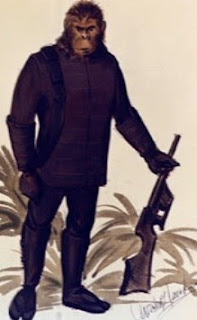
Art by Mentor Huebner
"You know as well as I that the wild humans have raided our farms. That, combined with the crop downturns, will cause starvation. We must invade and take those lands. What could be worse than famine, Doctor?" -General Ursus
Gorillas are the warriors of the apes; burly and brash and easily annoyed. Gorillas are often treated like the "big dumb cousins" of ape society, but many of them are in fact quite intelligent and can be quite gentle towards close friends and family.
Gorillas have a tendency towards "black and white" views on things, and tend to have lifelong prejudices. No gorilla is comfortable under the command of humans, as they see this as unnatural, they will work for pay from humans however. Many gorillas can be found in the ape-military or working as mercenaries in the city-states where they are in high demand.
GORILLA CHARACTER CREATION
Gorillas add +6 to their starting strength (max. 24). They modify their starting constitution by +1 and reduce their starting intelligence by 1 (max. 18, min. 3). When not using a weapon, a gorilla can make a claw or bite attack each round, scoring 1d4 points of damage. They are capable of launching into a menacing display of power that forces creatures with 0 HD or less than half the gorilla's hit dice to pass a Will saving throw or be frightened for 1d4 rounds. Gorillas speak Ape Common and might also speak Creole, English, Mexican or Spanglish.
Gorillas are limited to 7th level, except as fighters, at which they can advance to 9th level. They may not dual-class. Apes do not roll on the "youthful experience" chart as do humans (see Grit and Vigor pages 4-5 for details).

Chimpanzees (Chuman, Humanzee)
Art by Mentor Huebner
"Beware the beast Man, for he is the Devil's pawn. Alone among God's primates, he kills for sport or lust or greed. Yea, he will murder his brother to possess his brother's land. Let him not breed in great numbers, for he will make a desert of his home and yours. Shun him; drive him back into his jungle lair, for he is the harbinger of death." -Cornelius
The chimps are the adventurers and risk-takers of the ape people, always curious and often chattering. They are all curious and interested in learning and exploring, and so are the most likely to communicate with humanity than are other apes. Most Chimps are considered "cute" by other apes and many humans, and so can often get away with indiscretions more readily. Even cross-ape and cross species relationships are not unheard of, though they are still taboo.
Chimpanzees are emotional and intersted in experiencing life, and so many take to the life of the explorer and wanderer. Many can be found in the city-states working in a wide range of positions.
CHARACTER CREATION
Chimps add +2 to their starting strength (max. 20). They modify their starting intelligence by +1 and reduce their starting wisdom by 1 (max. 18, min. 3). Chimps have a knack for climbing sheer surfaces. In place of a weapon attack, a chimp can make a claw or bite attack that deals 1d3 points of damage. Chimps speak Ape Common and might also speak Creole, English, Mexican or Spanglish.
Chimps are limited to 9th level, except as rogues, at which they can advance to 11th level. They may not dual-class. Apes do not roll on the "youthful experience" chart as do humans (see Grit and Vigor pages 4-5 for details).

Orangutans (Hutan, Pongo)
Art by Mentor Huebner
"You are right, I have always known about man. From the evidence, I believe his wisdom must walk hand and hand with his idiocy. His emotions must rule his brain. He must be a warlike creature who gives battle to everything around him, even himself." -Dr. Zaius
Orangutans are the "wise old men" of the ape community, bureaucrats, clergy and leaders. Almost as strong as gorillas and deeply spiritual, Orangutans make excellent teachers, scientists and leaders. They are often found leading the Ape Republic, and settle matters via Democratic means.
Orangutans usually keep to Ape City or other Ape settlements, preferring not to mingle with mankind. Still, a few have made their way to the city-states and mingle with humans. Most however distrust mankind deeply.
CHARACTER CREATION
Orangutans add +4 to their starting strength (max. 22). They modify their starting wisdom by +1 and reduce their starting charisma by 1 (max. 18, min. 3) due their stodginess and superior attitudes. Orangutans have a knack for climbing sheer surfaces. In place of a weapon attack, an orangutan can make a claw or bite attack that deals 1d4 points of damage. Orangutans
speak Ape Common and might also speak Creole, English, Mexican or Spanglish.
They are limited to 8th level, except as scholars, at which they can advance to 10th level. They may not dual-class. Apes do not roll on the "youthful experience" chart as do humans (see Grit and Vigor pages 4-5 for details).

Friday, May 27, 2016

Mythos Space: Moon Beast Mecha

Lengite Trooper (L), Moon-Beast and Slave Walker (R)
Moon-Beast Slave Walker
Class: Light
Size: Large
Hit Dice: 20 (105 hp)
Armor Class: 18 (Steel 2)
Speed: 4 mph (35’)
Targeting: +3
Maneuver: +2
Weapons: 1x drill-whip (3d8), 2x light laser, 2x stun rifle (see advanced weapons), 1x psychic emitter (Mind Blast, Ego Whip, Dominate).
The dreaded moon-beasts are notorious slavers, and wicked merchants in the universe of Mythos Space. The moon-beasts are traders, exchanging Sharga Gems and weird technology for gold and slaves in their great black starships. They use the Lengites as their go-betweens and as foot soldiers, a role the Lengites happily take part in though they are slaves. The Moon beasts are happy to trade with those they cannot conquer, and can be found in the lower wards of many planetary slums. They are officially despised by the Empire and legitimate governments, but the arcane technology and forbidden pleasures that they sell are a source of great profit for many. Space Patrol has a particular loathing for Moon Beasts and Lengites.
The Slave Walkers are built for the taking of slaves for the Moon Beast merchant empire, and for waging war. These tripod walkers are a terror to encounter. The moon beast pilot is in clear view, but protected by a powerful force-field that grants full armor and renders the pilot and walker immune to lasers, fire or electricity. Pilots of these mecha can survive for 2d4 days within the vehicles without replenishment.

This Mecha make use of the Grit and Vigor RPG. Stats for Moon Beasts, Lengites, basics on Mythos Space and Mecha call all be found in NOD #29. Check it out!

DISNEY & DRAGONS: D&D in Fantasyland

Many times, in recent years I have encountered would-be players of Dungeons and Dragons whose sole experience with the fantasy genre h...